Find PDB structures and Computed Structure Models (CSM) by combining queries from tools in this suite: Attribute Search, Sequence Similarity, Sequence Motif, 3D Similarity, and 3D Motif with 'AND' logic.
Primary Citation Related Structures: 8XCH, 9IMK, 9IMM
PubMed Abstract:
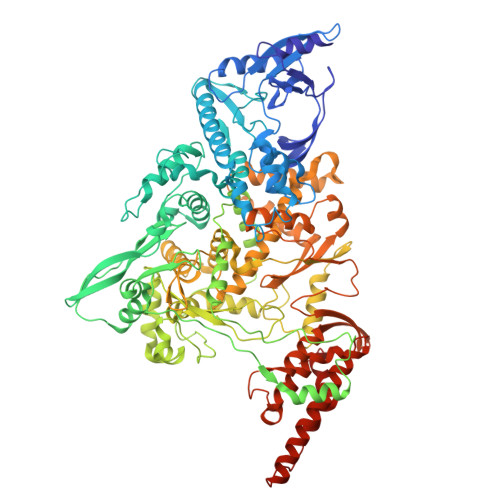
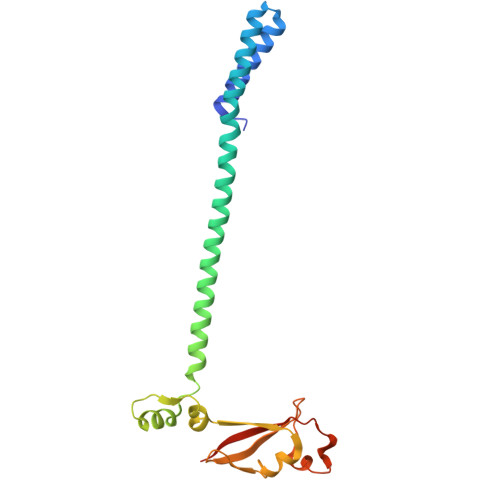
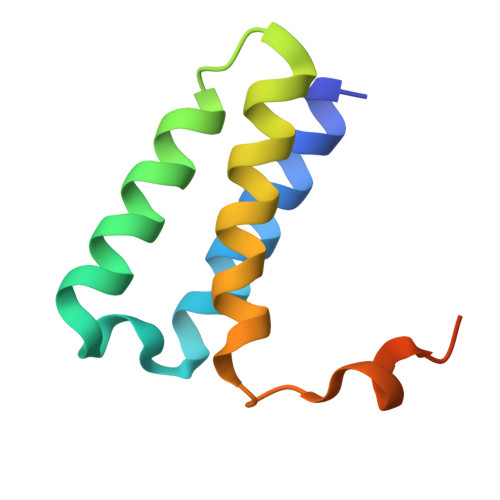
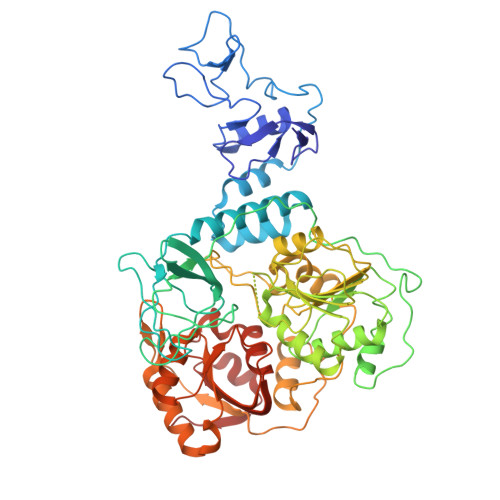
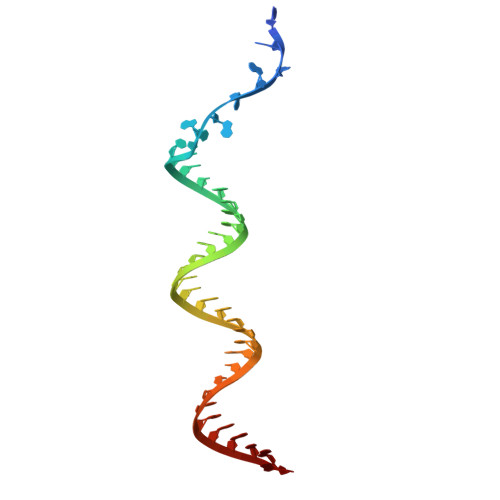
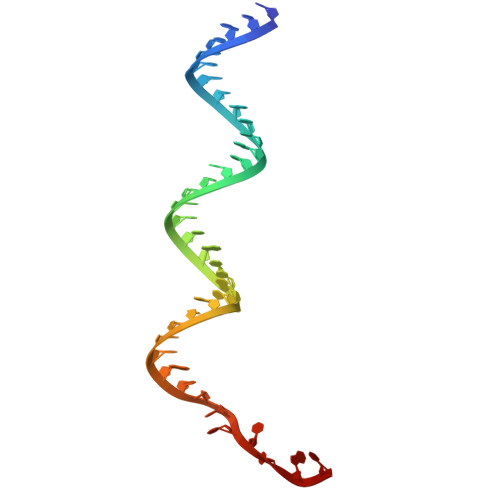
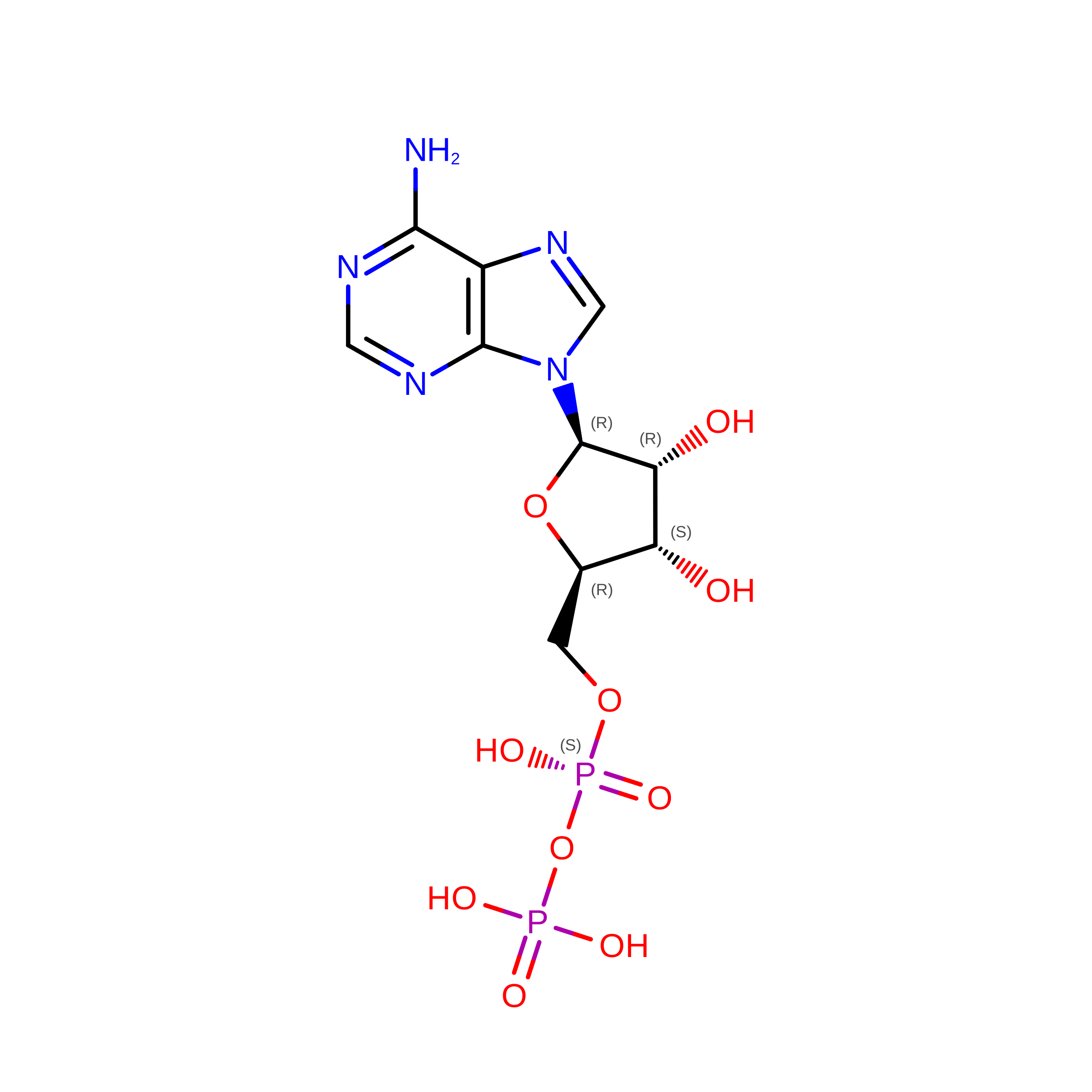
In the SARS-CoV-2 replication-transcription complex (RTC), the nascent template-product duplex is unwound into a template strand for recycling and a product strand that needs to be capped. Here, we determined structures of the SARS-CoV-2 RTC in the pre- and post-capping initiation (CI) states. In the pre-CI state, the RTC has a dimer-of-dimeric architecture (ddRTC). The upstream RNA duplex in one RTC is reciprocally unwound by a helicase in a head-to-head-positioned RTC in the 3'-5' direction. The helicases bind either ADP or ADP⋅P i in their ATP-binding pockets, suggesting a mechanism for ATP-hydrolysis-driven unwinding. In the post-CI state, the binding of nsp9 to the nsp12 nidovirus RdRp-associated nucleotidyltransferase (NiRAN) disrupts the ddRTC. The N terminus of nsp9 and the triphosphorylated 5' end of the product strand co-localize in NiRAN's catalytic site, exhibiting the state prior to nsp9 RNAylation for capping. These results provide an insight into the concurrence of template recycling and RNA capping in the SARS-CoV-2 RTC.
Organizational Affiliation:
MOE Key Laboratory of Protein Science, School of Basic Medical Sciences, Tsinghua University, Beijing 100084, China; Guangzhou National Laboratory, Guangzhou 510005, China; State Key Laboratory of Pathogen and Biosecurity, Beijing Institute of Microbiology and Epidemiology, Beijing 100071, China.
State Key Laboratory of Medicinal Chemical Biology, College of Life Sciences and College of Pharmacy, Nankai University, Tianjin 300350, China.
MOE Key Laboratory of Protein Science, School of Basic Medical Sciences, Tsinghua University, Beijing 100084, China.
The Second People's Hospital of Changzhou, the Third Affiliated Hospital of Nanjing Medical University, Changzhou 213299, China.
Department of Neurology, Aerospace Center Hospital, School of Life Science, Beijing Institute of Technology, Beijing 100081, China.
MOE Key Laboratory of Protein Science, School of Basic Medical Sciences, Tsinghua University, Beijing 100084, China; Shanghai Institute for Advanced Immunochemical Studies and School of Life Science and Technology, ShanghaiTech University, Shanghai 201210, China.
College of Veterinary Medicine, Huazhong Agricultural University, Wuhan 430070, China.
Department of Gynecology and Obstetrics, Peking Union Medical College Hospital, No. 1 Shuaifuyuan, Dongcheng District, Beijing 100730, China.
School of Chemistry and Molecular Biosciences, The University of Queensland, Brisbane 4072, Australia.
Shanghai Institute for Advanced Immunochemical Studies and School of Life Science and Technology, ShanghaiTech University, Shanghai 201210, China.
Department of Gynecology and Obstetrics, Peking Union Medical College Hospital, No. 1 Shuaifuyuan, Dongcheng District, Beijing 100730, China. Electronic address: zhu_julie@vip.sina.com.
MOE Key Laboratory of Protein Science, School of Basic Medical Sciences, Tsinghua University, Beijing 100084, China; Guangzhou National Laboratory, Guangzhou 510005, China; State Key Laboratory of Medicinal Chemical Biology, College of Life Sciences and College of Pharmacy, Nankai University, Tianjin 300350, China; Shanghai Institute for Advanced Immunochemical Studies and School of Life Science and Technology, ShanghaiTech University, Shanghai 201210, China; National Laboratory of Biomacromolecules, CAS Center for Excellence in Biomacromolecules, Institute of Biophysics, Chinese Academy of Sciences, Beijing 100101, China. Electronic address: raozh@tsinghua.edu.cn.
MOE Key Laboratory of Protein Science, School of Basic Medical Sciences, Tsinghua University, Beijing 100084, China. Electronic address: louzy@mail.tsinghua.edu.cn.
AB [auth U] BB [auth U] CB [auth U] DB [auth V] EB [auth V]
AB [auth U], BB [auth U], CB [auth U], DB [auth V], EB [auth V], FB [auth V], GA [auth A], GB [auth Y], HA [auth A], HB [auth Y], IA [auth E], JA [auth E], JB [auth c], KA [auth E], KB [auth c], LB [auth c], MA [auth F], MB [auth d], NA [auth F], NB [auth d], OA [auth F], OB [auth d], PA [auth I], QA [auth I], SA [auth M], TA [auth M], UA [auth M], VA [auth N], WA [auth N], XA [auth N], YA [auth Q], ZA [auth Q]

 Download Mendeley