Find PDB structures and Computed Structure Models (CSM) by combining queries from tools in this suite: Attribute Search, Sequence Similarity, Sequence Motif, 3D Similarity, and 3D Motif with 'AND' logic.
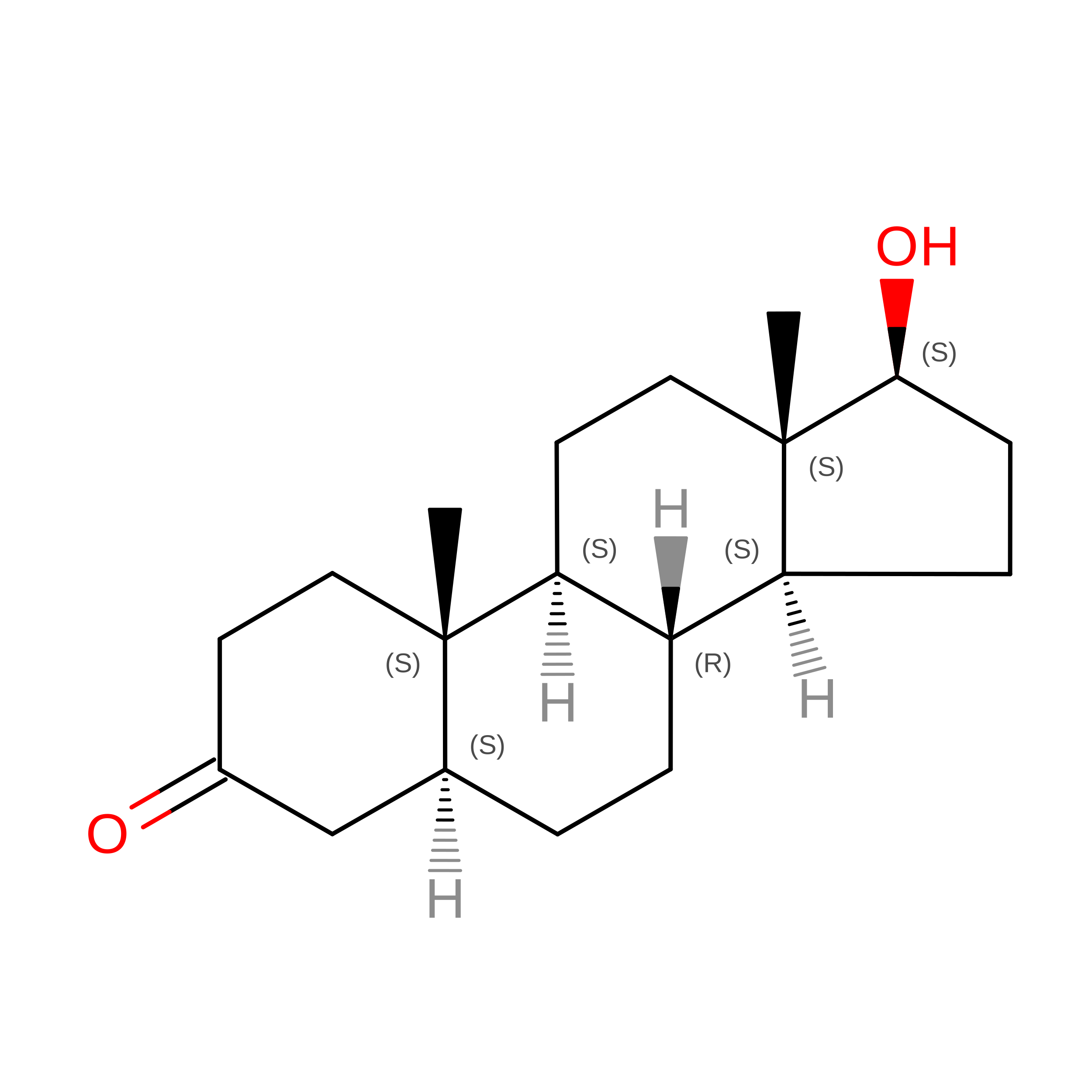
Androgens, such as 5α-dihydrotestosterone (5α-DHT), regulate numerous functions by binding to nuclear androgen receptors (ARs) and potential unknown membrane receptors. Here, we report that the androgen 5α-DHT activates membrane receptor GPR133 in muscle cells, thereby increasing intracellular cyclic AMP (cAMP) levels and enhancing muscle strength. Further cryoelectron microscopy (cryo-EM) structural analysis of GPR133-Gs in complex with 5α-DHT or its derivative methenolone (MET) reveals the structural basis for androgen recognition. Notably, the presence of the "Φ(F/L) 2.64 -F 3.40 -W 6.53 " and the "F 7.42 ××N/D 7.46 " motifs, which recognize the hydrophobic steroid core and polar groups, respectively, are common in adhesion GPCRs (aGPCRs), suggesting that many aGPCRs may recognize different steroid hormones. Finally, we exploited in silico screening methods to identify a small molecule, AP503, which activates GPR133 and separates the beneficial muscle-strengthening effects from side effects mediated by AR. Thus, GPR133 represents an androgen membrane receptor that contributes to normal androgen physiology and has important therapeutic potentials.
Organizational Affiliation:
Key Laboratory Experimental Teratology of the Ministry of Education, New Cornerstone Science Laboratory, Department of Biochemistry and Molecular Biology, School of Basic Medical Sciences, and Advanced Medical Research Institute, NHC Key Laboratory of Otorhinolaryngology, Qilu hospital, Cheeloo College of Medicine, Shandong University, Jinan 250012, China.
Medical Science and Technology Innovation Center, Shandong First Medical University & Shandong Academy of Medical Sciences, Jinan 250117, China.
Key Laboratory Experimental Teratology of the Ministry of Education, New Cornerstone Science Laboratory, Department of Biochemistry and Molecular Biology, School of Basic Medical Sciences, and Advanced Medical Research Institute, NHC Key Laboratory of Otorhinolaryngology, Qilu hospital, Cheeloo College of Medicine, Shandong University, Jinan 250012, China; Department of Clinical Laboratory, The Second Hospital, Cheeloo College of Medicine, Shandong University, Jinan 250012, China.
Key Laboratory Experimental Teratology of the Ministry of Education, New Cornerstone Science Laboratory, Department of Biochemistry and Molecular Biology, School of Basic Medical Sciences, and Advanced Medical Research Institute, NHC Key Laboratory of Otorhinolaryngology, Qilu hospital, Cheeloo College of Medicine, Shandong University, Jinan 250012, China; Department of Physiology, School of Basic Medical Sciences, Cheeloo College of Medicine, Shandong University, Jinan 250012, China.
Laboratory of Soft Matter Physics, Institute of Physics, Chinese Academy of Sciences, Beijing, China.
Department of Physiology, School of Basic Medical Sciences, Cheeloo College of Medicine, Shandong University, Jinan 250012, China.
Biomedical Research Center for Structural Analysis, Shandong University, Jinan 250012, Shandong, China.
Rudolf Schönheimer Institute of Biochemistry, Medical Faculty, Leipzig University, 04103 Leipzig, Germany.
Institute of Anatomy, Medical Faculty, Leipzig University, 04103 Leipzig, Germany.
Medical School of Nanjing University, Nanjing University, Nanjing 210061, China.
Department of Physiology, School of Basic Medical Sciences, Cheeloo College of Medicine, Shandong University, Jinan 250012, China. Electronic address: yuxiao@sdu.edu.cn.
Key Laboratory Experimental Teratology of the Ministry of Education, New Cornerstone Science Laboratory, Department of Biochemistry and Molecular Biology, School of Basic Medical Sciences, and Advanced Medical Research Institute, NHC Key Laboratory of Otorhinolaryngology, Qilu hospital, Cheeloo College of Medicine, Shandong University, Jinan 250012, China; Medical Science and Technology Innovation Center, Shandong First Medical University & Shandong Academy of Medical Sciences, Jinan 250117, China. Electronic address: pengxiao@sdu.edu.cn.
Key Laboratory of Infection and Immunity of Shandong Province, Department of Pharmacology, School of Basic Medical Sciences, Shandong University, Jinan 250012, China. Electronic address: fanyi@sdu.edu.cn.
Rudolf Schönheimer Institute of Biochemistry, Medical Faculty, Leipzig University, 04103 Leipzig, Germany. Electronic address: ines.liebscher@medizin.uni-leipzig.de.
Key Laboratory Experimental Teratology of the Ministry of Education, New Cornerstone Science Laboratory, Department of Biochemistry and Molecular Biology, School of Basic Medical Sciences, and Advanced Medical Research Institute, NHC Key Laboratory of Otorhinolaryngology, Qilu hospital, Cheeloo College of Medicine, Shandong University, Jinan 250012, China; Department of Physiology and Pathophysiology, School of Basic Medical Sciences, State Key Laboratory of Vascular Homeostasis and Remodeling, Beijing Key Laboratory of Cardiovascular Receptors Research, Peking University, Beijing 100191, China. Electronic address: sunjinpeng@sdu.edu.cn.

 Download Mendeley