8X7D | pdb_00008x7d

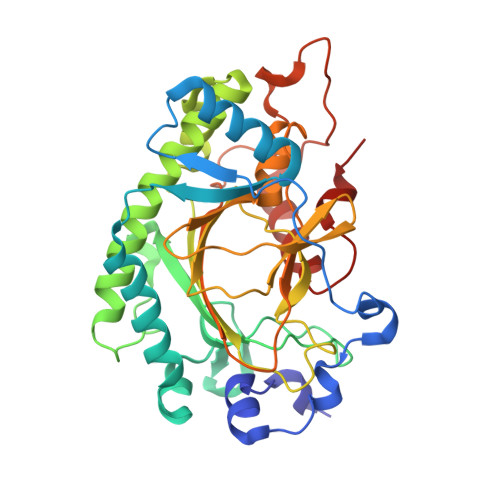
Crystal structure of OsHSL1 L204F/F298L/I335F


Experimental Data Snapshot

  • Method: X-RAY DIFFRACTION
  • Resolution: 2.20 Å
  • R-Value Free: 
    0.248 (Depositor), 0.252 (DCC) 
  • R-Value Work: 
    0.210 (Depositor), 0.215 (DCC) 
  • R-Value Observed: 
    0.213 (Depositor) 

Starting Model: experimental
View more details

wwPDB Validation 3D Report Full Report

Validation slider image for 8X7D

This is version 1.0 of the entry. See complete history

Literature

An artificially evolved gene for herbicide-resistant rice breeding.

Dong, J.Yu, X.H.Dong, J.Wang, G.H.Wang, X.L.Wang, D.W.Yan, Y.C.Xiao, H.Ye, B.Q.Lin, H.Y.Yang, G.F.

(2024) Proc Natl Acad Sci U S A 121: e2407285121-e2407285121

  • DOI: https://doi.org/10.1073/pnas.2407285121
  • Primary Citation Related Structures: 
    8X6Q, 8X74, 8X7C, 8X7D, 8XC3

  • PubMed Abstract: 

    Discovering and engineering herbicide-resistant genes is a crucial challenge in crop breeding. This study focuses on the 4-hydroxyphenylpyruvate dioxygenase Inhibitor Sensitive 1-Like (HSL) protein, prevalent in higher plants and exhibiting weak catalytic activity against many β-triketone herbicides (β-THs). The crystal structures of maize HSL1A complexed with β-THs were elucidated, identifying four essential herbicide-binding residues and explaining the weak activity of HSL1A against the herbicides. Utilizing an artificial evolution approach, we developed a series of rice HSL1 mutants targeting the four residues. Then, these mutants were systematically evaluated, identifying the M10 variant as the most effective in modifying β-THs. The initial active conformation of substrate binding in HSL1 was also revealed from these mutants. Furthermore, overexpression of M10 in rice significantly enhanced resistance to β-THs, resulting in a notable 32-fold increase in resistance to methyl-benquitrione. In conclusion, the artificially evolved M10 gene shows great potential for the development of herbicide-resistant crops.


  • Organizational Affiliation
    • State Key Laboratory of Green Pesticide, Central China Normal University, Wuhan 430079, People's Republic of China.

Macromolecule Content 

  • Total Structure Weight: 80.74 kDa 
  • Atom Count: 5,781 
  • Modeled Residue Count: 696 
  • Deposited Residue Count: 700 
  • Unique protein chains: 1

Macromolecules

Find similar proteins by:|  3D Structure
Entity ID: 1
MoleculeChains  Sequence LengthOrganismDetailsImage
HPPD Inhibitor Sensitive 1-like 1 protein
A, B
350Oryza sativaMutation(s): 3 
Gene Names: OsHSL1
UniProt
Find proteins for Q8H620 (Oryza sativa subsp. japonica)
Explore Q8H620 
Go to UniProtKB:  Q8H620
Entity Groups
Sequence Clusters30% Identity50% Identity70% Identity90% Identity95% Identity100% Identity
UniProt GroupQ8H620
Sequence Annotations
Expand
Reference Sequence

Experimental Data & Validation

Experimental Data

  • Method: X-RAY DIFFRACTION
  • Resolution: 2.20 Å
  • R-Value Free:  0.248 (Depositor), 0.252 (DCC) 
  • R-Value Work:  0.210 (Depositor), 0.215 (DCC) 
  • R-Value Observed: 0.213 (Depositor) 
Space Group: P 1 21 1
Unit Cell:
Length ( Å )Angle ( ˚ )
a = 46.019α = 90
b = 140.474β = 111.89
c = 58.976γ = 90
Software Package:
Software NamePurpose
PHENIXrefinement
XDSdata reduction
XDSdata scaling
PHASERphasing

Structure Validation

View Full Validation Report


Entry History 

& Funding Information

Deposition Data


Funding OrganizationLocationGrant Number
National Natural Science Foundation of China (NSFC)China--

Revision History  (Full details and data files)

  • Version 1.0: 2024-10-02
    Type: Initial release