Download Mendeley
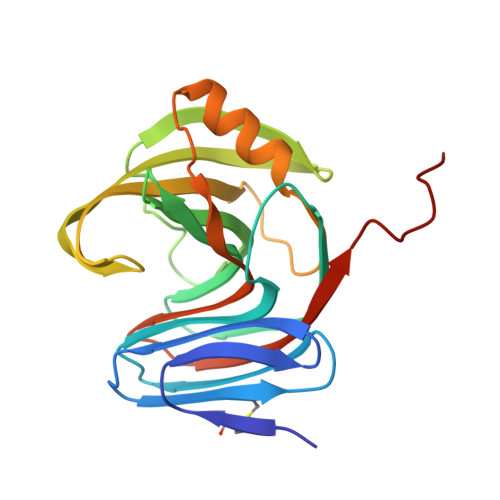
Hyperthermophilic xylanase and thermophilicity analysis by molecular dynamic simulation with quantum mechanics.
Boonyapakron, K., Keiser, B., Prabmark, K., Aiewviriyasakul, K., Arunrattanamook, N., Jaruwat, A., Chitnumsub, P., Li, J.Y., Wong, T.S., Zhao, X.Q., Liu, C.G., Wei, D.Q., Champreda, V.(2024) Appl Microbiol Biotechnol 108: 526-526
- PubMed: 39630239 Search on PubMedSearch on PubMed Central
- DOI: https://doi.org/10.1007/s00253-024-13356-3
- Primary Citation Related Structures:
8X65 - PubMed Abstract:
Thermophilic xylanases catalyzing the cleavage of β-1,4-glycosidic bonds in xylan have applications in food, feed, biorefinery, and pulp industries. In this study, a hyperthermophilic endo-xylanase was obtained by further enhancement of thermal tolerance of a thermophilic GH11 xylanase originated from metagenome of bagasse pile based on rational design. Introducing N13F and Q34L to the previously reported X11P enzyme shifted the optimal working temperature to 85 °C and led to 20.7-fold improvement in thermostability at 90 °C along with a marked increase in T m to 93.3 °C. X11PNQ enzyme converted xylan to prebiotic xylooligosaccharides with high specificity on xylobiose to xylohexaose and high operational stability at 85 °C, resulting in 10.3-folds yield improvement compared to the parental enzyme. Molecular dynamic simulation and quantum mechanical analysis revealed improved H-bonding networks within GH11 xylanase principal domains and greater dynamic cross-correlations. A novel thermostabilization mechanism by π-amide interaction with slightly lower interaction energy than the native H-bond, but compensated by increased occurrence frequency was firstly demonstrated for thermophilic enzymes. The enzyme represents one of the most thermostable xylanases ever reported with biotechnological potential. KEY POINTS: • Hyperthemophilic xylanase X11PNQ was obtained by rational design engineering. • X11PNQ showed specificity to prebiotic xylooligosaccharides (XOS) at 85 °C with improved t 1/2 at 90 °C. • Novel thermostabilization by π-amide interaction was demonstrated by MD/QM.
- Biorefinery and Bioproduct Technology Research Group, National Center for Genetic Engineering and Biotechnology (BIOTEC), 113 Thailand Science Park, Phaholyothin Road, Khlong Luang, 12120, Patumthani, Thailand.
Organizational Affiliation: