8X3L | pdb_00008x3l

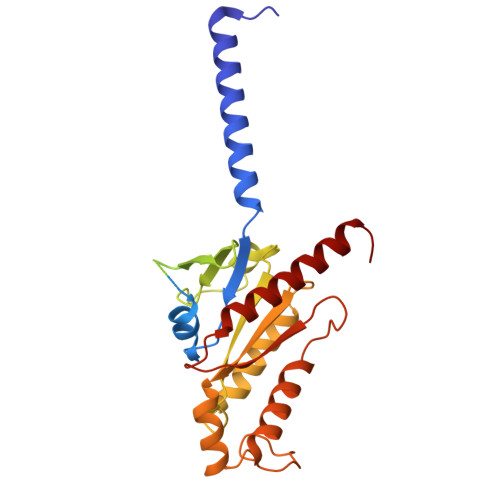
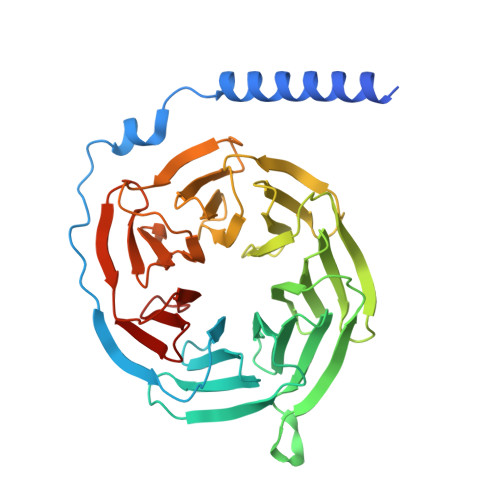
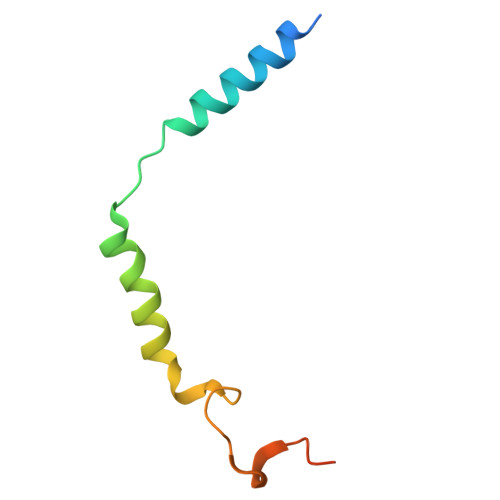
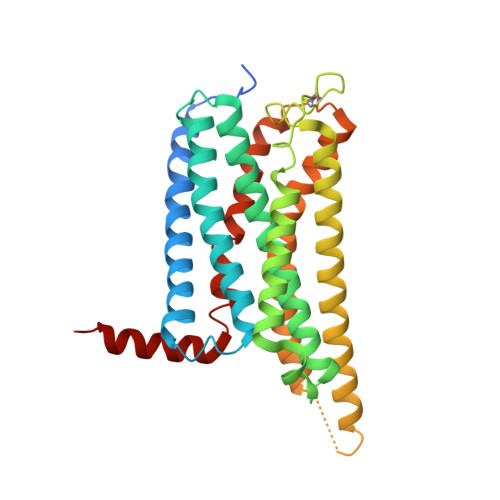
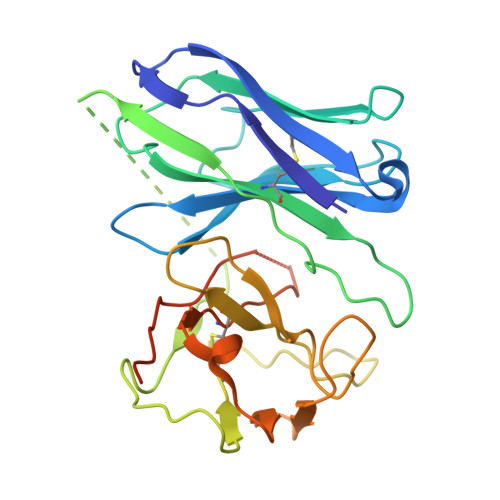
Cryo-EM structure of CB2-G protein complex


Experimental Data Snapshot

  • Method: ELECTRON MICROSCOPY
  • Resolution: 3.13 Å
  • Aggregation State: PARTICLE 
  • Reconstruction Method: SINGLE PARTICLE 

wwPDB Validation   3D Report Full Report


This is version 1.2 of the entry. See complete history


Literature

Entropy drives the ligand recognition in G-protein-coupled receptor subtypes.

Yang, X.Zhou, P.Shen, S.Hu, Q.Tian, C.Xia, A.Wang, Y.Yang, Z.Nan, J.Zhou, Y.Chen, S.Tian, X.Wu, C.Lin, G.Zhang, L.Wang, K.Zheng, T.Zou, J.Yan, W.Shao, Z.Yang, S.

(2024) Proc Natl Acad Sci U S A 121: e2401091121-e2401091121

  • DOI: https://doi.org/10.1073/pnas.2401091121
  • Primary Citation of Related Structures:  
    8X3L

  • PubMed Abstract: 

    Achieving ligand subtype selectivity within highly homologous subtypes of G-protein-coupled receptor (GPCR) is critical yet challenging for GPCR drug discovery, primarily due to the unclear mechanism underlying ligand subtype selectivity, which hampers the rational design of subtype-selective ligands. Herein, we disclose an unusual molecular mechanism of entropy-driven ligand recognition in cannabinoid (CB) receptor subtypes, revealed through atomic-level molecular dynamics simulations, cryoelectron microscopy structure, and mutagenesis experiments. This mechanism is attributed to the distinct conformational dynamics of the receptor's orthosteric pocket, leading to variations in ligand binding entropy and consequently, differential binding affinities, which culminate in specific ligand recognition. We experimentally validated this mechanism and leveraged it to design ligands with enhanced or ablated subtype selectivity. One such ligand demonstrated favorable pharmacokinetic properties and significant efficacy in rodent inflammatory analgesic models. More importantly, it is precisely due to the high subtype selectivity obtained based on this mechanism that this ligand does not show addictive properties in animal models. Our findings elucidate the unconventional role of entropy in CB receptor subtype selectivity and suggest a strategy for rational design of ligands to achieve entropy-driven subtype selectivity for many pharmaceutically important GPCRs.


  • Organizational Affiliation
    • Department of Biotherapy, State Key Laboratory of Biotherapy and Cancer Center, West China Hospital, Sichuan University, Chengdu, Sichuan 610041, China.

Macromolecules
Find similar proteins by:  (by identity cutoff)  |  3D Structure
Entity ID: 1
MoleculeChains Sequence LengthOrganismDetailsImage
Guanine nucleotide-binding protein G(i) subunit alpha-1354Homo sapiensMutation(s): 0 
Gene Names: GNAI1
EC: 3.6.5
Membrane Entity: Yes 
UniProt & NIH Common Fund Data Resources
Find proteins for P63096 (Homo sapiens)
Explore P63096 
Go to UniProtKB:  P63096
PHAROS:  P63096
GTEx:  ENSG00000127955 
Entity Groups  
Sequence Clusters30% Identity50% Identity70% Identity90% Identity95% Identity100% Identity
UniProt GroupP63096
Sequence Annotations
Expand
  • Reference Sequence
Find similar proteins by:  (by identity cutoff)  |  3D Structure
Entity ID: 2
MoleculeChains Sequence LengthOrganismDetailsImage
Guanine nucleotide-binding protein G(I)/G(S)/G(T) subunit beta-1356Homo sapiensMutation(s): 0 
Gene Names: GNB1
UniProt & NIH Common Fund Data Resources
Find proteins for P62873 (Homo sapiens)
Explore P62873 
Go to UniProtKB:  P62873
PHAROS:  P62873
GTEx:  ENSG00000078369 
Entity Groups  
Sequence Clusters30% Identity50% Identity70% Identity90% Identity95% Identity100% Identity
UniProt GroupP62873
Sequence Annotations
Expand
  • Reference Sequence
Find similar proteins by:  (by identity cutoff)  |  3D Structure
Entity ID: 3
MoleculeChains Sequence LengthOrganismDetailsImage
Guanine nucleotide-binding protein G(I)/G(S)/G(O) subunit gamma-271Homo sapiensMutation(s): 0 
Gene Names: GNG2
Membrane Entity: Yes 
UniProt & NIH Common Fund Data Resources
Find proteins for P59768 (Homo sapiens)
Explore P59768 
Go to UniProtKB:  P59768
PHAROS:  P59768
GTEx:  ENSG00000186469 
Entity Groups  
Sequence Clusters30% Identity50% Identity70% Identity90% Identity95% Identity100% Identity
UniProt GroupP59768
Sequence Annotations
Expand
  • Reference Sequence
Find similar proteins by:  (by identity cutoff)  |  3D Structure
Entity ID: 4
MoleculeChains Sequence LengthOrganismDetailsImage
Cannabinoid receptor 2D [auth R]319Homo sapiensMutation(s): 0 
Gene Names: CNR2
Membrane Entity: Yes 
UniProt & NIH Common Fund Data Resources
Find proteins for P34972 (Homo sapiens)
Explore P34972 
Go to UniProtKB:  P34972
PHAROS:  P34972
GTEx:  ENSG00000188822 
Entity Groups  
Sequence Clusters30% Identity50% Identity70% Identity90% Identity95% Identity100% Identity
UniProt GroupP34972
Sequence Annotations
Expand
  • Reference Sequence
Find similar proteins by:  (by identity cutoff)  |  3D Structure
Entity ID: 5
MoleculeChains Sequence LengthOrganismDetailsImage
scFV16E [auth S]266Mus musculusMutation(s): 0 
Entity Groups  
Sequence Clusters30% Identity50% Identity70% Identity90% Identity95% Identity100% Identity
Sequence Annotations
Expand
  • Reference Sequence
Small Molecules
Ligands 1 Unique
IDChains Name / Formula / InChI Key2D Diagram3D Interactions
XWD (Subject of Investigation/LOI)
Query on XWD

Download Ideal Coordinates CCD File 
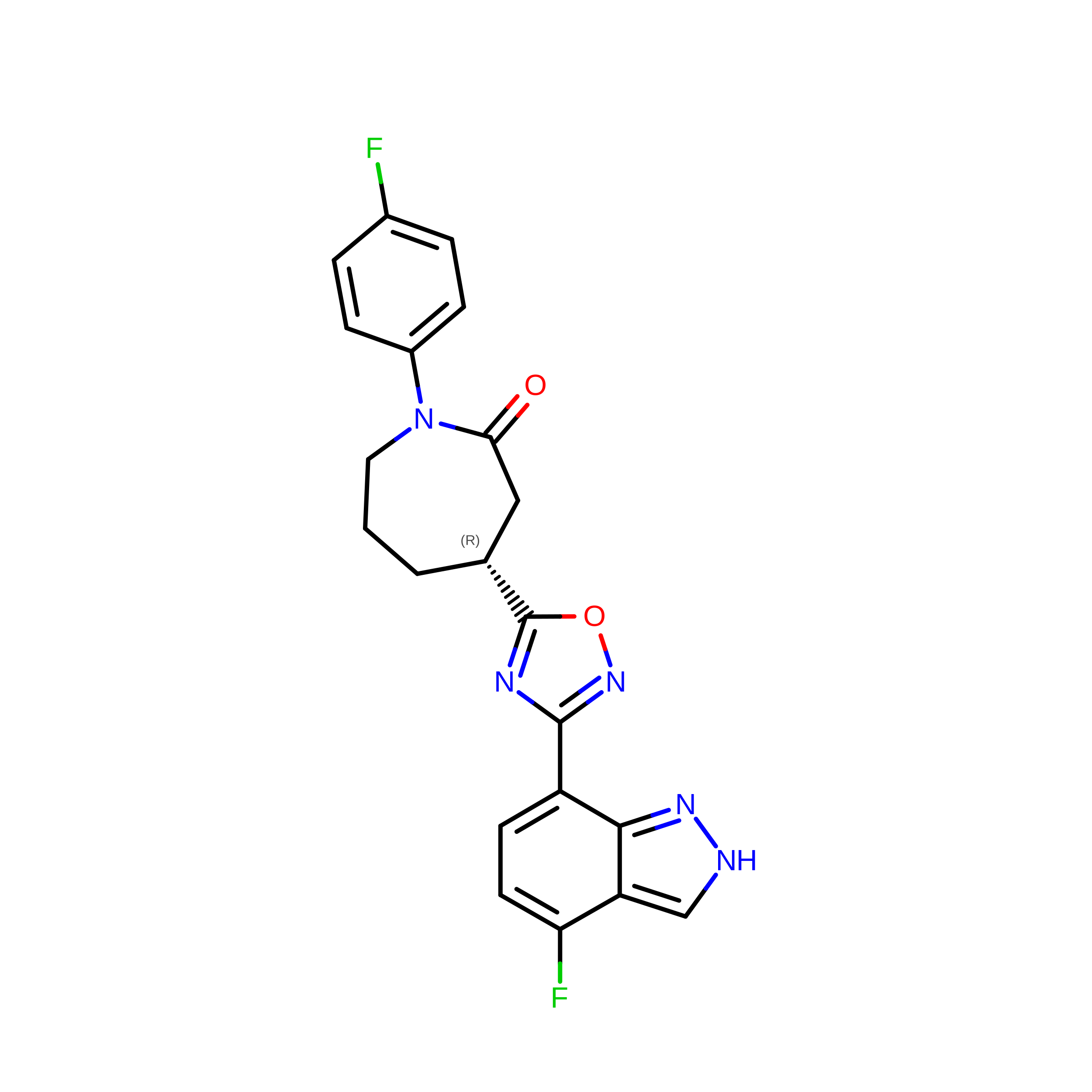
F [auth R]4-[3-(4-fluoranyl-2~{H}-indazol-7-yl)-1,2,4-oxadiazol-5-yl]-1-(4-fluorophenyl)azepan-2-one
BKJFYBNBUSLPGV-GFCCVEGCSA-N
Experimental Data & Validation

Experimental Data

  • Method: ELECTRON MICROSCOPY
  • Resolution: 3.13 Å
  • Aggregation State: PARTICLE 
  • Reconstruction Method: SINGLE PARTICLE 
EM Software:
TaskSoftware PackageVersion
MODEL REFINEMENTPHENIX

Structure Validation

View Full Validation Report


Entry History & Funding Information

Deposition Data


Funding OrganizationLocationGrant Number
National Natural Science Foundation of China (NSFC)China31972916

Revision History  (Full details and data files)

  • Version 1.0: 2024-11-20
    Type: Initial release
  • Version 1.1: 2025-02-12
    Changes: Data collection, Database references
  • Version 1.2: 2025-06-25
    Changes: Data collection