8X2C | pdb_00008x2c

Crystal structure of H5 hemagglutinin from swan-infecting H5N8 influenza virus


Experimental Data Snapshot

  • Method: X-RAY DIFFRACTION
  • Resolution: 2.59 Å
  • R-Value Free: 
    0.270 (Depositor), 0.271 (DCC) 
  • R-Value Work: 
    0.231 (Depositor), 0.231 (DCC) 
  • R-Value Observed: 
    0.232 (Depositor) 

Starting Model: experimental
View more details

wwPDB Validation 3D Report Full Report

Validation slider image for 8X2C

Ligand Structure Quality Assessment 


This is version 1.1 of the entry. See complete history

Literature

Hemagglutinin double-mutation enhances binding of human-infecting avian influenza virus clade 2.3.4.4b H5Ny to human and SLe X receptors.

Jin, X.Han, P.Wang, Y.Wang, H.Zhang, C.Di Maio, A.Yu, J.Hao, T.Gu, Y.Zhang, Z.Zhang, W.Qi, J.Bi, Y.Zhang, X.Sun, L.Wang, N.Liu, Y.Song, H.Gao, G.F.

(2026) EMBO Rep 

  • DOI: https://doi.org/10.1038/s44319-026-00816-2
  • Primary Citation Related Structures: 
    8X26, 8X27, 8X28, 8X29, 8X2C, 8X2D, 8X2F

  • PubMed Abstract: 

    Clade 2.3.4.4b H5Ny highly pathogenic avian influenza viruses (HPAIVs) continue to circulate worldwide, posing zoonotic threats, especially with recent cattle outbreaks. The mechanisms by which these viruses adapt to mammalian hosts while maintaining a broad avian tropism remain poorly understood. Here, we demonstrate that two naturally occurring mutations (K222Q and S227R) in the hemagglutinin (HA) of a human-infecting H5N8 strain, first identified in 2020, enhance binding affinity for both α2-6-linked and Sialyl Lewis X (SLe X ) glycans, which may underlie the broad tissue binding and cross-species potential. Structural analyses reveal that these mutations expand receptor specificity for these glycans, which are abundant in the human respiratory tract and duck trachea, providing a possible molecular basis for cross-species transmission. Our findings suggest that clade 2.3.4.4b H5Ny viruses evolved dual receptor specificity as early as the 2020 Russian H5N8 strain, potentially contributing to sporadic human infections and widespread dissemination among birds and mammals.


  • Organizational Affiliation
    • CAS Key Laboratory of Pathogen Microbiology and Immunology, Institute of Microbiology, Chinese Academy of Sciences, Beijing, China.

Macromolecule Content 

  • Total Structure Weight: 175.31 kDa 
  • Atom Count: 12,022 
  • Modeled Residue Count: 1,473 
  • Deposited Residue Count: 1,518 
  • Unique protein chains: 1

Macromolecules

Find similar proteins by:|  3D Structure
Entity ID: 1
MoleculeChains  Sequence LengthOrganismDetailsImage
Hemagglutinin
A, B, C
506Influenza A virusMutation(s): 3 
Gene Names: HA
UniProt
Find proteins for A0A8E4ZAK5 (Influenza A virus)
Explore A0A8E4ZAK5 
Go to UniProtKB:  A0A8E4ZAK5
Entity Groups
Sequence Clusters30% Identity50% Identity70% Identity90% Identity95% Identity100% Identity
UniProt GroupA0A8E4ZAK5
Glycosylation
Glycosylation Sites: 2
Sequence Annotations
Expand
Reference Sequence

Oligosaccharides

Help  
Entity ID: 2
MoleculeChains Length2D Diagram GlycosylationD Interactions
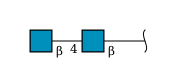
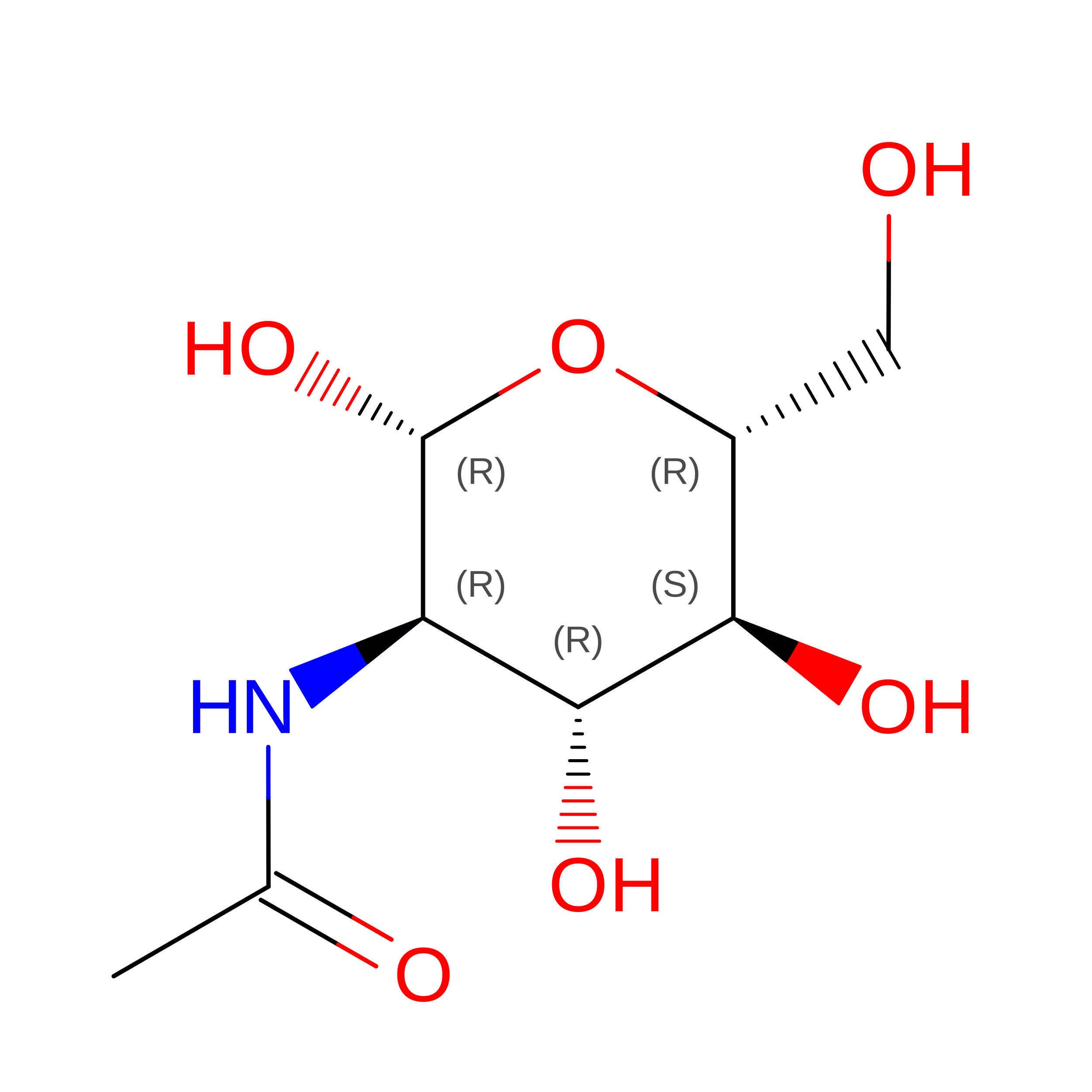
2-acetamido-2-deoxy-beta-D-glucopyranose-(1-4)-2-acetamido-2-deoxy-beta-D-glucopyranose
D
2N-Glycosylation
Glycosylation Resources
GlyTouCan: G42666HT
GlyCosmos: G42666HT
GlyGen: G42666HT

Small Molecules

Experimental Data & Validation

Experimental Data

  • Method: X-RAY DIFFRACTION
  • Resolution: 2.59 Å
  • R-Value Free:  0.270 (Depositor), 0.271 (DCC) 
  • R-Value Work:  0.231 (Depositor), 0.231 (DCC) 
  • R-Value Observed: 0.232 (Depositor) 
Space Group: P 1 21 1
Unit Cell:
Length ( Å )Angle ( ˚ )
a = 81.408α = 90
b = 107.033β = 101.052
c = 134.756γ = 90
Software Package:
Software NamePurpose
PHENIXrefinement
HKL-3000data reduction
HKL-3000data scaling
PHASERphasing

Structure Validation

View Full Validation Report


Ligand Structure Quality Assessment 


Entry History 

& Funding Information

Deposition Data


Funding OrganizationLocationGrant Number
National Natural Science Foundation of China (NSFC)China82122040

Revision History  (Full details and data files)

  • Version 1.0: 2025-05-14
    Type: Initial release
  • Version 1.1: 2026-07-01
    Changes: Database references