8WTO | pdb_00008wto

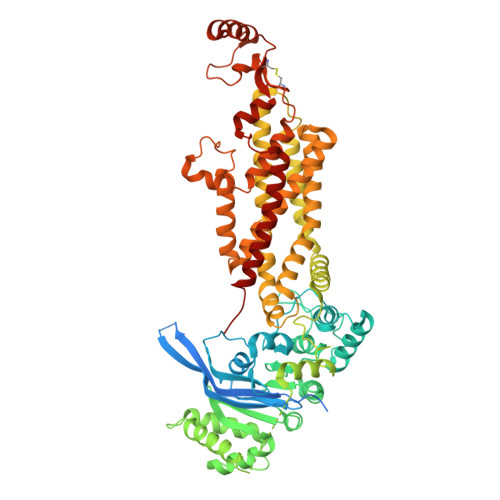
Cryo-EM structure of jasmonic acid transporter ABCG16 in outward conformation


Experimental Data Snapshot

  • Method: ELECTRON MICROSCOPY
  • Resolution: 2.38 Å
  • Aggregation State: PARTICLE 
  • Reconstruction Method: SINGLE PARTICLE 

wwPDB Validation   3D Report Full Report


This is version 1.3 of the entry. See complete history


Literature

Cryo-EM structure and molecular mechanism of the jasmonic acid transporter ABCG16.

An, N.Huang, X.Yang, Z.Zhang, M.Ma, M.Yu, F.Jing, L.Du, B.Wang, Y.F.Zhang, X.Zhang, P.

(2024) Nat Plants 10: 2052-2061

  • DOI: https://doi.org/10.1038/s41477-024-01839-0
  • Primary Citation of Related Structures:  
    8WTM, 8WTN, 8WTO, 8WTP

  • PubMed Abstract: 

    Jasmonates (JAs) are a class of oxylipin phytohormones including jasmonic acid (JA) and derivatives that regulate plant growth, development and biotic and abiotic stress. A number of transporters have been identified to be responsible for the cellular and subcellular translocation of JAs. However, the mechanistic understanding of how these transporters specifically recognize and transport JAs is scarce. Here we determined the cryogenic electron microscopy structure of JA exporter AtABCG16 in inward-facing apo, JA-bound and occluded conformations, and outward-facing post translocation conformation. AtABCG16 structure forms a homodimer, and each monomer contains a nucleotide-binding domain, a transmembrane domain and an extracellular domain. Structural analyses together with biochemical and plant physiological experiments revealed the molecular mechanism by which AtABCG16 specifically recognizes and transports JA. Structural analyses also revealed that AtABCG16 features a unique bifurcated substrate translocation pathway, which is composed of two independent substrate entrances, two substrate-binding pockets and a shared apoplastic cavity. In addition, residue Phe608 from each monomer is disclosed to function as a gate along the translocation pathway controlling the accessing of substrate JA from the cytoplasm or apoplast. Based on the structural and biochemical analyses, a working model of AtABCG16-mediated JA transport is proposed, which diversifies the molecular mechanisms of ABC transporters.


  • Organizational Affiliation
    • National Key Laboratory of Plant Molecular Genetics, Centre for Excellence in Molecular Plant Sciences, Institute of Plant Physiology and Ecology, Chinese Academy of Sciences, Shanghai, China.

Macromolecules
Find similar proteins by:  (by identity cutoff)  |  3D Structure
Entity ID: 1
MoleculeChains Sequence LengthOrganismDetailsImage
ABC transporter G family member 16
A, B
736Arabidopsis thalianaMutation(s): 0 
Gene Names: ABCG16
Membrane Entity: Yes 
UniProt
Find proteins for Q9M2V7 (Arabidopsis thaliana)
Explore Q9M2V7 
Go to UniProtKB:  Q9M2V7
Entity Groups  
Sequence Clusters30% Identity50% Identity70% Identity90% Identity95% Identity100% Identity
UniProt GroupQ9M2V7
Sequence Annotations
Expand
  • Reference Sequence
Small Molecules
Ligands 3 Unique
IDChains Name / Formula / InChI Key2D Diagram3D Interactions
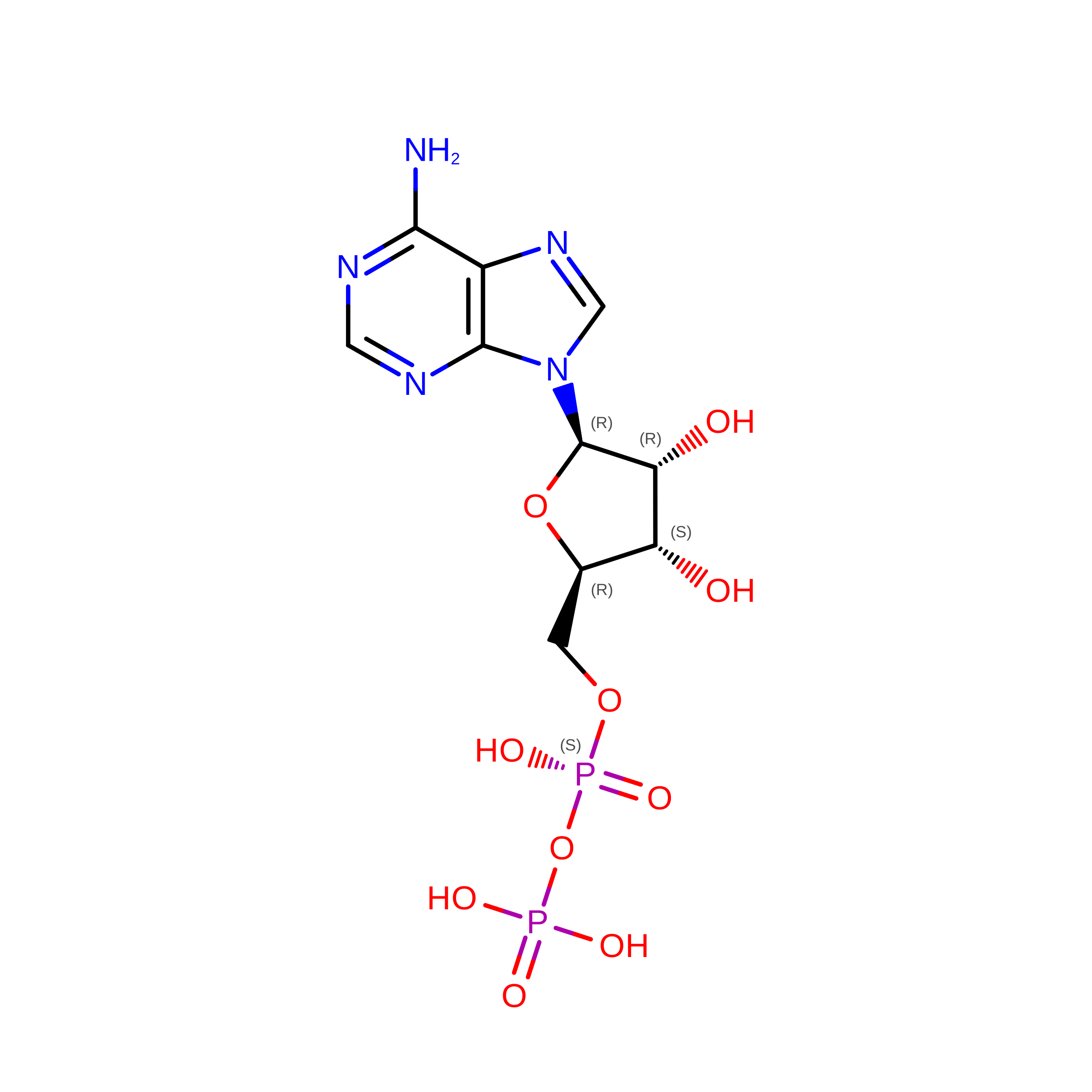
ADP (Subject of Investigation/LOI)
Query on ADP

Download Ideal Coordinates CCD File 
C [auth A],
F [auth B]
ADENOSINE-5'-DIPHOSPHATE
C10 H15 N5 O10 P2
XTWYTFMLZFPYCI-KQYNXXCUSA-N
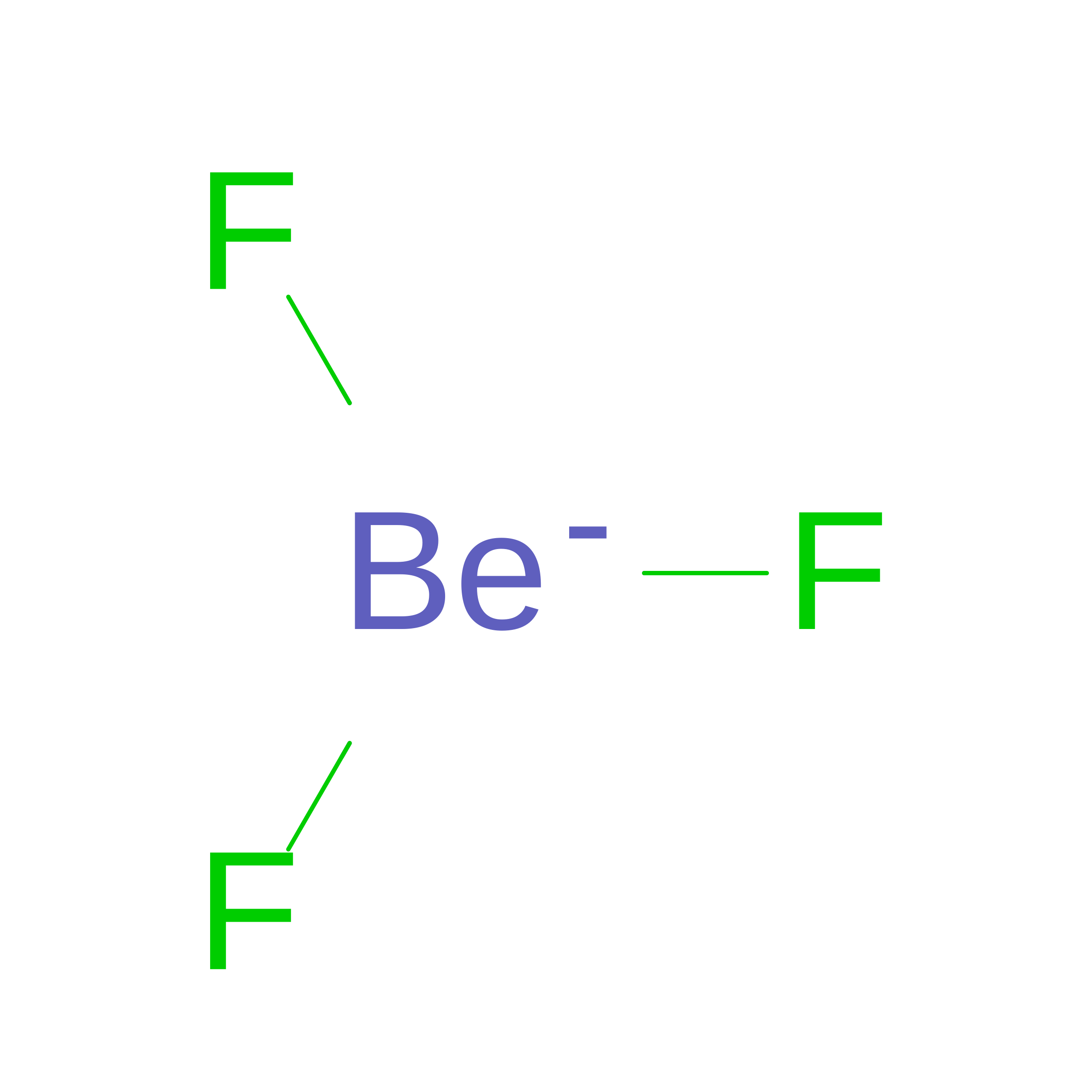
BEF (Subject of Investigation/LOI)
Query on BEF

Download Ideal Coordinates CCD File 
D [auth A],
G [auth B]
BERYLLIUM TRIFLUORIDE ION
Be F3
OGIAHMCCNXDTIE-UHFFFAOYSA-K
MG (Subject of Investigation/LOI)
Query on MG

Download Ideal Coordinates CCD File 
E [auth A],
H [auth B]
MAGNESIUM ION
Mg
JLVVSXFLKOJNIY-UHFFFAOYSA-N
Experimental Data & Validation

Experimental Data

  • Method: ELECTRON MICROSCOPY
  • Resolution: 2.38 Å
  • Aggregation State: PARTICLE 
  • Reconstruction Method: SINGLE PARTICLE 
EM Software:
TaskSoftware PackageVersion
MODEL REFINEMENTPHENIX1.14_3260:

Structure Validation

View Full Validation Report


Entry History & Funding Information

Deposition Data


Funding OrganizationLocationGrant Number
National Natural Science Foundation of China (NSFC)China--

Revision History  (Full details and data files)

  • Version 1.0: 2024-10-23
    Type: Initial release
  • Version 1.1: 2024-11-13
    Changes: Data collection, Database references
  • Version 1.2: 2024-11-20
    Changes: Data collection, Database references
  • Version 1.3: 2025-01-01
    Changes: Data collection, Database references