Download Mendeley
Self-association activates ThsB NAD + hydrolase for defense against phage infection.
Luo, Q., Liu, Q., Liu, T., Wang, X., Wu, X., Chen, Q., Yu, Y.(2025) Biochem Biophys Res Commun 776: 152217-152217
- PubMed: 40540948 Search on PubMed
- DOI: https://doi.org/10.1016/j.bbrc.2025.152217
- Primary Citation Related Structures:
8WC0, 8WCF - PubMed Abstract:
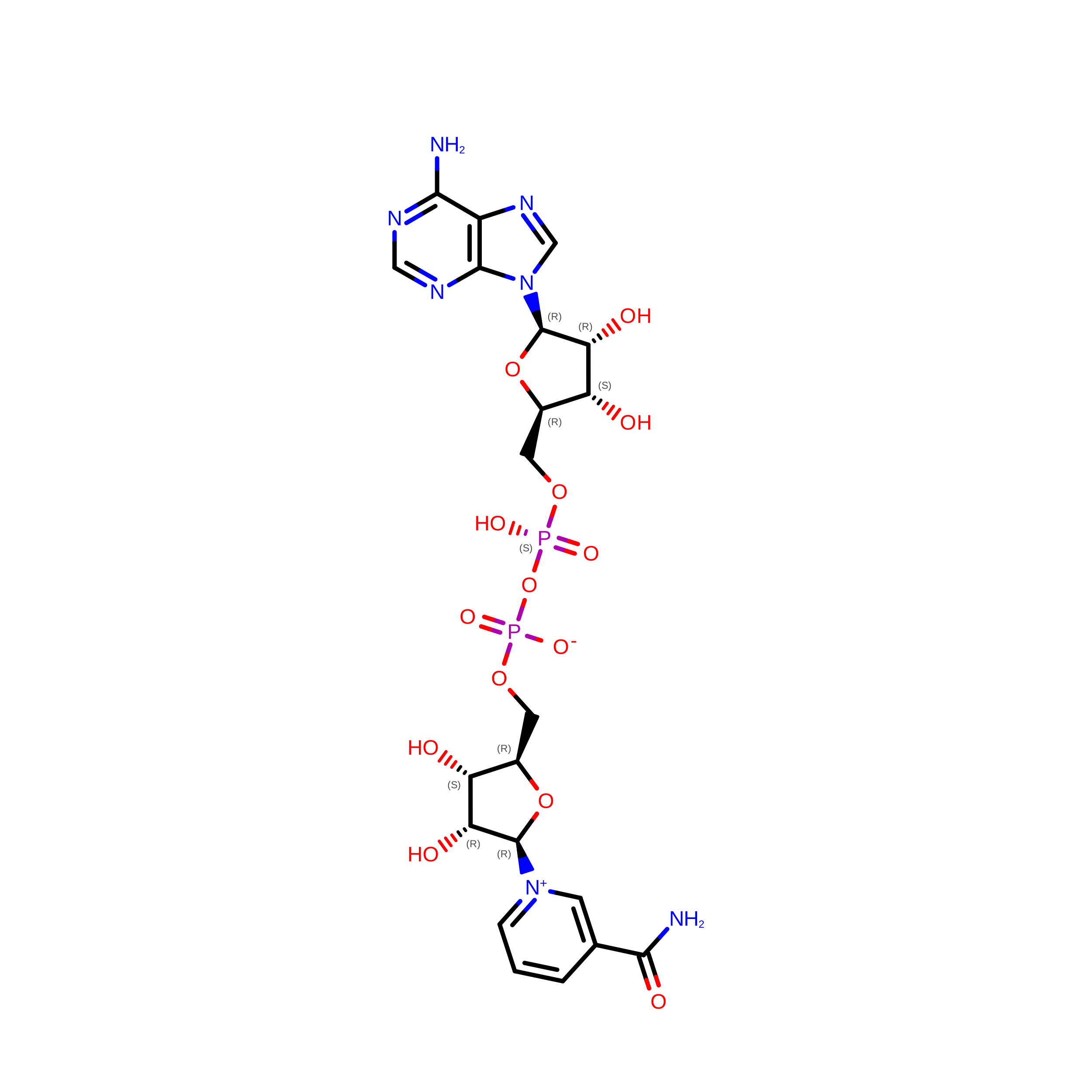
Toll/interleukin-1 receptor (TIR) domain serves as a canonical component in both animal and plant innate immunity pathways and is indicated, in some cases, to mediate nicotinamide adenine dinucleotide (NAD + ) cleavage via self-association. Recent studies have revealed the involvement of TIR domains in a bacterial anti-phage defense system called Thoeris. The Thoeris system consists of two core proteins, ThsA and ThsB. Phage infection triggers the TIR-containing ThsB to produce an isomer of cyclic ADP-ribose, which is then transferred to and activates ThsA, leading to NAD + depletion and subsequent cell death. However, the mechanism of ThsB activation remains elusive. Here, we present high-resolution crystal structures of E. coli ThsA and ThsB. Notably, an intact NAD + molecule is observed in the active site of ThsB, implying that monomeric ThsB does not possess NADase activity. We demonstrate that ThsB forms 7-fold oligomers through negative staining electron microscopy, suggesting that self-association activates ThsB NAD + hydrolase. Our findings indicate a new TIR self-association assembly in bacterial anti-phage systems.
- Department of Biotherapy, Cancer Center and State Key Laboratory of Biotherapy, West China Hospital, Sichuan University, Chengdu, 610041, China.
Organizational Affiliation: