Download Mendeley
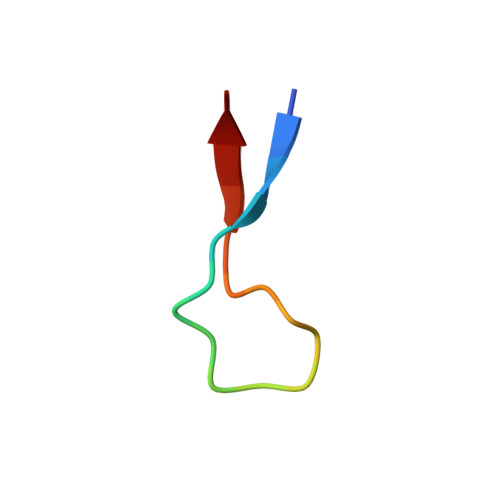
De Novo Synthesis and Structural Elucidation of CDR-H3 Loop Mimics.
Zhao, G., Richaud, A.D., Williamson, R.T., Feig, M., Roche, S.P.(2024) ACS Chem Biol 19: 1583-1592
- PubMed: 38916527 Search on PubMedSearch on PubMed Central
- DOI: https://doi.org/10.1021/acschembio.4c00236
- Primary Citation Related Structures:
8W0Q - PubMed Abstract:
The binding affinity of antibodies to specific antigens stems from a remarkably broad repertoire of hypervariable loops known as complementarity-determining regions (CDRs). While recognizing the pivotal role of the heavy-chain 3 CDRs (CDR-H3s) in maximizing antibody-antigen affinity and specificity, the key structural determinants responsible for their adaptability to diverse loop sequences, lengths, and noncanonical structures are hitherto unknown. To address this question, we achieved a de novo synthesis of bulged CDR-H3 mimics excised from their full antibody context. CD and NMR data revealed that these stable standalone β-hairpin scaffolds are well-folded and retain many of the native bulge CDR-H3 features in water. In particular, the tryptophan residue, highly conserved across CDR-H3 sequences, was found to extend the kinked base of these β-bulges through a combination of stabilizing intramolecular hydrogen bond and CH/π interaction. The structural ensemble consistent with our NMR observations exposed the dynamic nature of residues at the base of the loop, suggesting that β-bulges act as molecular hinges connecting the rigid stem to the more flexible loops of CDR-H3s. We anticipate that this deeper structural understanding of CDR-H3s will lay the foundation to inform the design of antibody drugs broadly and engineer novel CDR-H3 peptide scaffolds as therapeutics.
- Department of Chemistry and Biochemistry, Florida Atlantic University, Boca Raton, Florida 33431, United States.
Organizational Affiliation: