Download Mendeley
GABA A receptor pi forms channels that stimulate ERK through a G-protein-dependent pathway.
Wang, Y., Zhang, Y., Li, W., Salovska, B., Zhang, J., Li, T., Li, H., Liu, Y., Kaczmarek, L.K., Pusztai, L., Klein, D.E.(2025) Mol Cell 85: 166-176.e5
- PubMed: 39642883 Search on PubMedSearch on PubMed Central
- DOI: https://doi.org/10.1016/j.molcel.2024.11.016
- Primary Citation Related Structures:
8VSZ, 8VV0 - PubMed Abstract:
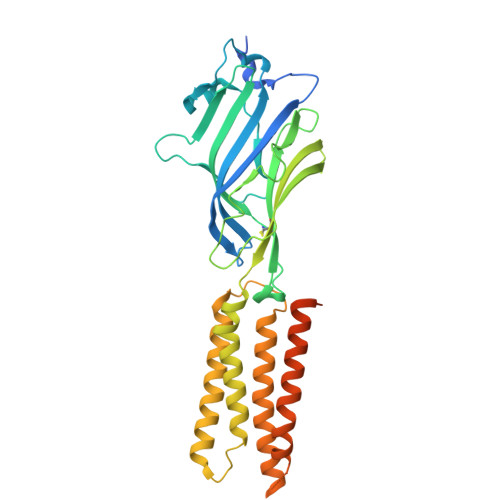
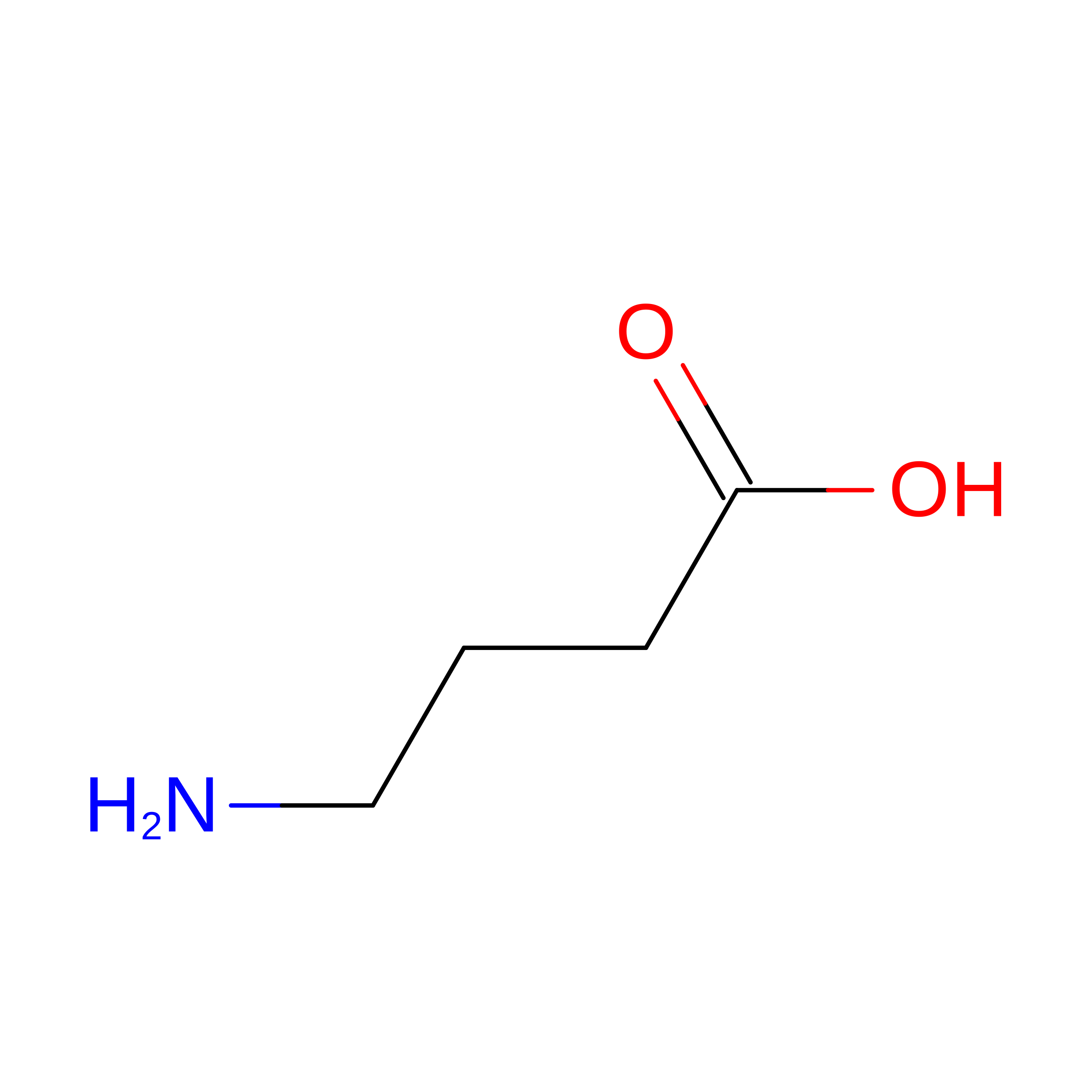
The rare γ-aminobutyric acid type-A receptor (GABA A R) subunit π (GABRP) is highly expressed in certain cancers, where it stimulates growth through extracellular-regulated kinase (ERK) signaling by an uncharacterized pathway. To elucidate GABRP's signaling mechanism, we determined cryoelectron microscopy (cryo-EM) structures of GABRP embedded in native nanodiscs, both in the presence and absence of GABA. Structurally, GABRP homopentamers closely resemble heteropentameric GABA A R anion channels, transitioning from a closed "resting" state to an open "active" state upon GABA binding. However, functional assays reveal that GABRP responds more like a type-B metabotropic receptor. At physiological concentrations of GABA, chloride flux is not detected. Rather, GABRP activates a G-protein-coupled pathway leading to ERK signaling. Ionotropic activity is only triggered at supraphysiological GABA concentrations, effectively decoupling it from GABRP's signaling functions. These findings provide a structural and functional blueprint for GABRP, opening new avenues for targeted inhibition of GABA growth signals in GABRP-positive cancers.
- Yale Cancer Biology Institute, Yale University, West Haven, CT 06516, USA; Breast Medical Oncology, Yale Cancer Center, Yale University School of Medicine, New Haven, CT 06520, USA.
Organizational Affiliation: