Download Mendeley
A conserved chaperone protein is required for the formation of a noncanonical type VI secretion system spike tip complex.
Sachar, K., Kanarek, K., Colautti, J., Kim, Y., Bosis, E., Prehna, G., Salomon, D., Whitney, J.C.(2025) J Biol Chem 301: 108242-108242
- PubMed: 39880087 Search on PubMedSearch on PubMed Central
- DOI: https://doi.org/10.1016/j.jbc.2025.108242
- Primary Citation Related Structures:
8VTH - PubMed Abstract:
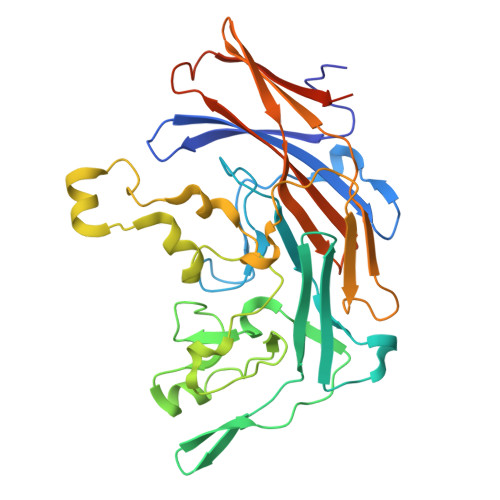
Type VI secretion systems (T6SSs) are dynamic protein nanomachines found in Gram-negative bacteria that deliver toxic effector proteins into target cells in a contact-dependent manner. Prior to secretion, many T6SS effector proteins require chaperones and/or accessory proteins for proper loading onto the structural components of the T6SS apparatus. However, despite their established importance, the precise molecular function of several T6SS accessory protein families remains unclear. In this study, we set out to characterize the DUF2169 family of T6SS accessory proteins. Using gene co-occurrence analyses, we find that DUF2169-encoding genes strictly co-occur with genes encoding T6SS spike complexes formed by valine-glycine repeat protein G (VgrG) and DUF4150 domains. Although structurally similar to Pro-Ala-Ala-Arg (PAAR) domains, "PAAR-like" DUF4150 domains lack PAAR motifs and instead contain a conserved PIPY motif, leading us to designate them PIPY domains. Next, we present both genetic and biochemical evidence that PIPY domains require a cognate DUF2169 protein to form a functional T6SS spike complex with VgrG. This contrasts with canonical PAAR proteins, which bind VgrG on their own to form functional spike complexes. By solving the first crystal structure of a DUF2169 protein, we show that this T6SS accessory protein adopts a novel protein fold. Furthermore, biophysical and structural modeling data suggest that DUF2169 contains a dynamic loop that physically interacts with a hydrophobic patch on the surface of its cognate PIPY domain. Based on these findings, we propose a model whereby DUF2169 proteins function as molecular chaperones that maintain VgrG-PIPY spike complexes in a secretion-competent state prior to their export by the T6SS apparatus.
- Department of Biochemistry and Biomedical Sciences, McMaster University, Hamilton, Ontario, Canada; Department of Microbiology, University of Manitoba, Winnipeg, Manitoba, Canada.
Organizational Affiliation: