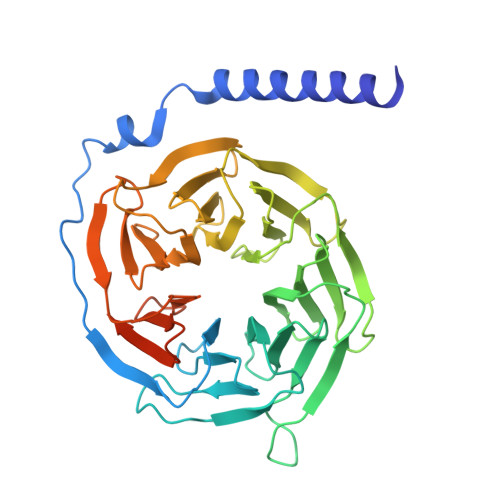
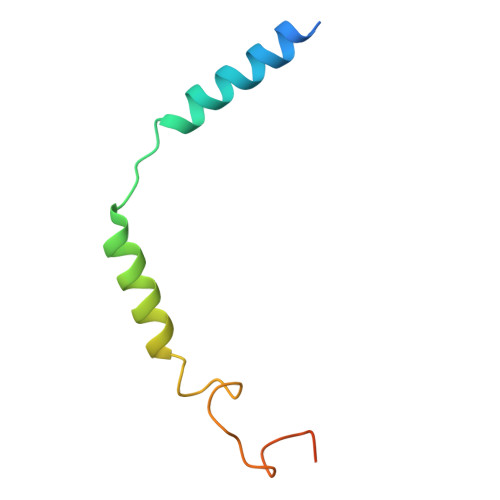
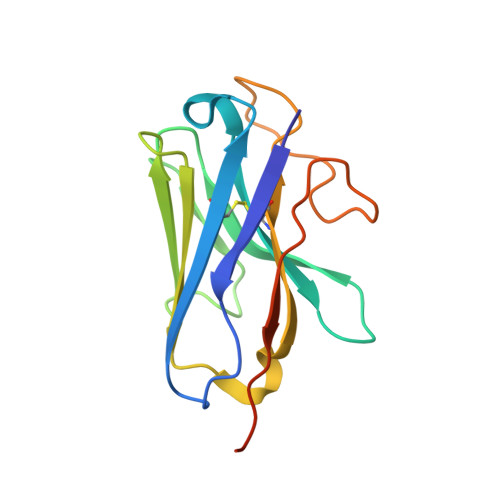
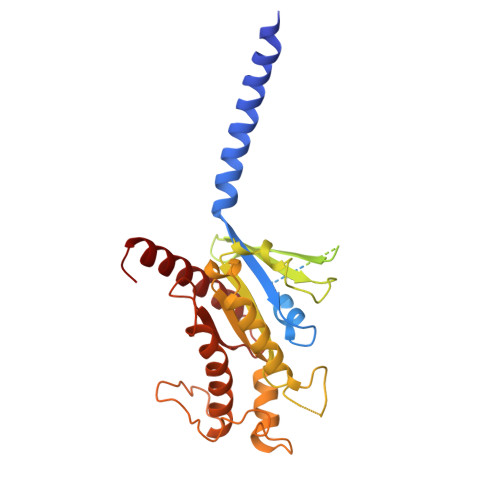
8VHF | pdb_00008vhf

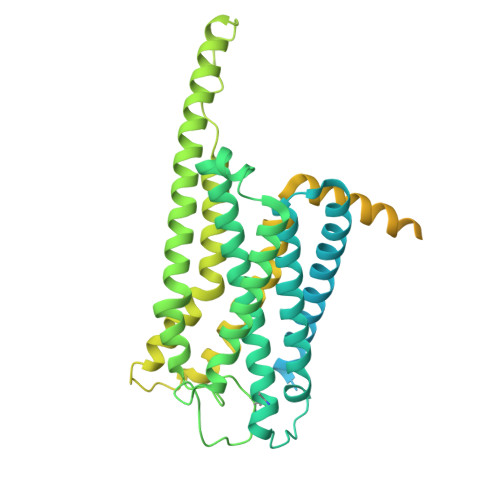
Cryo-EM structure of GPR119-Gs-Nb35 complex with small molecule agonist MBX-2982


Experimental Data Snapshot

  • Method: ELECTRON MICROSCOPY
  • Resolution: 3.51 Å
  • Aggregation State: PARTICLE 
  • Reconstruction Method: SINGLE PARTICLE 

Starting Model: experimental
View more details

wwPDB Validation   3D Report Full Report


This is version 1.2 of the entry. See complete history


Literature

Native mass spectrometry prescreening of G protein-coupled receptor complexes for cryo-EM structure determination.

Kim, D.Liu, W.Viner, R.Cherezov, V.

(2024) Structure 32: 2206-2219.e4

  • DOI: https://doi.org/10.1016/j.str.2024.10.004
  • Primary Citation of Related Structures:  
    8VHF

  • PubMed Abstract: 

    G protein-coupled receptors (GPCRs) are essential transmembrane proteins playing key roles in human health and disease. Understanding their atomic-level molecular structure and conformational states is imperative for advancing drug development. Recent breakthroughs in single-particle cryogenic electron microscopy (cryo-EM) have propelled the structural biology of GPCRs into a new era. Nevertheless, the preparation of suitable GPCR samples and their complexes for cryo-EM analysis remains challenging due to their poor stability and highly dynamic nature. Here, we present our online buffer exchange-native MS method combined with Direct Mass Technology (OBE-nMS+DMT) which facilitates high-throughput analysis and guides sample preparation. We applied this method to optimize the GPR119-G s complex sample prior to cryo-EM analysis, leading to a 3.51 Å resolution structure from only 396 movies collected on a 200 kV Glacios. This study suggests that the OBE-nMS+DMT method emerges as a powerful tool for prescreening sample conditions in cryo-EM studies of GPCRs and other membrane protein complexes.


  • Organizational Affiliation
    • Bridge Institute, Michelson Center for Convergent Bioscience, University of Southern California, Los Angeles, CA 90089, USA; Department of Chemistry, University of Southern California, Los Angeles, CA 90089, USA.

Macromolecules
Find similar proteins by:  (by identity cutoff)  |  3D Structure
Entity ID: 1
MoleculeChains Sequence LengthOrganismDetailsImage
Guanine nucleotide-binding protein G(I)/G(S)/G(T) subunit beta-1, HiBiTA [auth B]371Homo sapiensMutation(s): 0 
Gene Names: GNB1
UniProt & NIH Common Fund Data Resources
Find proteins for P62873 (Homo sapiens)
Explore P62873 
Go to UniProtKB:  P62873
PHAROS:  P62873
GTEx:  ENSG00000078369 
Entity Groups  
Sequence Clusters30% Identity50% Identity70% Identity90% Identity95% Identity100% Identity
UniProt GroupP62873
Sequence Annotations
Expand
  • Reference Sequence
Find similar proteins by:  (by identity cutoff)  |  3D Structure
Entity ID: 2
MoleculeChains Sequence LengthOrganismDetailsImage
Guanine nucleotide-binding protein G(I)/G(S)/G(O) subunit gamma-2B [auth C]71Homo sapiensMutation(s): 0 
Gene Names: GNG2
Membrane Entity: Yes 
UniProt & NIH Common Fund Data Resources
Find proteins for P59768 (Homo sapiens)
Explore P59768 
Go to UniProtKB:  P59768
PHAROS:  P59768
GTEx:  ENSG00000186469 
Entity Groups  
Sequence Clusters30% Identity50% Identity70% Identity90% Identity95% Identity100% Identity
UniProt GroupP59768
Sequence Annotations
Expand
  • Reference Sequence
Find similar proteins by:  (by identity cutoff)  |  3D Structure
Entity ID: 3
MoleculeChains Sequence LengthOrganismDetailsImage
Nanobody35C [auth N]138Lama glamaMutation(s): 0 
Entity Groups  
Sequence Clusters30% Identity50% Identity70% Identity90% Identity95% Identity100% Identity
Sequence Annotations
Expand
  • Reference Sequence
Find similar proteins by:  (by identity cutoff)  |  3D Structure
Entity ID: 4
MoleculeChains Sequence LengthOrganismDetailsImage
Guanine nucleotide-binding protein G(s) subunit alpha isoforms shortD [auth A]394Homo sapiensMutation(s): 8 
Gene Names: GNASGNAS1GSP
EC: 3.6.5
Membrane Entity: Yes 
UniProt & NIH Common Fund Data Resources
Find proteins for P63092 (Homo sapiens)
Explore P63092 
Go to UniProtKB:  P63092
PHAROS:  P63092
GTEx:  ENSG00000087460 
Entity Groups  
Sequence Clusters30% Identity50% Identity70% Identity90% Identity95% Identity100% Identity
UniProt GroupP63092
Sequence Annotations
Expand
  • Reference Sequence
Find similar proteins by:  (by identity cutoff)  |  3D Structure
Entity ID: 5
MoleculeChains Sequence LengthOrganismDetailsImage
Soluble cytochrome b562,Glucose-dependent insulinotropic receptor,LgBiTE [auth R]615Escherichia coliHomo sapiensOplophorus gracilirostris
This entity is chimeric
Mutation(s): 3 
Gene Names: cybCGPR119
Membrane Entity: Yes 
UniProt & NIH Common Fund Data Resources
Find proteins for P0ABE7 (Escherichia coli)
Explore P0ABE7 
Go to UniProtKB:  P0ABE7
Find proteins for Q8TDV5 (Homo sapiens)
Explore Q8TDV5 
Go to UniProtKB:  Q8TDV5
PHAROS:  Q8TDV5
GTEx:  ENSG00000147262 
Entity Groups  
Sequence Clusters30% Identity50% Identity70% Identity90% Identity95% Identity100% Identity
UniProt GroupsQ8TDV5P0ABE7
Sequence Annotations
Expand
  • Reference Sequence
Small Molecules
Ligands 1 Unique
IDChains Name / Formula / InChI Key2D Diagram3D Interactions
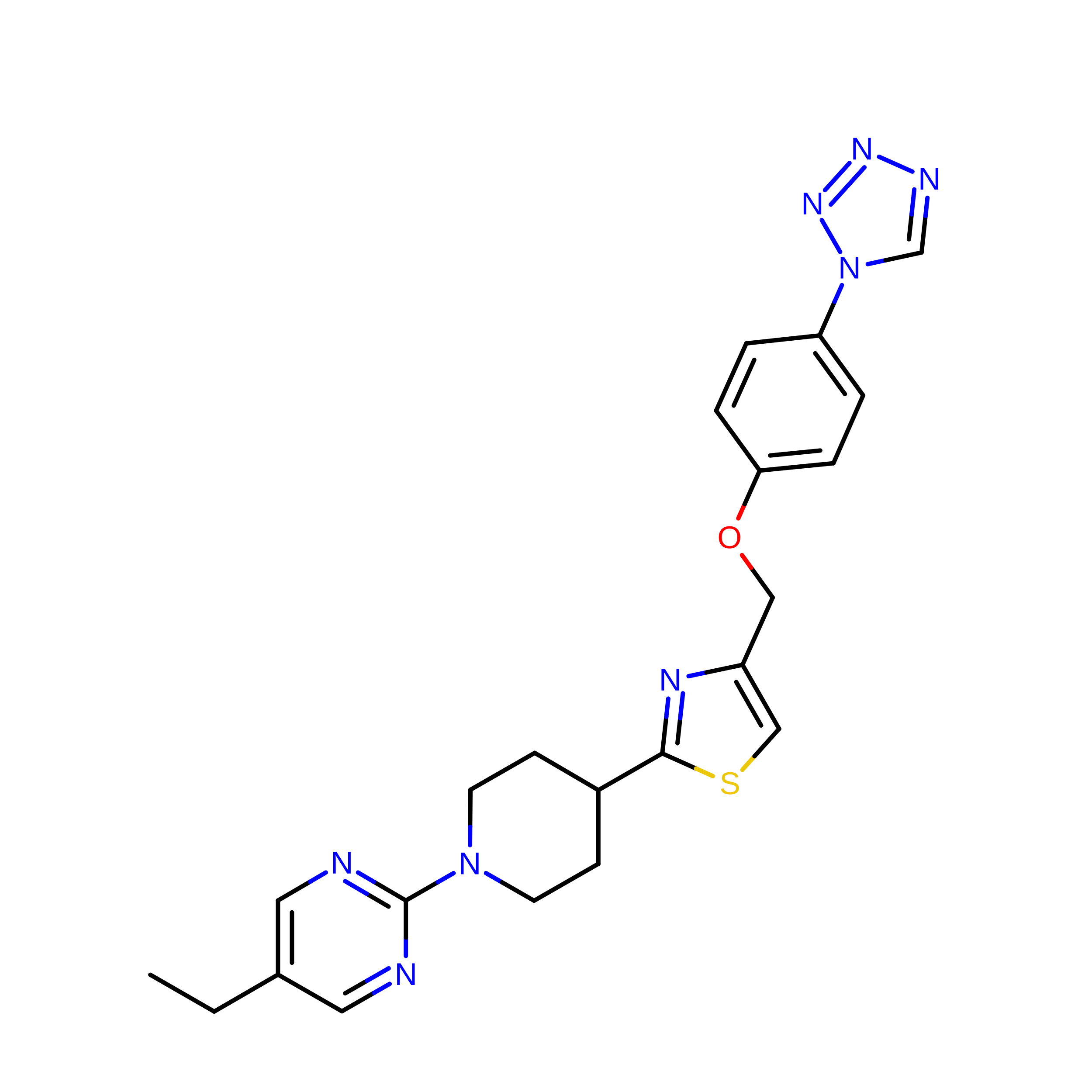
8VP (Subject of Investigation/LOI)
Query on 8VP

Download Ideal Coordinates CCD File 
F [auth R]2-[1-(5-ethylpyrimidin-2-yl)piperidin-4-yl]-4-[[4-(1,2,3,4-tetrazol-1-yl)phenoxy]methyl]-1,3-thiazole
C22 H24 N8 O S
NFTMKHWBOINJGM-UHFFFAOYSA-N
Experimental Data & Validation

Experimental Data

  • Method: ELECTRON MICROSCOPY
  • Resolution: 3.51 Å
  • Aggregation State: PARTICLE 
  • Reconstruction Method: SINGLE PARTICLE 
EM Software:
TaskSoftware PackageVersion
RECONSTRUCTIONcryoSPARC4.3.1
MODEL REFINEMENTPHENIX1.21rc1_5156:

Structure Validation

View Full Validation Report


Entry History & Funding Information

Deposition Data


Funding OrganizationLocationGrant Number
National Institutes of Health/National Institute of General Medical Sciences (NIH/NIGMS)United StatesGM127086

Revision History  (Full details and data files)

  • Version 1.0: 2024-10-30
    Type: Initial release
  • Version 1.1: 2024-11-13
    Changes: Data collection
  • Version 1.2: 2025-03-05
    Changes: Data collection, Database references