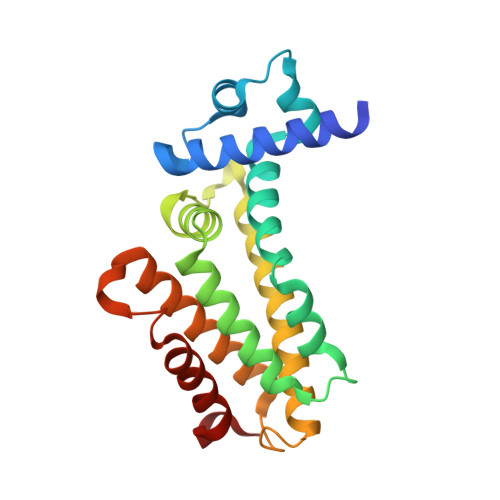
8V90 | pdb_00008v90

TtgR variant 3A7 with naltrexone


Experimental Data Snapshot

  • Method: X-RAY DIFFRACTION
  • Resolution: 2.08 Å
  • R-Value Free: 
    0.249 (Depositor), 0.250 (DCC) 
  • R-Value Work: 
    0.201 (Depositor), 0.202 (DCC) 
  • R-Value Observed: 
    0.203 (Depositor) 

Starting Model: experimental
View more details

wwPDB Validation   3D Report Full Report


Ligand Structure Quality Assessment 


This is version 1.1 of the entry. See complete history


Literature

Highly multiplexed design of an allosteric transcription factor to sense new ligands.

Nishikawa, K.K.Chen, J.Acheson, J.F.Harbaugh, S.V.Huss, P.Frenkel, M.Novy, N.Sieren, H.R.Lodewyk, E.C.Lee, D.H.Chavez, J.L.Fox, B.G.Raman, S.

(2024) Nat Commun 15: 10001-10001

  • DOI: https://doi.org/10.1038/s41467-024-54260-8
  • Primary Citation of Related Structures:  
    8V90

  • PubMed Abstract: 

    Allosteric transcription factors (aTF) regulate gene expression through conformational changes induced by small molecule binding. Although widely used as biosensors, aTFs have proven challenging to design for detecting new molecules because mutation of ligand-binding residues often disrupts allostery. Here, we develop Sensor-seq, a high-throughput platform to design and identify aTF biosensors that bind to non-native ligands. We screen a library of 17,737 variants of the aTF TtgR, a regulator of a multidrug exporter, against six non-native ligands of diverse chemical structures - four derivatives of the cancer therapeutic tamoxifen, the antimalarial drug quinine, and the opiate analog naltrexone - as well as two native flavonoid ligands, naringenin and phloretin. Sensor-seq identifies biosensors for each of these ligands with high dynamic range and diverse specificity profiles. The structure of a naltrexone-bound design shows shape-complementary methionine-aromatic interactions driving ligand specificity. To demonstrate practical utility, we develop cell-free detection systems for naltrexone and quinine. Sensor-seq enables rapid and scalable design of new biosensors, overcoming constraints of natural biosensors.


  • Organizational Affiliation
    • Department of Biochemistry, University of Wisconsin-Madison, Madison, WI, USA.

Macromolecules
Find similar proteins by:  (by identity cutoff)  |  3D Structure
Entity ID: 1
MoleculeChains Sequence LengthOrganismDetailsImage
HTH-type transcriptional regulator TtgR
A, B, C, D
211Pseudomonas putida DOT-T1EMutation(s): 4 
Gene Names: ttgR
UniProt
Find proteins for Q9AIU0 (Pseudomonas putida (strain DOT-T1E))
Explore Q9AIU0 
Go to UniProtKB:  Q9AIU0
Entity Groups  
Sequence Clusters30% Identity50% Identity70% Identity90% Identity95% Identity100% Identity
UniProt GroupQ9AIU0
Sequence Annotations
Expand
  • Reference Sequence
Small Molecules
Ligands 2 Unique
IDChains Name / Formula / InChI Key2D Diagram3D Interactions
YOE (Subject of Investigation/LOI)
Query on YOE

Download Ideal Coordinates CCD File 
E [auth A]
F [auth A]
H [auth B]
I [auth B]
K [auth C]
E [auth A],
F [auth A],
H [auth B],
I [auth B],
K [auth C],
M [auth D]
nalterxone
C20 H23 N O4
DQCKKXVULJGBQN-YGWPLHOASA-N
MG
Query on MG

Download Ideal Coordinates CCD File 
G [auth A],
J [auth B],
L [auth C],
N [auth D]
MAGNESIUM ION
Mg
JLVVSXFLKOJNIY-UHFFFAOYSA-N
Experimental Data & Validation

Experimental Data

  • Method: X-RAY DIFFRACTION
  • Resolution: 2.08 Å
  • R-Value Free:  0.249 (Depositor), 0.250 (DCC) 
  • R-Value Work:  0.201 (Depositor), 0.202 (DCC) 
  • R-Value Observed: 0.203 (Depositor) 
Space Group: P 1
Unit Cell:
Length ( Å )Angle ( ˚ )
a = 43.1α = 99.07
b = 43.169β = 97.02
c = 115.826γ = 95.97
Software Package:
Software NamePurpose
PHENIXrefinement
autoPROCdata reduction
Aimlessdata scaling
PHENIXphasing

Structure Validation

View Full Validation Report


Ligand Structure Quality Assessment 


Entry History & Funding Information

Deposition Data


Funding OrganizationLocationGrant Number
Department of Defense (DOD, United States)United StatesW911NF-20-C0005

Revision History  (Full details and data files)

  • Version 1.0: 2024-12-11
    Type: Initial release
  • Version 1.1: 2025-12-24
    Changes: Database references