Download Mendeley
Potent efficacy of an IgG-specific endoglycosidase against IgG-mediated pathologies.
Sastre, D.E., Bournazos, S., Du, J., Boder, E.J., Edgar, J.E., Azzam, T., Sultana, N., Huliciak, M., Flowers, M., Yoza, L., Xu, T., Chernova, T.A., Ravetch, J.V., Sundberg, E.J.(2024) Cell 187: 6994
- PubMed: 39437779 Search on PubMedSearch on PubMed Central
- DOI: https://doi.org/10.1016/j.cell.2024.09.038
- Primary Citation Related Structures:
8UEN, 8URA - PubMed Abstract:
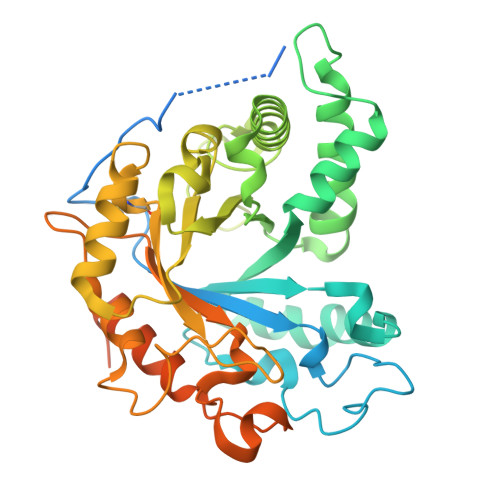
Endo-β-N-acetylglucosaminidases (ENGases) that specifically hydrolyze the Asn297-linked glycan on immunoglobulin G (IgG) antibodies, the major molecular determinant of fragment crystallizable (Fc) γ receptor (FcγR) binding, are exceedingly rare. All previously characterized IgG-specific ENGases are multi-domain proteins secreted as an immune evasion strategy by Streptococcus pyogenes strains. Here, using in silico analysis and mass spectrometry techniques, we identified a family of single-domain ENGases secreted by pathogenic corynebacterial species that exhibit strict specificity for IgG antibodies. By X-ray crystallographic and surface plasmon resonance analyses, we found that the most catalytically efficient IgG-specific ENGase family member recognizes both protein and glycan components of IgG. Employing in vivo models, we demonstrated the remarkable efficacy of this IgG-specific ENGase in mitigating numerous pathologies that rely on FcγR-mediated effector functions, including T and B lymphocyte depletion, autoimmune hemolytic anemia, and antibody-dependent enhancement of dengue disease, revealing its potential for treating and/or preventing a wide range of IgG-mediated diseases in humans.
- Department of Biochemistry, Emory University School of Medicine, Atlanta, GA 30322, USA. Electronic address: dsastre@emory.edu.
Organizational Affiliation: