8ULF | pdb_00008ulf

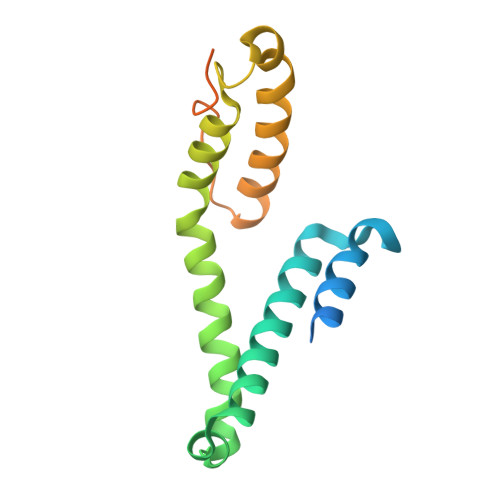
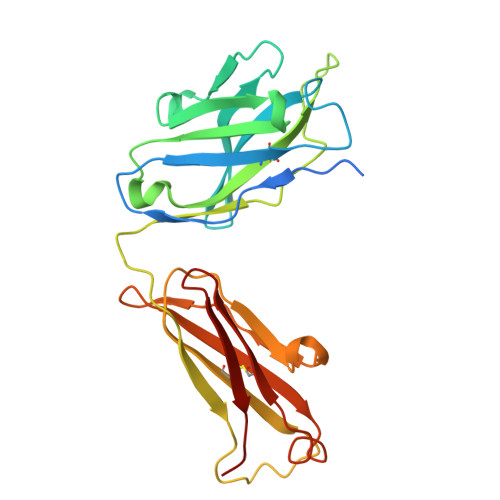
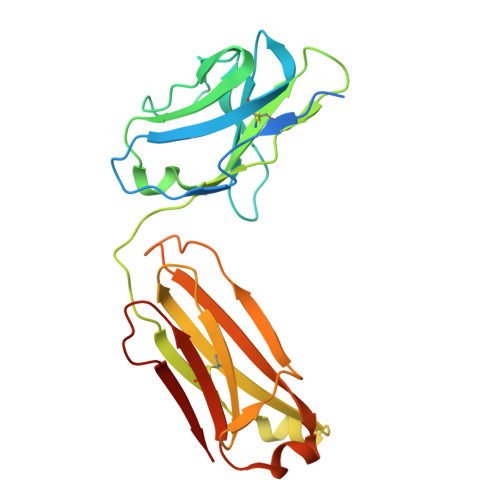
Crystal structure of Plasmodium vivax CelTOS in complex with antibody 7g7


Experimental Data Snapshot

  • Method: X-RAY DIFFRACTION
  • Resolution: 3.20 Å
  • R-Value Free: 
    0.295 (Depositor), 0.310 (DCC) 
  • R-Value Work: 
    0.275 (Depositor), 0.279 (DCC) 
  • R-Value Observed: 
    0.278 (Depositor) 

Starting Models: experimental
View more details

wwPDB Validation 3D Report Full Report

Validation slider image for 8ULF

This is version 1.1 of the entry. See complete history

Literature

Multistage protective anti-CelTOS monoclonal antibodies with cross-species sterile protection against malaria.

Tang, W.K.Salinas, N.D.Kolli, S.K.Xu, S.Urusova, D.V.Kumar, H.Jimah, J.R.Subramani, P.A.Ogbondah, M.M.Barnes, S.J.Adams, J.H.Tolia, N.H.

(2024) Nat Commun 15: 7487-7487

  • DOI: https://doi.org/10.1038/s41467-024-51701-2
  • Primary Citation Related Structures: 
    8UKH, 8ULF

  • PubMed Abstract: 

    CelTOS is a malaria vaccine antigen that is conserved in Plasmodium and other apicomplexan parasites and plays a role in cell-traversal. The structural basis and mechanisms of CelTOS-induced protective immunity to parasites are unknown. Here, CelTOS-specific monoclonal antibodies (mAbs) 7g7 and 4h12 demonstrated multistage activity, protecting against liver infection and preventing parasite transmission to mosquitoes. Both mAbs demonstrated cross-species activity with sterile protection against in vivo challenge with transgenic parasites containing either P. falciparum or P. vivax CelTOS, and with transmission reducing activity against P. falciparum. The mAbs prevented CelTOS-mediated pore formation providing insight into the protective mechanisms. X-ray crystallography and mutant-library epitope mapping revealed two distinct broadly conserved neutralizing epitopes. 7g7 bound to a parallel dimer of CelTOS, while 4h12 bound to a novel antiparallel dimer architecture. These findings inform the design of antibody therapies and vaccines and raise the prospect of a single intervention to simultaneously combat P. falciparum and P. vivax malaria.


  • Organizational Affiliation
    • Host‒Pathogen Interactions and Structural Vaccinology Section, Laboratory of Malaria Immunology and Vaccinology, National Institute of Allergy and Infectious Diseases, National Institutes of Health, Bethesda, MD, USA.

Macromolecule Content 

  • Total Structure Weight: 282.5 kDa 
  • Atom Count: 16,912 
  • Modeled Residue Count: 2,208 
  • Deposited Residue Count: 2,584 
  • Unique protein chains: 3

Macromolecules

Find similar proteins by:|  3D Structure
Entity ID: 1
MoleculeChains  Sequence LengthOrganismDetailsImage
Pv cell-traversal proteinA,
D [auth B],
G [auth C],
J [auth D]
171Plasmodium vivaxMutation(s): 0 
Gene Names: pvCelTOS
UniProt
Find proteins for Q53UB7 (Plasmodium vivax)
Explore Q53UB7 
Go to UniProtKB:  Q53UB7
Entity Groups
Sequence Clusters30% Identity50% Identity70% Identity90% Identity95% Identity100% Identity
UniProt GroupQ53UB7
Sequence Annotations
Expand
Reference Sequence
Find similar proteins by:|  3D Structure
Entity ID: 2
MoleculeChains  Sequence LengthOrganismDetailsImage
7g7 heavy chainB [auth H],
E [auth I],
H [auth J],
K
240Mus musculusMutation(s): 0 
Find similar proteins by:|  3D Structure
Entity ID: 3
MoleculeChains  Sequence LengthOrganismDetailsImage
7g7 light chainC [auth L],
F [auth M],
I [auth N],
L [auth O]
235Mus musculusMutation(s): 0 

Experimental Data & Validation

Experimental Data

  • Method: X-RAY DIFFRACTION
  • Resolution: 3.20 Å
  • R-Value Free:  0.295 (Depositor), 0.310 (DCC) 
  • R-Value Work:  0.275 (Depositor), 0.279 (DCC) 
  • R-Value Observed: 0.278 (Depositor) 
Space Group: P 1
Unit Cell:
Length ( Å )Angle ( ˚ )
a = 182.89α = 90.03
b = 78.62β = 95.37
c = 47.32γ = 89.88
Software Package:
Software NamePurpose
PHENIXrefinement
XDSdata reduction
XSCALEdata scaling
PHASERphasing

Structure Validation

View Full Validation Report


Entry History 

& Funding Information

Deposition Data


Funding OrganizationLocationGrant Number
National Institutes of Health/National Institute Of Allergy and Infectious Diseases (NIH/NIAID)United States--

Revision History  (Full details and data files)

  • Version 1.0: 2024-09-11
    Type: Initial release
  • Version 1.1: 2024-11-13
    Changes: Structure summary