Download Mendeley
Generative beta-hairpin design using a residue-based physicochemical property landscape.
Satalkar, V., Degaga, G.D., Li, W., Pang, Y.T., McShan, A.C., Gumbart, J.C., Mitchell, J.C., Torres, M.P.(2024) Biophys J 123: 2790-2806
- PubMed: 38297834 Search on PubMedSearch on PubMed Central
- DOI: https://doi.org/10.1016/j.bpj.2024.01.029
- Primary Citation Related Structures:
8T61, 8T62, 8T63, 8TXS - PubMed Abstract:
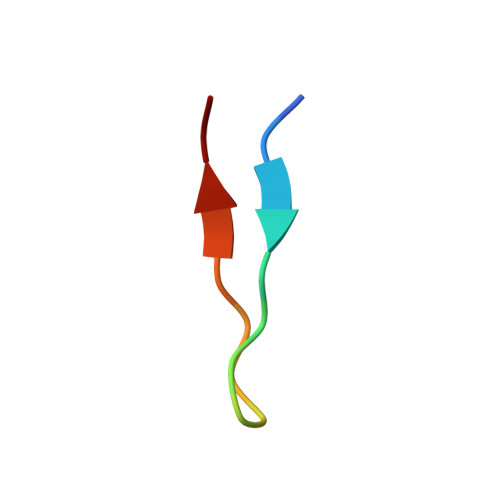
De novo peptide design is a new frontier that has broad application potential in the biological and biomedical fields. Most existing models for de novo peptide design are largely based on sequence homology that can be restricted based on evolutionarily derived protein sequences and lack the physicochemical context essential in protein folding. Generative machine learning for de novo peptide design is a promising way to synthesize theoretical data that are based on, but unique from, the observable universe. In this study, we created and tested a custom peptide generative adversarial network intended to design peptide sequences that can fold into the β-hairpin secondary structure. This deep neural network model is designed to establish a preliminary foundation of the generative approach based on physicochemical and conformational properties of 20 canonical amino acids, for example, hydrophobicity and residue volume, using extant structure-specific sequence data from the PDB. The beta generative adversarial network model robustly distinguishes secondary structures of β hairpin from α helix and intrinsically disordered peptides with an accuracy of up to 96% and generates artificial β-hairpin peptide sequences with minimum sequence identities around 31% and 50% when compared against the current NCBI PDB and nonredundant databases, respectively. These results highlight the potential of generative models specifically anchored by physicochemical and conformational property features of amino acids to expand the sequence-to-structure landscape of proteins beyond evolutionary limits.
- School of Biological Sciences, Georgia Institute of Technology, Atlanta, Georgia.
Organizational Affiliation: