Download Mendeley
Synthesis and Evaluation of diaryl ether modulators of the leukotriene A 4 hydrolase aminopeptidase activity.
Petruncio, G., Lee, K.H., Girgis, M., Shellnutt, Z., Beaulac, Z., Xiang, J., Lee, S.H., Peng, X., Burdick, M., Noble, S.M., Shim, Y.M., Paige, M.(2024) Eur J Med Chem 272: 116459-116459
- PubMed: 38704942 Search on PubMed
- DOI: https://doi.org/10.1016/j.ejmech.2024.116459
- Primary Citation Related Structures:
8TWX - PubMed Abstract:
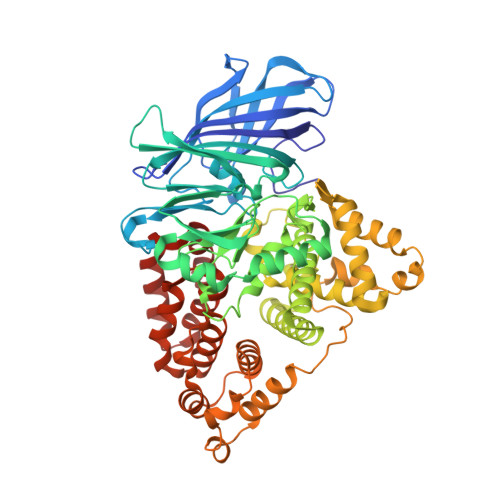
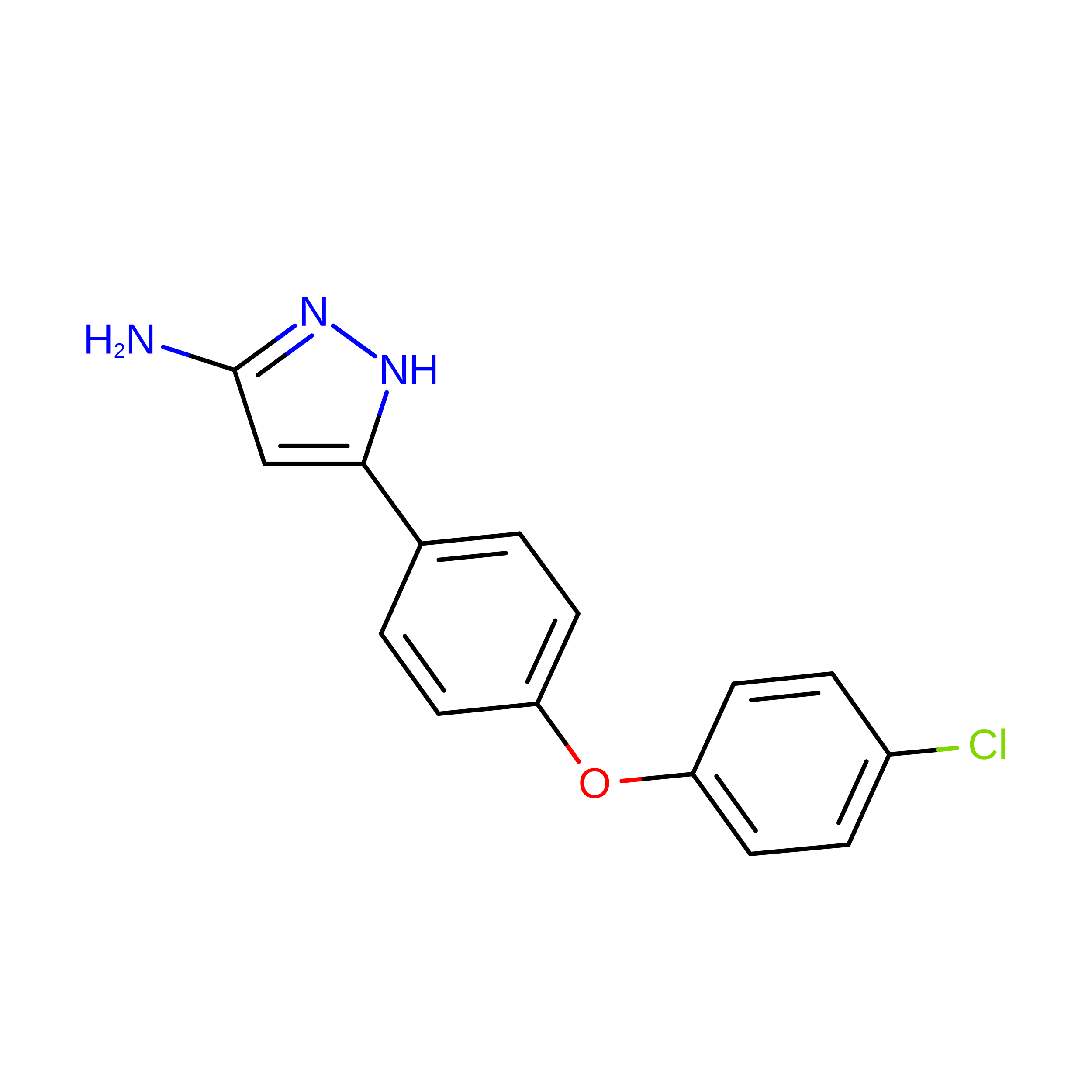
Activation of the aminopeptidase (AP) activity of leukotriene A 4 hydrolase (LTA 4 H) presents a potential therapeutic strategy for resolving chronic inflammation. Previously, ARM1 and derivatives were found to activate the AP activity using the alanine-p-nitroanilide (Ala-pNA) as a reporter group in an enzyme kinetics assay. As an extension of this previous work, novel ARM1 derivatives were synthesized using a palladium-catalyzed Ullmann coupling reaction and screened using the same assay. Analogue 5, an aminopyrazole (AMP) analogue of ARM1, was found to be a potent AP activator with an AC 50 of 0.12 μM. An X-ray crystal structure of LTA 4 H in complex with AMP was refined at 2.7 Å. Despite its AP activity with Ala-pNA substrate, AMP did not affect hydrolysis of the previously proposed natural ligand of LTA 4 H, Pro-Gly-Pro (PGP). This result highlights a discrepancy between the hydrolysis of more conveniently monitored chromogenic synthetic peptides typically employed in assays and endogenous peptides. The epoxide hydrolase (EH) activity of AMP was measured in vivo and the compound significantly reduced leukotriene B 4 (LTB 4 ) levels in a murine bacterial pneumonia model. However, AMP did not enhance survival in the murine pneumonia model over a 14-day period. A liver microsome stability assay showed metabolic stability of AMP. The results suggested that accelerated Ala-pNA cleavage is not sufficient for predicting therapeutic potential, even when the full mechanism of activation is known.
- Department of Chemistry & Biochemistry, George Mason University, 10920 George Mason Circle, Manassas, VA, 20110, United States; Center for Molecular Engineering, George Mason University, 10920 George Mason Circle, Manassas, VA, 20110, United States. Electronic address: gpetrunc@gmu.edu.
Organizational Affiliation: