8TQ5 | pdb_00008tq5

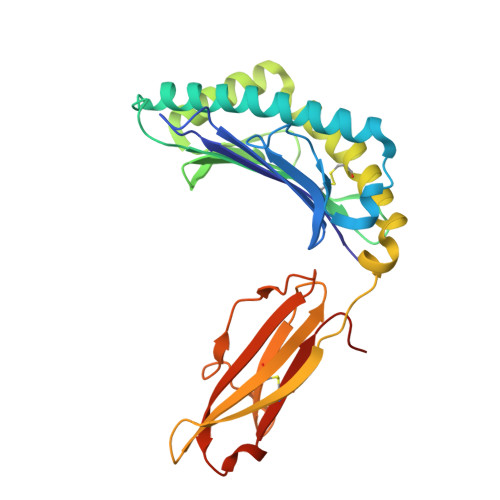
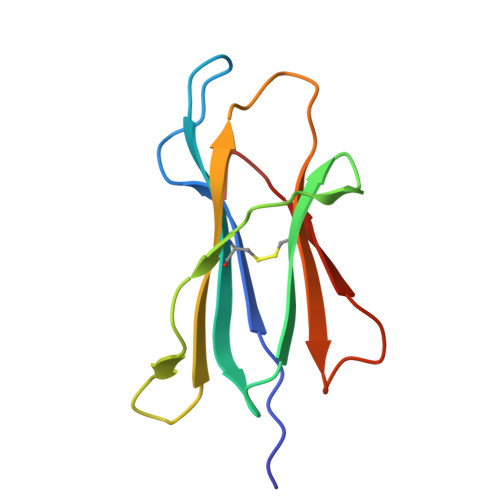
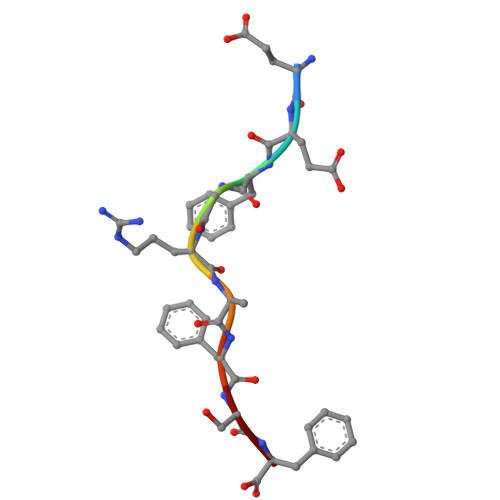
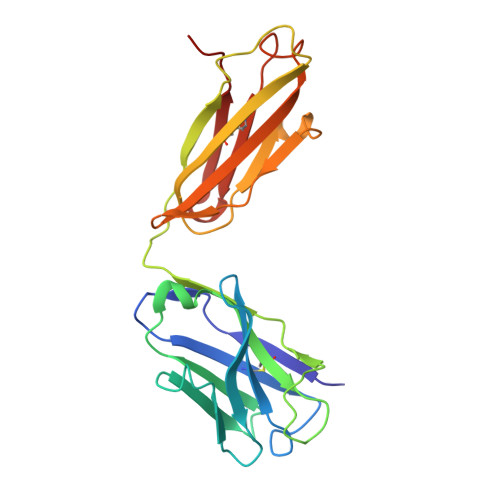
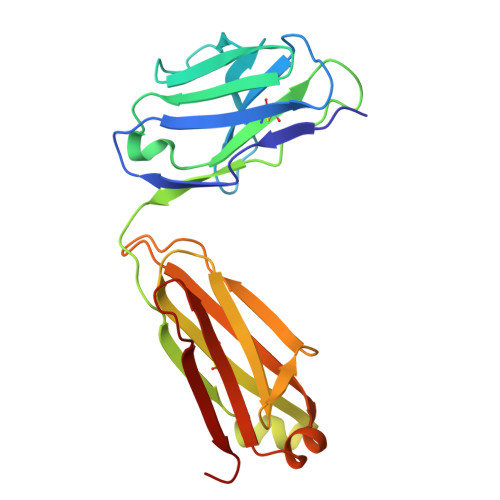
Crystal structure of Fab DX17 in complex with MHC-I (HLA-B*44:05)


Experimental Data Snapshot

  • Method: X-RAY DIFFRACTION
  • Resolution: 2.30 Å
  • R-Value Free: 
    0.234 (Depositor), 0.235 (DCC) 
  • R-Value Work: 
    0.193 (Depositor), 0.193 (DCC) 
  • R-Value Observed: 
    0.195 (Depositor) 

Starting Model: experimental
View more details

wwPDB Validation   3D Report Full Report


Ligand Structure Quality Assessment 


This is version 1.1 of the entry. See complete history


Literature

Antibody Mediated Inhibition of HLA/LILR Interactions Breaks Innate Immune Tolerance and Induces Antitumor Immunity.

Panda, A.K.Natarajan, K.Sinha, S.Jiang, J.Chempati, S.Boyd, L.F.Desai, P.P.Buszko, M.Kim, Y.H.Kazmi, S.Fisk, B.Teke, M.E.Larrain, C.M.Remmert, K.Blakely, A.M.Douagi, I.Hernandez, J.M.Margulies, D.H.Shevach, E.M.

(2025) Cancer Immunol Res 

  • DOI: https://doi.org/10.1158/2326-6066.CIR-25-0343
  • Primary Citation of Related Structures:  
    8TQ5

  • PubMed Abstract: 

    Immune check-point blockade for the treatment of malignancies has been focused on reversing inhibitory pathways in T lymphocytes. Natural killer (NK) cells are a potent innate defense against tumors and virally infected cells, but their therapeutic manipulation for anti-cancer immunity has been inadequately explored. Considerable attention has been focused on approaches to blocking inhibitory receptors on NK and myeloid cells. Most effort has been directed to the killer immunoglobulin-like receptors (KIR) and CD94/NKG2A on NK cells. Another set of receptors with similar function in both NK cells and myeloid cells is the leukocyte immunoglobulin like receptors (LILR) that interact with a wide variety of HLA molecules. Using pan-anti-HLA mAbs that recognize a conserved epitopic region on HLA also seen by LILR, we investigated their functional effects in several models of tumor immunity. The pan-anti-HLA-mAbs blocked the binding of most LILRs, did not block killer cell immunoglobulin-like receptors (KIR) or CD94/NKG2A/C or TCR recognition. They also activated dysfunctional NK cells explanted from a variety of human cancers, and resulted in enhancement of tumor immunity in humanized mice. The mAbs also exert direct anti-tumor effects. These results suggest that activation of innate immunity via disruption of HLA/LILR interactions is a potent approach for control of both primary tumors and potentially tumor metastases.


  • Organizational Affiliation
    • National Institute of Allergy and Infectious Diseases, Bethesda, Maryland, United States.

Macromolecules
Find similar proteins by:  (by identity cutoff)  |  3D Structure
Entity ID: 1
MoleculeChains Sequence LengthOrganismDetailsImage
HLA class I histocompatibility antigen B alpha chain (HLA-B*44:05)274Homo sapiensMutation(s): 0 
Gene Names: HLA-B
UniProt
Find proteins for Q860B7 (Homo sapiens)
Explore Q860B7 
Go to UniProtKB:  Q860B7
Entity Groups  
Sequence Clusters30% Identity50% Identity70% Identity90% Identity95% Identity100% Identity
UniProt GroupQ860B7
Sequence Annotations
Expand
  • Reference Sequence
Find similar proteins by:  (by identity cutoff)  |  3D Structure
Entity ID: 2
MoleculeChains Sequence LengthOrganismDetailsImage
Beta-2-microglobulin100Homo sapiensMutation(s): 0 
Gene Names: B2MCDABP0092HDCMA22P
UniProt & NIH Common Fund Data Resources
Find proteins for P61769 (Homo sapiens)
Explore P61769 
Go to UniProtKB:  P61769
PHAROS:  P61769
GTEx:  ENSG00000166710 
Entity Groups  
Sequence Clusters30% Identity50% Identity70% Identity90% Identity95% Identity100% Identity
UniProt GroupP61769
Sequence Annotations
Expand
  • Reference Sequence

Find similar proteins by:  Sequence   |   3D Structure  

Entity ID: 3
MoleculeChains Sequence LengthOrganismDetailsImage
MHC class II antigenC [auth P]9Homo sapiensMutation(s): 0 
Gene Names: HLA-DPA1
UniProt
Find proteins for Q9TQB0 (Homo sapiens)
Explore Q9TQB0 
Go to UniProtKB:  Q9TQB0
Entity Groups  
UniProt GroupQ9TQB0
Sequence Annotations
Expand
  • Reference Sequence
Find similar proteins by:  (by identity cutoff)  |  3D Structure
Entity ID: 4
MoleculeChains Sequence LengthOrganismDetailsImage
Fab DX17 H-chainD [auth H]221Mus musculusMutation(s): 0 
Entity Groups  
Sequence Clusters30% Identity50% Identity70% Identity90% Identity95% Identity100% Identity
Glycosylation
Glycosylation Sites: 1
Sequence Annotations
Expand
  • Reference Sequence
Find similar proteins by:  (by identity cutoff)  |  3D Structure
Entity ID: 5
MoleculeChains Sequence LengthOrganismDetailsImage
Fab DX17 L-chainE [auth L]214Mus musculusMutation(s): 0 
Entity Groups  
Sequence Clusters30% Identity50% Identity70% Identity90% Identity95% Identity100% Identity
Sequence Annotations
Expand
  • Reference Sequence
Small Molecules
Ligands 1 Unique
IDChains Name / Formula / InChI Key2D Diagram3D Interactions
NAG
Query on NAG

Download Ideal Coordinates CCD File 
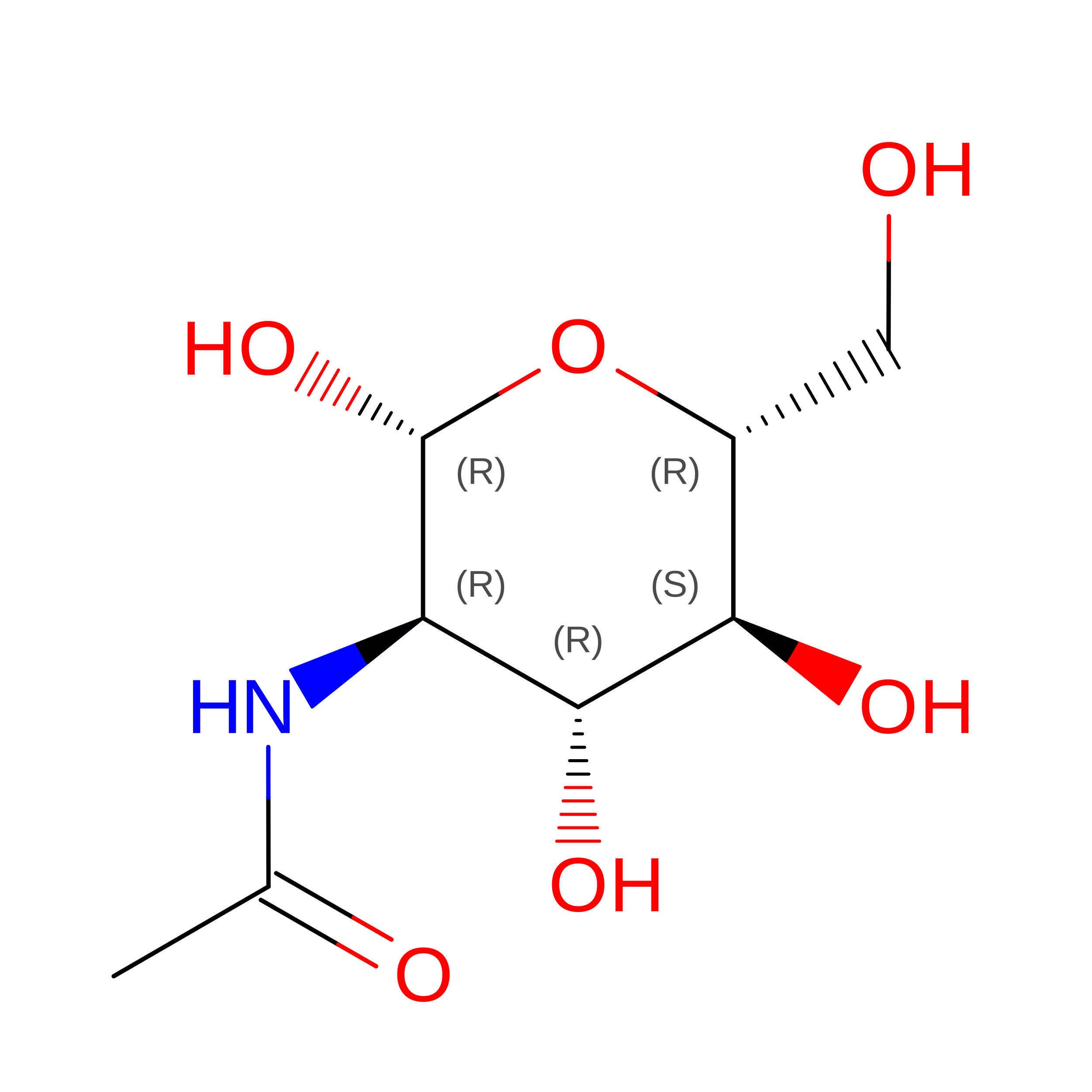
F [auth H]2-acetamido-2-deoxy-beta-D-glucopyranose
C8 H15 N O6
OVRNDRQMDRJTHS-FMDGEEDCSA-N
Experimental Data & Validation

Experimental Data

  • Method: X-RAY DIFFRACTION
  • Resolution: 2.30 Å
  • R-Value Free:  0.234 (Depositor), 0.235 (DCC) 
  • R-Value Work:  0.193 (Depositor), 0.193 (DCC) 
  • R-Value Observed: 0.195 (Depositor) 
Space Group: P 21 21 21
Unit Cell:
Length ( Å )Angle ( ˚ )
a = 77.115α = 90
b = 104.427β = 90
c = 131.49γ = 90
Software Package:
Software NamePurpose
PHENIXrefinement
PHENIXrefinement
XDSdata reduction
XDSdata scaling
PHASERphasing

Structure Validation

View Full Validation Report


Ligand Structure Quality Assessment 


Entry History & Funding Information

Deposition Data


Funding OrganizationLocationGrant Number
National Institutes of Health/National Institute Of Allergy and Infectious Diseases (NIH/NIAID)United States--

Revision History  (Full details and data files)

  • Version 1.0: 2025-02-05
    Type: Initial release
  • Version 1.1: 2025-10-08
    Changes: Database references