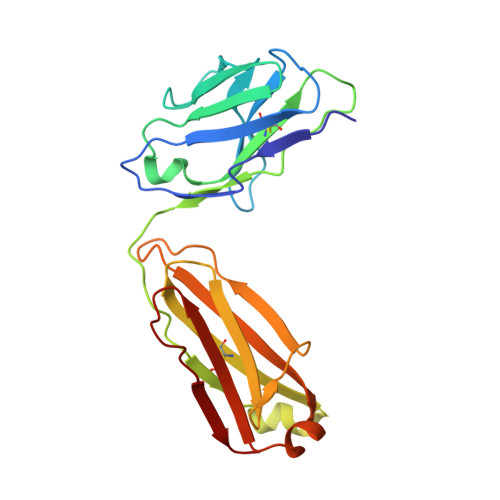
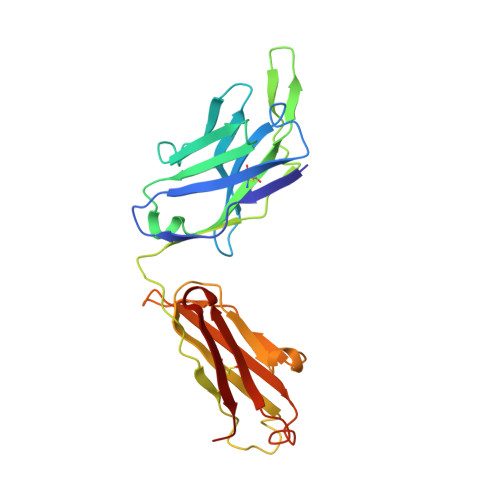
8SXP | pdb_00008sxp

Crystal structure of long neurotoxin from the venom of the king cobra (3FTx-L15) in complex with Fab of broadly neutralizing antibody 95Mat5


Experimental Data Snapshot

  • Method: X-RAY DIFFRACTION
  • Resolution: 2.90 Å
  • R-Value Free: 
    0.320 (Depositor), 0.331 (DCC) 
  • R-Value Work: 
    0.261 (Depositor), 0.294 (DCC) 
  • R-Value Observed: 
    0.264 (Depositor) 

Starting Model: experimental
View more details

wwPDB Validation 3D Report Full Report

Validation slider image for 8SXP

This is version 1.1 of the entry. See complete history

Literature

Synthetic development of a broadly neutralizing antibody against snake venom long-chain neurotoxins

Khalek, I.S.Senji Laxme, R.R.Nguyen, Y.T.K.Khochare, S.Patel, R.N.Woehl, J.Smith, J.M.Saye-Francisco, K.Kim, Y.Misson Mindrebo, L.Tran, Q.Kedzior, M.Bore, E.Limbo, O.Verma, M.Stanfield, R.L.Menzies, S.K.Ainsworth, S.Harrison, R.A.Burton, D.R.Sok, D.Wilson, I.A.Casewell, N.R.Sunagar, K.Jardine, J.G.

(2024) Sci Transl Med 16: eadk1867

  • DOI: https://doi.org/10.1126/scitranslmed.adk1867
  • Primary Citation Related Structures: 
    8SXP

  • PubMed Abstract: 

    Snakebite envenoming is a major global public health concern for which improved therapies are urgently needed. The antigenic diversity present in snake venom toxins from various species presents a considerable challenge to the development of a universal antivenom. Here, we used a synthetic human antibody library to find and develop an antibody that neutralizes long-chain three-finger α-neurotoxins produced by numerous medically relevant snakes. Our antibody bound diverse toxin variants with high affinity, blocked toxin binding to the nicotinic acetylcholine receptor in vitro, and protected mice from lethal venom challenge. Structural analysis of the antibody-toxin complex revealed a binding mode that mimics the receptor-toxin interaction. The overall workflow presented is generalizable for the development of antibodies that target conserved epitopes among antigenically diverse targets, and it offers a promising framework for the creation of a monoclonal antibody-based universal antivenom to treat snakebite envenoming.


  • Organizational Affiliation
    • Department of Immunology and Microbiology, Scripps Research Institute, La Jolla, CA 92037, USA.

Macromolecule Content 

  • Total Structure Weight: 54.71 kDa 
  • Atom Count: 3,830 
  • Modeled Residue Count: 507 
  • Deposited Residue Count: 508 
  • Unique protein chains: 3

Macromolecules

Find similar proteins by:|  3D Structure
Entity ID: 1
MoleculeChains  Sequence LengthOrganismDetailsImage
95Mat5 Fab light chainA [auth L]212Homo sapiensMutation(s): 0 
Find similar proteins by:|  3D Structure
Entity ID: 2
MoleculeChains  Sequence LengthOrganismDetailsImage
Long neurotoxin 2B [auth C]68Ophiophagus hannahMutation(s): 0 
UniProt
Find proteins for P01386 (Ophiophagus hannah)
Explore P01386 
Go to UniProtKB:  P01386
Entity Groups
Sequence Clusters30% Identity50% Identity70% Identity90% Identity95% Identity100% Identity
UniProt GroupP01386
Sequence Annotations
Expand
Reference Sequence
Find similar proteins by:|  3D Structure
Entity ID: 3
MoleculeChains  Sequence LengthOrganismDetailsImage
95Mat5 Fab heavy chainC [auth H]228Homo sapiensMutation(s): 0 

Experimental Data & Validation

Experimental Data

  • Method: X-RAY DIFFRACTION
  • Resolution: 2.90 Å
  • R-Value Free:  0.320 (Depositor), 0.331 (DCC) 
  • R-Value Work:  0.261 (Depositor), 0.294 (DCC) 
  • R-Value Observed: 0.264 (Depositor) 
Space Group: C 1 2 1
Unit Cell:
Length ( Å )Angle ( ˚ )
a = 135.86α = 90
b = 42.443β = 103.7
c = 103.356γ = 90
Software Package:
Software NamePurpose
PHENIXrefinement
HKL-2000data scaling
HKL-2000data reduction
PHENIXphasing

Structure Validation

View Full Validation Report


Entry History 

& Funding Information

Deposition Data


Funding OrganizationLocationGrant Number
Wellcome TrustUnited Kingdom221705

Revision History  (Full details and data files)

  • Version 1.0: 2024-03-20
    Type: Initial release
  • Version 1.1: 2024-11-13
    Changes: Structure summary