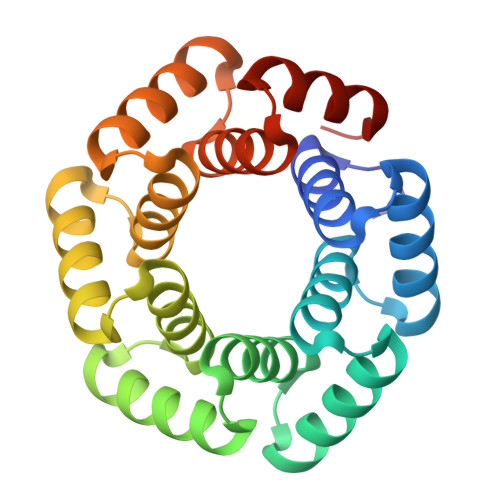
8S6P | pdb_00008s6p

Crystal structure of a computationally designed protein bound to a Ru-containing cofactor


Experimental Data Snapshot

  • Method: X-RAY DIFFRACTION
  • Resolution: 2.90 Å
  • R-Value Free: 
    0.318 (Depositor), 0.297 (DCC) 
  • R-Value Work: 
    0.263 (Depositor), 0.255 (DCC) 

Starting Model: experimental
View more details

wwPDB Validation   3D Report Full Report


Ligand Structure Quality Assessment 


This is version 1.1 of the entry. See complete history


Literature

De novo design and evolution of an artificial metathase for cytoplasmic olefin metathesis.

Zou, Z.Kalvet, I.Lozhkin, B.Morris, E.Zhang, K.Chen, D.Ernst, M.L.Zhang, X.Baker, D.Ward, T.R.

(2025) Nat Catal 8: 1208-1219

  • DOI: https://doi.org/10.1038/s41929-025-01436-0
  • Primary Citation of Related Structures:  
    8S6P, 9GVF, 9H3C

  • PubMed Abstract: 

    Artificial metalloenzymes present a promising avenue for abiotic catalysis within living systems. However, their in vivo application is currently limited by critical challenges, particularly in selecting suitable protein scaffolds capable of binding abiotic cofactors and maintaining catalytic activity in complex media. Here we address these limitations by introducing an artificial metathase-an artificial metalloenzyme designed for ring-closing metathesis-for whole-cell biocatalysis. Our approach integrates a tailored metal cofactor into a hyper-stable, de novo-designed protein. By combining computational design with genetic optimization, a binding affinity ( K D  ≤ 0.2 μM) between the protein scaffold and cofactor is achieved through supramolecular anchoring. Directed evolution of the artificial metathase yielded variants exhibiting excellent catalytic performance (turnover number ≥1,000) and biocompatibility. This work represents a pronounced leap in the de novo design and in cellulo engineering of artificial metalloenzymes, paving the way for abiological catalysis in living systems.


  • Organizational Affiliation
    • Department of Chemistry, University of Basel, Basel, Switzerland.

Macromolecules
Find similar proteins by:  (by identity cutoff)  |  3D Structure
Entity ID: 1
MoleculeChains Sequence LengthOrganismDetailsImage
TRP_18 F116W (R0)215synthetic constructMutation(s): 0 
Entity Groups  
Sequence Clusters30% Identity50% Identity70% Identity90% Identity95% Identity100% Identity
Sequence Annotations
Expand
  • Reference Sequence
Small Molecules
Ligands 1 Unique
IDChains Name / Formula / InChI Key2D Diagram3D Interactions
A1IPF (Subject of Investigation/LOI)
Query on A1IPF

Download Ideal Coordinates CCD File 
B [auth A](3~{a}~{S},8~{a}~{R})-2-[8,8-bis(chloranyl)-7-propan-2-yl-7$l^{3}-oxa-8$l^{5}-ruthenabicyclo[4.3.0]nona-1(6),2,4-trien-8-yl]-1,3-bis(2,4,6-trimethylphenyl)-3~{a},7,8,8~{a}-tetrahydroimidazo[4,5-d][1,2,7]thiadiazepine 6,6-dioxide
C33 H44 Cl2 N4 O3 Ru S
IJZBEQMJAGTRMB-ZPVXIRCVSA-L
Experimental Data & Validation

Experimental Data

  • Method: X-RAY DIFFRACTION
  • Resolution: 2.90 Å
  • R-Value Free:  0.318 (Depositor), 0.297 (DCC) 
  • R-Value Work:  0.263 (Depositor), 0.255 (DCC) 
Space Group: I 2 2 2
Unit Cell:
Length ( Å )Angle ( ˚ )
a = 53.165α = 90
b = 85.142β = 90
c = 90.235γ = 90
Software Package:
Software NamePurpose
REFMACrefinement
DIALSdata reduction
Aimlessdata scaling
PHASERphasing

Structure Validation

View Full Validation Report


Ligand Structure Quality Assessment 


Entry History & Funding Information

Deposition Data


Funding OrganizationLocationGrant Number
Swiss National Science FoundationSwitzerland200020_212088
Swiss National Science FoundationSwitzerland200021_178760

Revision History  (Full details and data files)

  • Version 1.0: 2025-05-28
    Type: Initial release
  • Version 1.1: 2025-12-10
    Changes: Database references