8RVH | pdb_00008rvh

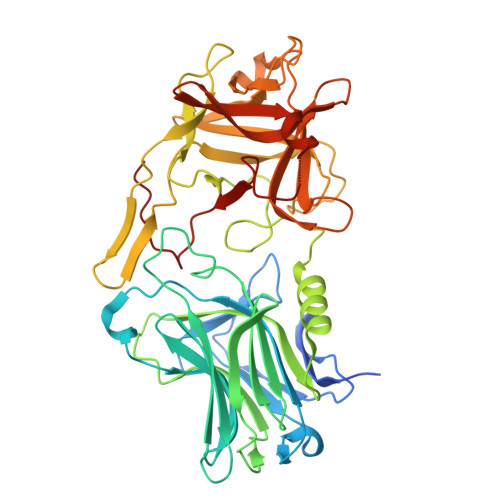
Structure of the binding domain of BoNT/A mutant Y1117V/H1253K in complex with the GD1a ganglioside receptor


Experimental Data Snapshot

  • Method: X-RAY DIFFRACTION
  • Resolution: 1.80 Å
  • R-Value Free: 
    0.207 (Depositor), 0.214 (DCC) 
  • R-Value Work: 
    0.167 (Depositor), 0.175 (DCC) 
  • R-Value Observed: 
    0.169 (Depositor) 

Starting Model: experimental
View more details

wwPDB Validation   3D Report Full Report


Ligand Structure Quality Assessment 


This is version 1.1 of the entry. See complete history


Literature

Botulinum neurotoxin A mutants with enhanced ganglioside binding show improved potency and altered ganglioside selectivity.

Masuyer, G.Rummel, A.Stenmark, P.

(2025) Commun Chem 8: 171-171

  • DOI: https://doi.org/10.1038/s42004-025-01569-0
  • Primary Citation of Related Structures:  
    8RVG, 8RVH, 8RVI

  • PubMed Abstract: 

    Botulinum neurotoxins are the causative agents of botulism, a lethal paralytic disease, but are also one of the most commonly used therapeutics for the treatment of numerous neuromuscular conditions. These toxins recognise motor nerve terminals with high specificity and affinity by using a dual binding mechanism involving gangliosides and protein receptors. The initial recognition of gangliosides is crucial for the toxins' potency. In this study, we employed a synaptosome-binding screening strategy to identify BoNT/A mutants with enhanced ganglioside-binding which translated into improved potency. X-ray crystallography and receptor-binding assays were used to elucidate the molecular mechanisms underlying the increased affinity or altered ganglioside selectivity of these mutants. Our findings provide a basis for the development of BoNT/A variants with enhanced therapeutic potential.


  • Organizational Affiliation
    • Department of Biochemistry and Biophysics, Stockholm University, 10691, Stockholm, Sweden.

Macromolecules
Find similar proteins by:  (by identity cutoff)  |  3D Structure
Entity ID: 1
MoleculeChains Sequence LengthOrganismDetailsImage
Botulinum neurotoxin A heavy chain444Clostridium botulinumMutation(s): 2 
Gene Names: botAatxbonT
UniProt
Find proteins for P0DPI0 (Clostridium botulinum)
Explore P0DPI0 
Go to UniProtKB:  P0DPI0
Entity Groups  
Sequence Clusters30% Identity50% Identity70% Identity90% Identity95% Identity100% Identity
UniProt GroupP0DPI0
Sequence Annotations
Expand
  • Reference Sequence
Oligosaccharides

Help

Entity ID: 2
MoleculeChains Length2D Diagram Glycosylation3D Interactions
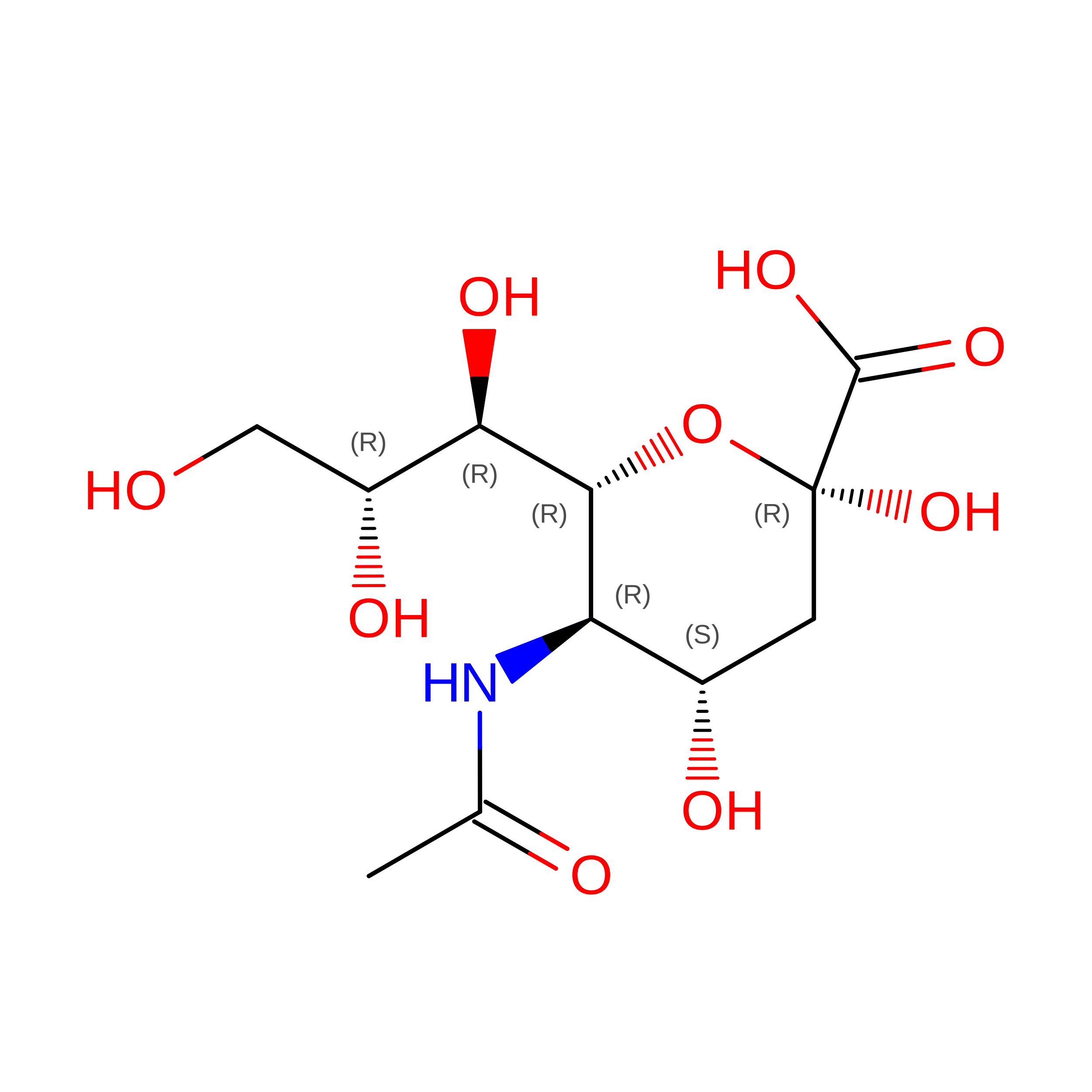
beta-D-galactopyranose-(1-3)-2-acetamido-2-deoxy-beta-D-galactopyranose-(1-4)-beta-D-galactopyranose-(1-4)-beta-D-glucopyranoseB [auth G]4N/A
Glycosylation Resources
GlyTouCan:  G21856LC
GlyCosmos:  G21856LC
GlyGen:  G21856LC
Experimental Data & Validation

Experimental Data

  • Method: X-RAY DIFFRACTION
  • Resolution: 1.80 Å
  • R-Value Free:  0.207 (Depositor), 0.214 (DCC) 
  • R-Value Work:  0.167 (Depositor), 0.175 (DCC) 
  • R-Value Observed: 0.169 (Depositor) 
Space Group: I 1 2 1
Unit Cell:
Length ( Å )Angle ( ˚ )
a = 77.637α = 90
b = 43.582β = 95.71
c = 133.211γ = 90
Software Package:
Software NamePurpose
REFMACrefinement
DIALSdata reduction
Aimlessdata scaling
PHASERphasing

Structure Validation

View Full Validation Report


Ligand Structure Quality Assessment 


Entry History & Funding Information

Deposition Data


Funding OrganizationLocationGrant Number
Swedish Research CouncilSweden--

Revision History  (Full details and data files)

  • Version 1.0: 2025-02-12
    Type: Initial release
  • Version 1.1: 2025-08-27
    Changes: Database references