Download Mendeley
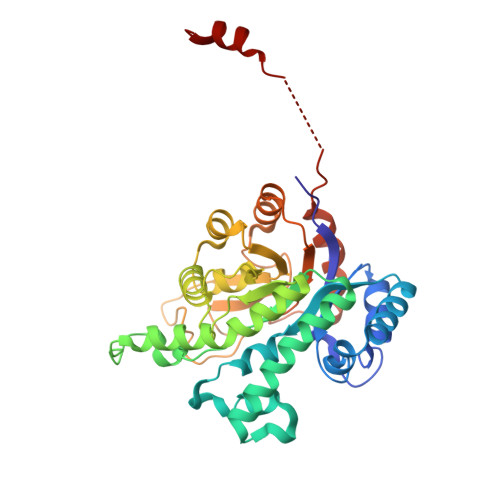
Enzyme Machinery for Bacterial Glucoside Metabolism through a Conserved Non-hydrolytic Pathway.
Kastner, K., Bitter, J., Pfeiffer, M., Grininger, C., Oberdorfer, G., Pavkov-Keller, T., Weber, H., Nidetzky, B.(2024) Angew Chem Int Ed Engl 63: e202410681-e202410681
- PubMed: 39041709 Search on PubMed
- DOI: https://doi.org/10.1002/anie.202410681
- Primary Citation Related Structures:
8RO4, 8RR2 - PubMed Abstract:
The flexible acquisition of substrates from nutrient pools is critical for microbes to prevail in competitive environments. To acquire glucose from diverse glycoside and disaccharide substrates, many free-living and symbiotic bacteria have developed, alongside hydrolysis, a non-hydrolytic pathway comprised of four biochemical steps and conferred from a single glycoside utilization gene locus (GUL). Mechanistically, this pathway integrates within the framework of oxidation and reduction at the glucosyl/glucose C3, the eliminative cleavage of the glycosidic bond and the addition of water in two consecutive lyase-catalyzed reactions. Here, based on study of enzymes from the phytopathogen Agrobacterium tumefaciens, we reveal a conserved Mn 2+ metallocenter active site in both lyases and identify the structural requirements for specific catalysis to elimination of 3-keto-glucosides and water addition to the resulting 2-hydroxy-3-keto-glycal product, yielding 3-keto-glucose. Extending our search of GUL-encoded putative lyases to the human gut commensal Bacteroides thetaiotaomicron, we discover a Ca 2+ metallocenter active site in a putative glycoside hydrolase-like protein and demonstrate its catalytic function in the eliminative cleavage of 3-keto-glucosides of opposite (α) anomeric configuration as preferred by the A. tumefaciens enzyme (β). Structural and biochemical comparisons reveal the molecular-mechanistic origin of 3-keto-glucoside lyase stereo-complementarity. Our findings identify a basic set of GUL-encoded lyases for glucoside metabolism and assign physiological significance to GUL genetic diversity in the bacterial domain of life.
- Institute of Biotechnology and Biochemical Engineering, Graz University of Technology, NAWI Graz, Petersgasse 12, A-8010, Graz, Austria.
Organizational Affiliation: