Download Mendeley
Bioinformatics and Computationally Supported Redesign of Aspartase for beta-Alanine Synthesis by Acrylic Acid Hydroamination.
Gran-Scheuch, A., Wijma, H.J., Capra, N., van Beek, H.L., Trajkovic, M., Baldenius, K., Breuer, M., Thunnissen, A.W.H., Janssen, D.B.(2025) ACS Catal 15: 928-938
- PubMed: 39839848 Search on PubMedSearch on PubMed Central
- DOI: https://doi.org/10.1021/acscatal.4c05525
- Primary Citation Related Structures:
8RJ0, 8RJ1 - PubMed Abstract:
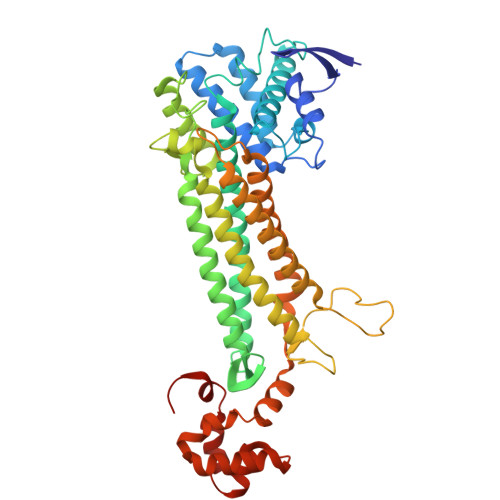
Aspartate ammonia lyases catalyze the reversible amination of fumarate to l-aspartate. Recent studies demonstrate that the thermostable enzyme from Bacillus sp. YM55-1 (AspB) can be engineered for the enantioselective production of substituted β-amino acids. This reaction would be attractive for the conversion of acrylic acid to β-alanine, which is an important building block for the preparation of bioactive compounds. Here we describe a bioinformatics and computational approach aimed at introducing the β-alanine synthesis activity. Three strategies were used: First, we redesigned the α-carboxylate binding pocket of AspB to introduce activity with the acrylic acid. Next, different template enzymes were identified by genome mining, equipped with a redesigned α-carboxylate pocket, and investigated for β-alanine synthesis, which yielded variants with better activity. Third, interactions of the SS-loop that covers the active site and harbors a catalytic serine were computationally redesigned using energy calculations to stabilize reactive conformations and thereby further increase the desired β-alanine synthesis activity. Different improved enzymes were obtained and the best variants showed k cat values with acrylic acid of at least 0.6-1.5 s -1 with K M values in the high mM range. Since the β-alanine production of wild-type enzyme was below the detection limit, this suggests that the k cat / K m was improved by at least 1000-fold. Crystal structures of the 6-fold mutant of redesigned AspB and the similarly engineered aspartase from Caenibacillus caldisaponilyticus revealed that their ligand-free structures have the SS-loop in a closed (reactive) conformation, which for wild-type AspB is only observed in the substrate-bound enzyme. AlphaFold-generated models suggest that other aspartase variants redesigned for acrylic acid hydroamination also prefer a 3D structure with the loop in a closed conformation. The combination of binding pocket redesign, genome mining, and enhanced active-site loop closure thus created effective β-alanine synthesizing variants of aspartase.
- Chemical Biotechnology, Groningen Biomolecular Sciences and Biotechnology Institute (GBB), University of Groningen, 9747 AG Groningen, the Netherlands.
Organizational Affiliation: