8RAY | pdb_00008ray

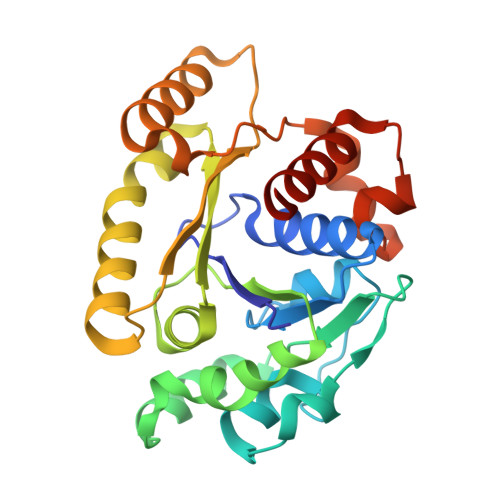
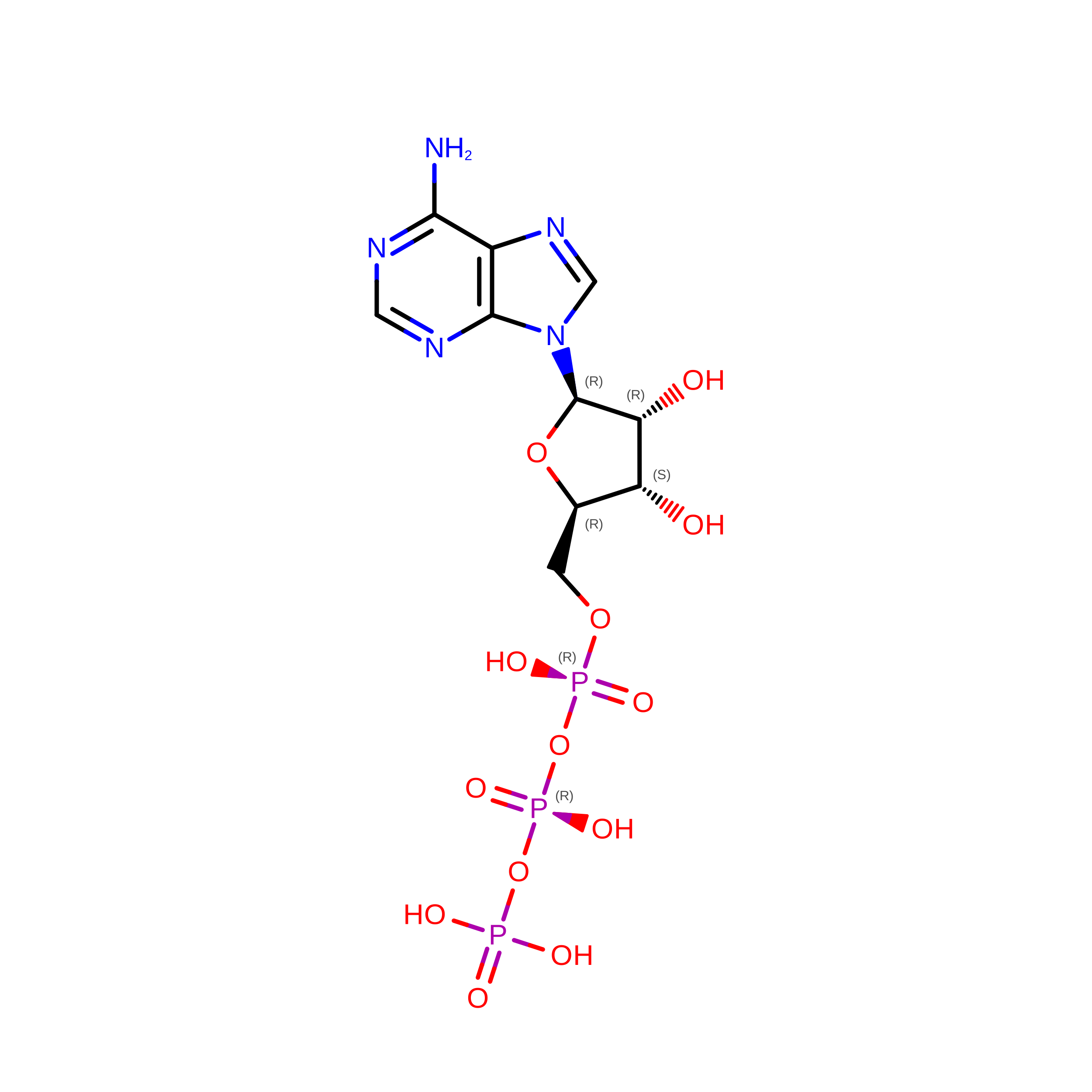
ParA in complex with ATP


Experimental Data Snapshot

  • Method: X-RAY DIFFRACTION
  • Resolution: 1.58 Å
  • R-Value Free: 
    0.200 (Depositor), 0.203 (DCC) 
  • R-Value Work: 
    0.174 (Depositor), 0.177 (DCC) 
  • R-Value Observed: 
    0.175 (Depositor) 

Starting Model: experimental
View more details

wwPDB Validation   3D Report Full Report


Ligand Structure Quality Assessment 


This is version 2.1 of the entry. See complete history


Literature

Molecular basis of ParA ATPase activation by the CTPase ParB during bacterial chromosome segregation.

Schnabel, L.Osorio-Valeriano, M.Perez-Borrajero, C.Steinchen, W.Mais, C.N.Simon, B.Hanssmann, J.Thamm, M.Hennig, J.Bange, G.Thanbichler, M.

(2025) Nat Commun 16: 8428-8428

  • DOI: https://doi.org/10.1038/s41467-025-63976-0
  • Primary Citation of Related Structures:  
    8RAY

  • PubMed Abstract: 

    DNA segregation by bacterial ParABS systems is mediated by transient tethering interactions between nucleoid-bound dimers of the ATPase ParA and centromere (parS)-associated complexes of the clamp-forming CTPase ParB. The lifetime of these interactions is limited by the ParB-dependent activation of ParA ATPase activity. Here, we elucidate the functional interplay between ParA and ParB in the model bacterium Myxococcus xanthus. We demonstrate that the N-terminal ParA-binding motif of ParB associates with a conserved bipartite binding pocket at the ParA dimer interface, in a manner dependent on ParB clamp closure. Moreover, we show that ParB and non-specific DNA interact cooperatively with ParA and synergistically induce structural changes in its Walker A and Walker B motifs that correlate with the activation of ParA ATPase activity. These results advance our understanding of the mechanism underlying DNA transport by the ParABS system and may help to unravel the mode of action of related cargo-positioning systems.


  • Organizational Affiliation
    • Department of Biology, Marburg University, Marburg, Germany.

Macromolecules
Find similar proteins by:  (by identity cutoff)  |  3D Structure
Entity ID: 1
MoleculeChains Sequence LengthOrganismDetailsImage
ParA family proteinA [auth B],
B [auth A]
255Myxococcus xanthus DK 1622Mutation(s): 1 
Gene Names: MXAN_7477
UniProt
Find proteins for Q1CVJ3 (Myxococcus xanthus (strain DK1622))
Explore Q1CVJ3 
Go to UniProtKB:  Q1CVJ3
Entity Groups  
Sequence Clusters30% Identity50% Identity70% Identity90% Identity95% Identity100% Identity
UniProt GroupQ1CVJ3
Sequence Annotations
Expand
  • Reference Sequence
Experimental Data & Validation

Experimental Data

  • Method: X-RAY DIFFRACTION
  • Resolution: 1.58 Å
  • R-Value Free:  0.200 (Depositor), 0.203 (DCC) 
  • R-Value Work:  0.174 (Depositor), 0.177 (DCC) 
  • R-Value Observed: 0.175 (Depositor) 
Space Group: P 21 21 21
Unit Cell:
Length ( Å )Angle ( ˚ )
a = 59.74α = 90
b = 85.78β = 90
c = 97.28γ = 90
Software Package:
Software NamePurpose
PHENIXrefinement
XDSdata reduction
XSCALEdata scaling
PHASERphasing

Structure Validation

View Full Validation Report


Ligand Structure Quality Assessment 


Entry History & Funding Information

Deposition Data


Funding OrganizationLocationGrant Number
Not funded--

Revision History  (Full details and data files)

  • Version 1.0: 2025-03-26
    Type: Initial release
  • Version 1.1: 2025-04-02
    Changes: Database references
  • Version 2.0: 2025-07-16
    Changes: Advisory, Atomic model, Data collection, Database references, Derived calculations, Structure summary
  • Version 2.1: 2025-10-08
    Changes: Database references