8R0T | pdb_00008r0t

STRUCTURE OF THE MOUSE FCGBP DIMER PROTEIN IN ITS SEMIEXTENDED CONFORMATION


Experimental Data Snapshot

  • Method: ELECTRON MICROSCOPY
  • Resolution: 3.90 Å
  • Aggregation State: PARTICLE 
  • Reconstruction Method: SINGLE PARTICLE 

wwPDB Validation 3D Report Full Report

Validation slider image for 8R0T

This is version 1.2 of the entry. See complete history

Literature

The structure of FCGBP is formed as a disulfide-mediated homodimer between its C-terminal domains.

Ehrencrona, E.Gallego, P.Trillo-Muyo, S.Garcia-Bonete, M.J.Recktenwald, C.V.Hansson, G.C.Johansson, M.E.V.

(2025) FEBS J 292: 582-601

  • DOI: https://doi.org/10.1111/febs.17383
  • Primary Citation Related Structures: 
    8R0T, 8RDE

  • PubMed Abstract: 

    Mucus in the colon is crucial for intestinal homeostasis by forming a barrier that separates microbes from the epithelium. This is achieved by the structural arrangement of the major mucus proteins, such as MUC2 and FCGBP, both of which are comprised of several von Willebrand D domains (vWD) and assemblies. Numerous disulfide bonds stabilise these domains, and intermolecular bonds generate multimers of MUC2. The oligomeric nature of FCGBP is not known. Human hFCGBP contains 13 vWD domains whereas mouse mFCGBP consists of only 7. We found unpaired cysteines in the vWD1 (human and mouse) and vWD5 (mouse)/vWD11 (human) assemblies which were not involved in disulfide bonds. However, the most C-terminal vWD domains, vWD7 (mouse)/vWD13 (human), formed disulfide-linked dimers. The intermolecular bond between C 5284 and C 5403 of human hFCGBP was observed by using mass spectrometry to generate the dimer. Cryo-EM structure analysis of recombinant mouse mFCGBP revealed a compact dimer with two symmetric intermolecular disulfide bonds between C 2462 and C 2581 , corresponding to the dimerising cysteines in the human hFCGBP. This compact conformation involves interactions between the vWD assemblies, but although the domains involved at the interface are the same, the nature of the interactions differ. Mouse mFCGBP was also found to exist in a semi-extended conformation. These different interactions offer insights into the dynamic nature of the FCGBP homodimer.


  • Organizational Affiliation
    • Department of Medical Biochemistry and Cell Biology, Institute of Biomedicine, University of Gothenburg, Sweden.

Macromolecule Content 

  • Total Structure Weight: 373.46 kDa 
  • Atom Count: 11,461 
  • Modeled Residue Count: 1,534 
  • Deposited Residue Count: 3,491 
  • Unique protein chains: 3

Macromolecules

Find similar proteins by:|  3D Structure
Entity ID: 1
MoleculeChains  Sequence LengthOrganismDetailsImage
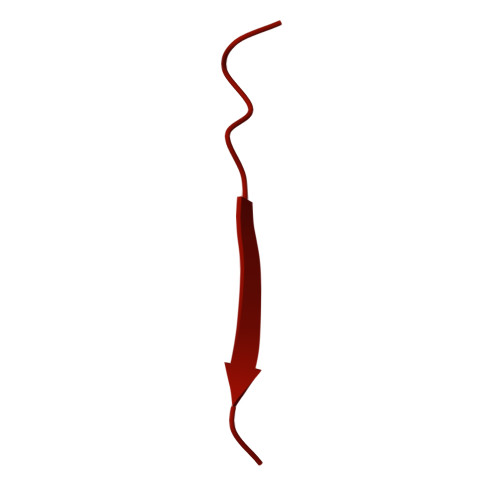
Fc fragment of IgG binding protein1,232Mus musculusMutation(s): 0 
Gene Names: Fcgbp
UniProt & NIH Common Fund Data Resources
Find proteins for E9Q0B5 (Mus musculus)
Explore E9Q0B5 
Go to UniProtKB:  E9Q0B5
IMPC:  MGI:2444336
Entity Groups
Sequence Clusters30% Identity50% Identity70% Identity90% Identity95% Identity100% Identity
UniProt GroupE9Q0B5
Glycosylation
Glycosylation Sites: 1
Sequence Annotations
Expand
Reference Sequence
Find similar proteins by:|  3D Structure
Entity ID: 2
MoleculeChains  Sequence LengthOrganismDetailsImage
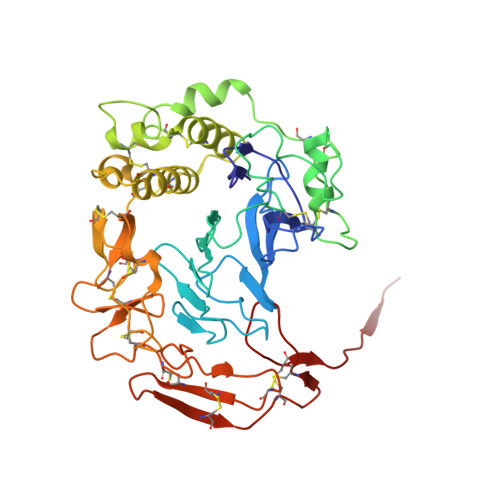
Fc fragment of IgG binding protein399Mus musculusMutation(s): 0 
Gene Names: Fcgbp
UniProt & NIH Common Fund Data Resources
Find proteins for E9Q0B5 (Mus musculus)
Explore E9Q0B5 
Go to UniProtKB:  E9Q0B5
IMPC:  MGI:2444336
Entity Groups
Sequence Clusters30% Identity50% Identity70% Identity90% Identity95% Identity100% Identity
UniProt GroupE9Q0B5
Glycosylation
Glycosylation Sites: 1
Sequence Annotations
Expand
Reference Sequence
Find similar proteins by:|  3D Structure
Entity ID: 3
MoleculeChains  Sequence LengthOrganismDetailsImage
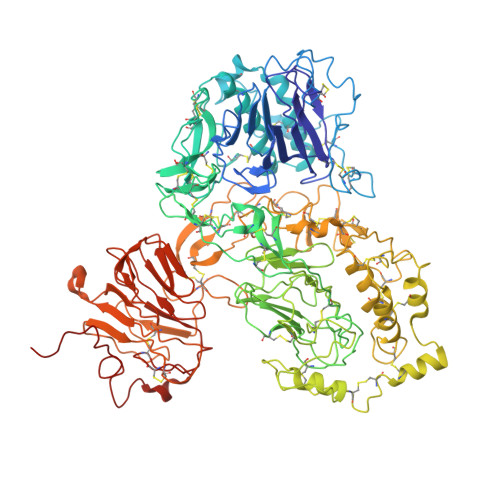
Fc fragment of IgG binding proteinC,
D [auth F]
930Mus musculusMutation(s): 0 
Gene Names: Fcgbp
UniProt & NIH Common Fund Data Resources
Find proteins for E9Q0B5 (Mus musculus)
Explore E9Q0B5 
Go to UniProtKB:  E9Q0B5
IMPC:  MGI:2444336
Entity Groups
Sequence Clusters30% Identity50% Identity70% Identity90% Identity95% Identity100% Identity
UniProt GroupE9Q0B5
Glycosylation
Glycosylation Sites: 1
Sequence Annotations
Expand
Reference Sequence

Small Molecules

Ligands 2 Unique
IDChains Name / Formula / InChI Key2D Diagram3D Interactions
NAG

Query on NAG


Download:Ideal Coordinates CCD File
E [auth A]
F [auth B]
H [auth C]
I [auth C]
J [auth C]
E [auth A],
F [auth B],
H [auth C],
I [auth C],
J [auth C],
K [auth C],
N [auth F]
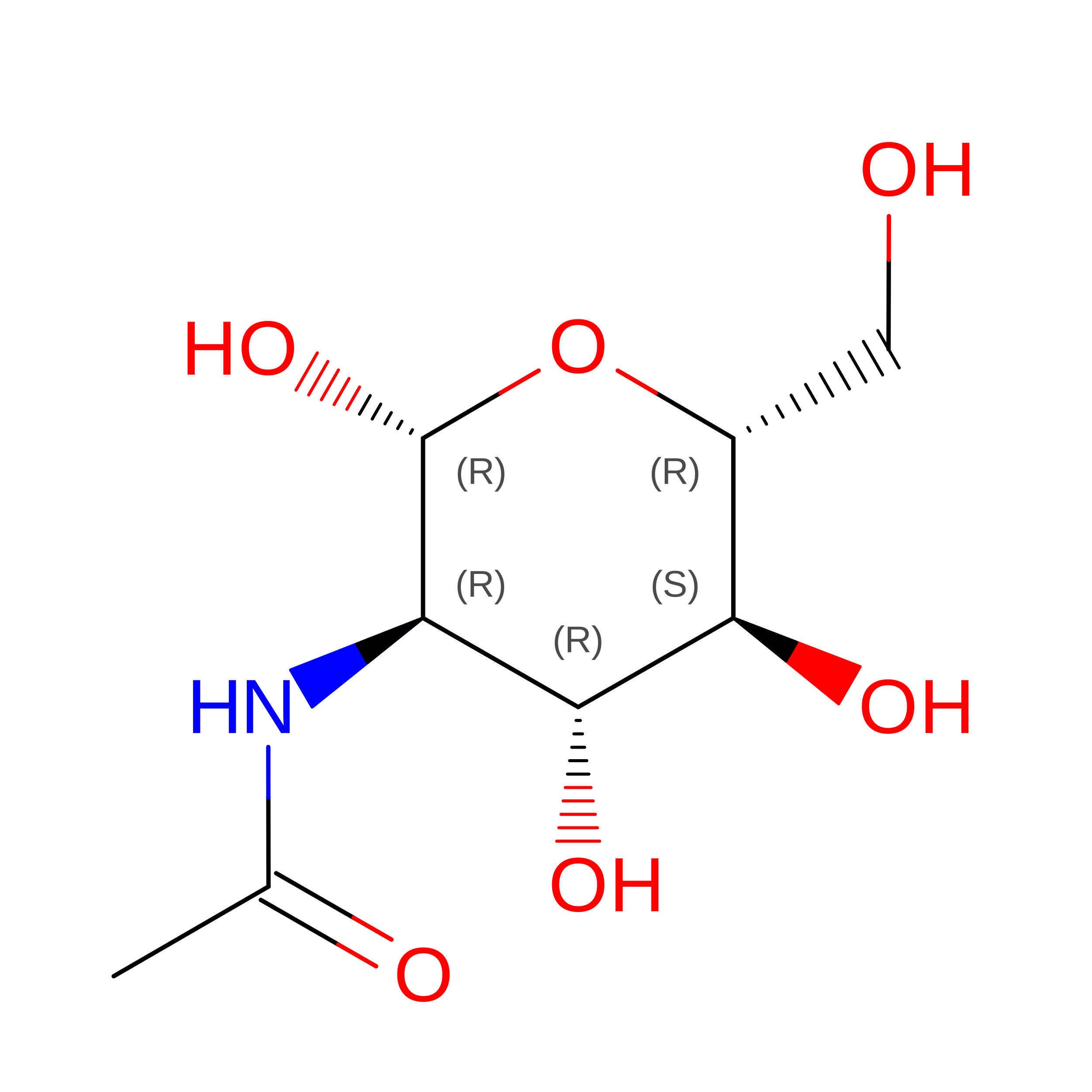
2-acetamido-2-deoxy-beta-D-glucopyranose
C8 H15 N O6
OVRNDRQMDRJTHS-FMDGEEDCSA-N
CA

Query on CA


Download:Ideal Coordinates CCD File
G [auth B],
L [auth C],
M [auth C],
O [auth F]
CALCIUM ION
Ca
BHPQYMZQTOCNFJ-UHFFFAOYSA-N

Experimental Data & Validation

Experimental Data

  • Method: ELECTRON MICROSCOPY
  • Resolution: 3.90 Å
  • Aggregation State: PARTICLE 
  • Reconstruction Method: SINGLE PARTICLE 

Structure Validation

View Full Validation Report


Entry History 

& Funding Information

Deposition Data


Funding OrganizationLocationGrant Number
Other privateSweden--

Revision History  (Full details and data files)

  • Version 1.0: 2025-01-08
    Type: Initial release
  • Version 1.1: 2025-01-22
    Changes: Data collection, Database references
  • Version 1.2: 2025-02-12
    Changes: Data collection, Database references