8QAT | pdb_00008qat

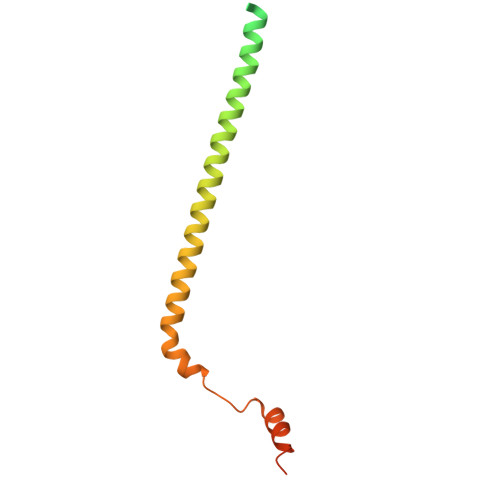
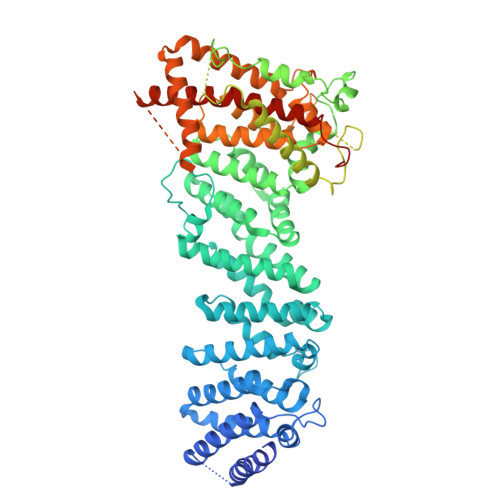
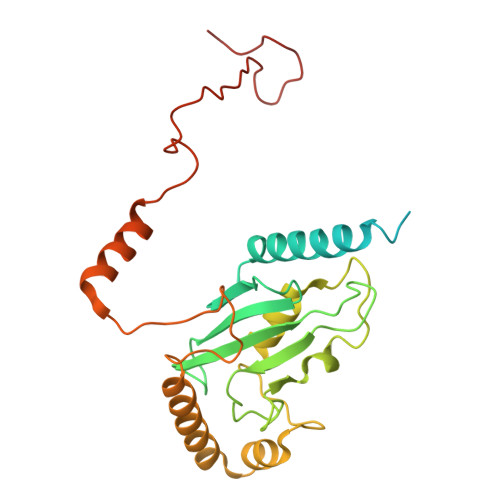
Cryo-EM structure of Fts-Hook3-FHIP1B at 3.2 A resolution.


Experimental Data Snapshot

  • Method: ELECTRON MICROSCOPY
  • Resolution: 3.20 Å
  • Aggregation State: PARTICLE 
  • Reconstruction Method: SINGLE PARTICLE 

Starting Model: in silico
View more details

wwPDB Validation   3D Report Full Report


This is version 1.2 of the entry. See complete history


Literature

KIF1C activates and extends dynein movement through the FHF cargo adapter.

Abid Ali, F.Zwetsloot, A.J.Stone, C.E.Morgan, T.E.Wademan, R.F.Carter, A.P.Straube, A.

(2025) Nat Struct Mol Biol 32: 756-766

  • DOI: https://doi.org/10.1038/s41594-024-01418-z
  • Primary Citation of Related Structures:  
    8QAT

  • PubMed Abstract: 

    Cellular cargos move bidirectionally on microtubules by recruiting opposite polarity motors dynein and kinesin. These motors show codependence, where one requires the activity of the other, although the mechanism is unknown. Here we show that kinesin-3 KIF1C acts as both an activator and a processivity factor for dynein, using in vitro reconstitutions of human proteins. Activation requires only a fragment of the KIF1C nonmotor stalk binding the cargo adapter HOOK3. The interaction site is separate from the constitutive factors FTS and FHIP, which link HOOK3 to small G-proteins on cargos. We provide a structural model for the autoinhibited FTS-HOOK3-FHIP1B (an FHF complex) and explain how KIF1C relieves it. Collectively, we explain codependency by revealing how mutual activation of dynein and kinesin occurs through their shared adapter. Many adapters bind both dynein and kinesins, suggesting this mechanism could be generalized to other bidirectional complexes.


  • Organizational Affiliation
    • MRC Laboratory of Molecular Biology, Cambridge, UK.

Macromolecules
Find similar proteins by:  (by identity cutoff)  |  3D Structure
Entity ID: 1
MoleculeChains Sequence LengthOrganismDetailsImage
Protein Hook homolog 3
A, B
148Homo sapiensMutation(s): 0 
Gene Names: HOOK3
UniProt & NIH Common Fund Data Resources
Find proteins for Q86VS8 (Homo sapiens)
Explore Q86VS8 
Go to UniProtKB:  Q86VS8
PHAROS:  Q86VS8
GTEx:  ENSG00000168172 
Entity Groups  
Sequence Clusters30% Identity50% Identity70% Identity90% Identity95% Identity100% Identity
UniProt GroupQ86VS8
Sequence Annotations
Expand
  • Reference Sequence
Find similar proteins by:  (by identity cutoff)  |  3D Structure
Entity ID: 2
MoleculeChains Sequence LengthOrganismDetailsImage
FHF complex subunit HOOK-interacting protein 1B972Homo sapiensMutation(s): 0 
Gene Names: FHIP1B
UniProt & NIH Common Fund Data Resources
Find proteins for Q8N612 (Homo sapiens)
Explore Q8N612 
Go to UniProtKB:  Q8N612
PHAROS:  Q8N612
GTEx:  ENSG00000051009 
Entity Groups  
Sequence Clusters30% Identity50% Identity70% Identity90% Identity95% Identity100% Identity
UniProt GroupQ8N612
Sequence Annotations
Expand
  • Reference Sequence
Find similar proteins by:  (by identity cutoff)  |  3D Structure
Entity ID: 3
MoleculeChains Sequence LengthOrganismDetailsImage
AKT-interacting protein292Homo sapiensMutation(s): 0 
Gene Names: AKTIP
UniProt & NIH Common Fund Data Resources
Find proteins for Q9H8T0 (Homo sapiens)
Explore Q9H8T0 
Go to UniProtKB:  Q9H8T0
PHAROS:  Q9H8T0
GTEx:  ENSG00000166971 
Entity Groups  
Sequence Clusters30% Identity50% Identity70% Identity90% Identity95% Identity100% Identity
UniProt GroupQ9H8T0
Sequence Annotations
Expand
  • Reference Sequence
Experimental Data & Validation

Experimental Data

  • Method: ELECTRON MICROSCOPY
  • Resolution: 3.20 Å
  • Aggregation State: PARTICLE 
  • Reconstruction Method: SINGLE PARTICLE 

Structure Validation

View Full Validation Report


Entry History & Funding Information

Deposition Data


Funding OrganizationLocationGrant Number
Medical Research Council (MRC, United Kingdom)United Kingdom--
Wellcome TrustUnited Kingdom--

Revision History  (Full details and data files)

  • Version 1.0: 2024-09-04
    Type: Initial release
  • Version 1.1: 2025-01-15
    Changes: Data collection, Database references, Structure summary
  • Version 1.2: 2025-04-23
    Changes: Data collection, Database references