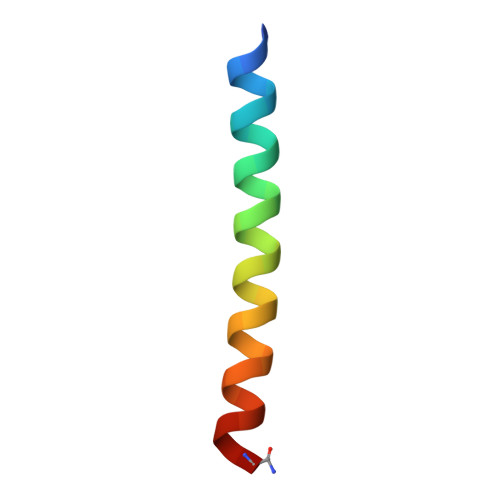
8QAA | pdb_00008qaa

X-ray crystal structure of a de novo designed antiparallel coiled-coil 6-helix bundle with 4 heptad repeats, antiparallel 6-helix bundle-ALIA


Experimental Data Snapshot

  • Method: X-RAY DIFFRACTION
  • Resolution: 1.60 Å
  • R-Value Free: 
    0.224 (Depositor), 0.226 (DCC) 
  • R-Value Work: 
    0.181 (Depositor), 0.181 (DCC) 
  • R-Value Observed: 
    0.183 (Depositor) 

wwPDB Validation 3D Report Full Report

Validation slider image for 8QAA

This is version 1.2 of the entry. See complete history

Literature

Rationally seeded computational protein design of ɑ-helical barrels.

Albanese, K.I.Petrenas, R.Pirro, F.Naudin, E.A.Borucu, U.Dawson, W.M.Scott, D.A.Leggett, G.J.Weiner, O.D.Oliver, T.A.A.Woolfson, D.N.

(2024) Nat Chem Biol 20: 991-999

  • DOI: https://doi.org/10.1038/s41589-024-01642-0
  • Primary Citation Related Structures: 
    8QAA, 8QAB, 8QAC, 8QAD, 8QAE, 8QAF, 8QAG, 8QAH, 8QAI, 8QKD

  • PubMed Abstract: 

    Computational protein design is advancing rapidly. Here we describe efficient routes starting from validated parallel and antiparallel peptide assemblies to design two families of α-helical barrel proteins with central channels that bind small molecules. Computational designs are seeded by the sequences and structures of defined de novo oligomeric barrel-forming peptides, and adjacent helices are connected by loop building. For targets with antiparallel helices, short loops are sufficient. However, targets with parallel helices require longer connectors; namely, an outer layer of helix-turn-helix-turn-helix motifs that are packed onto the barrels. Throughout these computational pipelines, residues that define open states of the barrels are maintained. This minimizes sequence sampling, accelerating the design process. For each of six targets, just two to six synthetic genes are made for expression in Escherichia coli. On average, 70% of these genes express to give soluble monomeric proteins that are fully characterized, including high-resolution structures for most targets that match the design models with high accuracy.


  • Organizational Affiliation
    • School of Chemistry, University of Bristol, Bristol, UK.

Macromolecule Content 

  • Total Structure Weight: 19.41 kDa 
  • Atom Count: 1,437 
  • Modeled Residue Count: 190 
  • Deposited Residue Count: 192 
  • Unique protein chains: 1

Macromolecules

Find similar proteins by:|  3D Structure
Entity ID: 1
MoleculeChains  Sequence LengthOrganismDetailsImage
antiparallel 6-helix bundle-ALIA
A, B, C, D, E
A, B, C, D, E, F
32synthetic constructMutation(s): 0 

Experimental Data & Validation

Experimental Data

  • Method: X-RAY DIFFRACTION
  • Resolution: 1.60 Å
  • R-Value Free:  0.224 (Depositor), 0.226 (DCC) 
  • R-Value Work:  0.181 (Depositor), 0.181 (DCC) 
  • R-Value Observed: 0.183 (Depositor) 
Space Group: P 1 21 1
Unit Cell:
Length ( Å )Angle ( ˚ )
a = 29.274α = 90
b = 89.496β = 115.21
c = 32.667γ = 90
Software Package:
Software NamePurpose
PHENIXrefinement
DIALSdata reduction
DIALSdata scaling
Arcimboldophasing

Structure Validation

View Full Validation Report


Entry History 

& Funding Information

Deposition Data


Funding OrganizationLocationGrant Number
Max Planck Bristol Centre for Minimal Biology - University of BristolUnited Kingdom--

Revision History  (Full details and data files)

  • Version 1.0: 2024-07-03
    Type: Initial release
  • Version 1.1: 2024-08-07
    Changes: Database references
  • Version 1.2: 2024-11-20
    Changes: Structure summary