Find PDB structures and Computed Structure Models (CSM) by combining queries from tools in this suite: Attribute Search, Sequence Similarity, Sequence Motif, 3D Similarity, and 3D Motif with 'AND' logic.
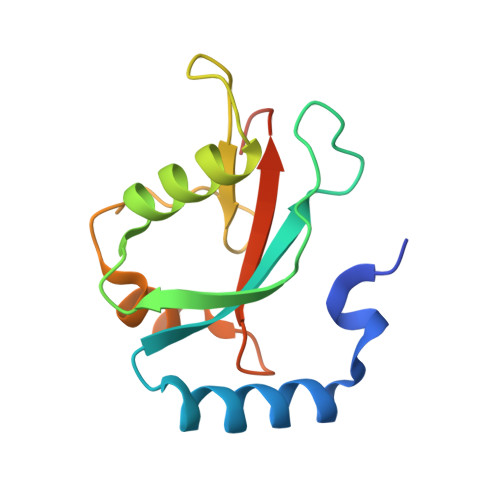
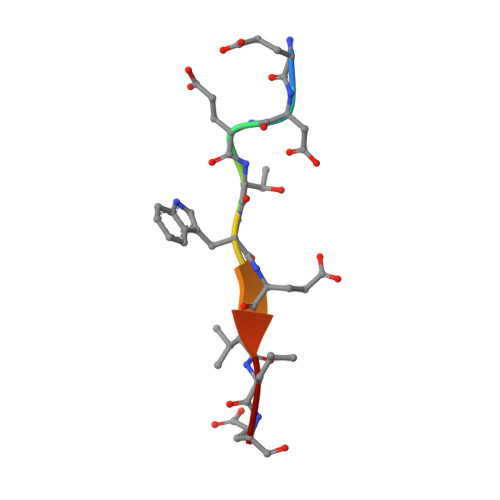
The autophagy-lysosome system directs the degradation of a wide variety of cargo and is also involved in tumor progression. Here, we show that the immunity-related GTPase family Q protein (IRGQ), an uncharacterized protein to date, acts in the quality control of major histocompatibility complex class I (MHC class I) molecules. IRGQ directs misfolded MHC class I toward lysosomal degradation through its binding mode to GABARAPL2 and LC3B. In the absence of IRGQ, free MHC class I heavy chains do not only accumulate in the cell but are also transported to the cell surface, thereby promoting an immune response. Mice and human patients suffering from hepatocellular carcinoma show improved survival rates with reduced IRGQ levels due to increased reactivity of CD8+ T cells toward IRGQ knockout tumor cells. Thus, we reveal IRGQ as a regulator of MHC class I quality control, mediating tumor immune evasion.
Organizational Affiliation:
Institute of Biochemistry II, Goethe University Frankfurt, Medical Faculty, Theodor-Stern-Kai 7, 60590 Frankfurt am Main, Germany. Electronic address: lina.herhaus@gmail.com.
Institute of Biochemistry II, Goethe University Frankfurt, Medical Faculty, Theodor-Stern-Kai 7, 60590 Frankfurt am Main, Germany.
Division of Radiation and Genome Stability, Department of Radiation Oncology, Dana-Farber Cancer Institute, Harvard Institutes of Medicine, 450 Brookline Avenue, Boston, MA 02215, USA; Department of Cell Biology, Harvard Medical School, 240 Longwood Avenue, Boston, MA 02115, USA.
Institute of Biochemistry II, Goethe University Frankfurt, Medical Faculty, Theodor-Stern-Kai 7, 60590 Frankfurt am Main, Germany; Institute of Biochemistry I, Goethe University School of Medicine, Theodor-Stern-Kai 7, 60590 Frankfurt am Main, Germany.
Institute of Biochemistry II, Goethe University Frankfurt, Medical Faculty, Theodor-Stern-Kai 7, 60590 Frankfurt am Main, Germany; Buchmann Institute for Molecular Life Sciences, Goethe University Frankfurt, Riedberg Campus, Max-von-Laue-Straße 15, 60438 Frankfurt am Main, Germany.
Institute of Biochemistry II, Goethe University Frankfurt, Medical Faculty, Theodor-Stern-Kai 7, 60590 Frankfurt am Main, Germany; Buchmann Institute for Molecular Life Sciences, Goethe University Frankfurt, Riedberg Campus, Max-von-Laue-Straße 15, 60438 Frankfurt am Main, Germany; Max Planck Institute of Biophysics, Goethe University Frankfurt, Riedberg Campus, 60438 Frankfurt am Main, Germany.
Institute for Immunology, University Medical Center, Johannes Gutenberg University Mainz, Mainz, Germany.
Max Planck Institute of Biophysics, Goethe University Frankfurt, Riedberg Campus, 60438 Frankfurt am Main, Germany.
Division of Radiation and Genome Stability, Department of Radiation Oncology, Dana-Farber Cancer Institute, Harvard Institutes of Medicine, 450 Brookline Avenue, Boston, MA 02215, USA.
Department of Cell and Chemical Biology, Leiden University Medical Center, Leiden, the Netherlands.
Institute of Biochemistry I, Goethe University School of Medicine, Theodor-Stern-Kai 7, 60590 Frankfurt am Main, Germany.
Department of Cell Biology, Harvard Medical School, 240 Longwood Avenue, Boston, MA 02115, USA.
Institute of Biochemistry II, Goethe University Frankfurt, Medical Faculty, Theodor-Stern-Kai 7, 60590 Frankfurt am Main, Germany; Buchmann Institute for Molecular Life Sciences, Goethe University Frankfurt, Riedberg Campus, Max-von-Laue-Straße 15, 60438 Frankfurt am Main, Germany; Max Planck Institute of Biophysics, Goethe University Frankfurt, Riedberg Campus, 60438 Frankfurt am Main, Germany. Electronic address: dikic@biochem2.uni-frankfurt.de.

 Download Mendeley