Download Mendeley
Conservative Tryptophan Residue in the Vicinity of an Active Site of the M15 Family l,d-Peptidases: A Key Element in the Catalysis.
Mikoulinskaia, G.V., Prokhorov, D.A., Chernyshov, S.V., Sitnikova, D.S., Arakelian, A.G., Uversky, V.N.(2023) Int J Mol Sci 24
- PubMed: 37686055 Search on PubMedSearch on PubMed Central
- DOI: https://doi.org/10.3390/ijms241713249
- Primary Citation Related Structures:
8P3A - PubMed Abstract:
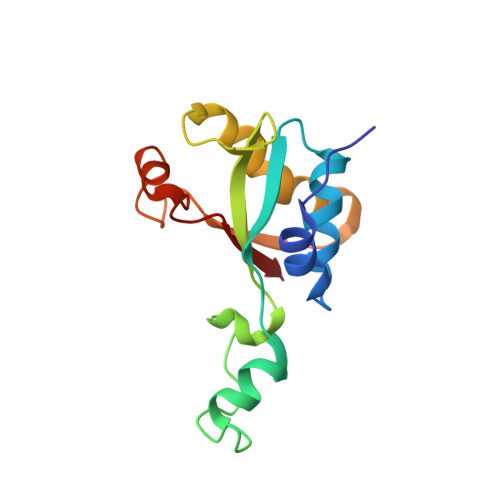
Bioinformatics analysis of the sequences of orthologous zinc-containing peptidases of the M15_C subfamily revealed the presence of a conserved tryptophan residue near the active site, which is not involved in the formation of the protein core. Site-directed mutagenesis of this Trp114/109 residue using two representatives of the family, l-alanoyl-d-glutamate peptidases of bacteriophages T5 (calcium-activated EndoT5) and RB49 (EndoRB49, without ion regulation) as examples, and further analysis of the 1 H NMR spectra of the mutants showed that a decrease in the volume of the W → F → A residue leads to changes in the hydrophobic core and active center of the protein, and also decreases the affinity for regulatory Ca 2+ in the EndoT5 mutants. The inactive T5W114A mutant lacks the ability to bind the substrate. In general, the conserved Trp114/109 residue, due to the spatial restrictions of its side chain, significantly affects the formation of the catalytically active form of the enzyme and is critical for catalysis.
- Branch of Shemyakin & Ovchinnikov's Institute of Bioorganic Chemistry, RAS, Prospekt Nauki, 6, 142290 Pushchino, Moscow Region, Russia.
Organizational Affiliation: