8OY1 | pdb_00008oy1

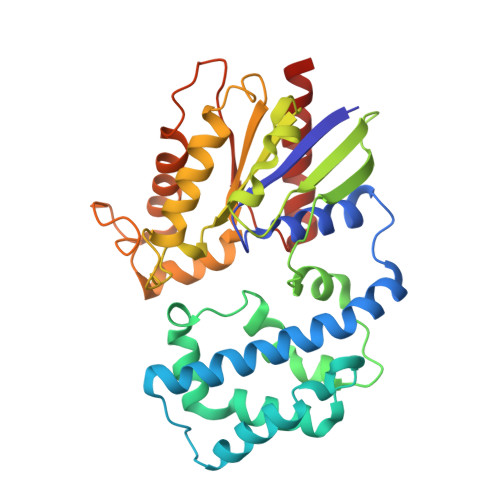
Structure of the human Guanine Nucleotide-Binding Protein G(K) Subunit Alpha


Experimental Data Snapshot

  • Method: X-RAY DIFFRACTION
  • Resolution: 3.34 Å
  • R-Value Free: 
    0.280 (Depositor), 0.290 (DCC) 
  • R-Value Work: 
    0.205 (Depositor), 0.210 (DCC) 
  • R-Value Observed: 
    0.208 (Depositor) 

Starting Model: experimental
View more details

wwPDB Validation   3D Report Full Report


Ligand Structure Quality Assessment 


This is version 1.1 of the entry. See complete history


Literature

Integrated NMR-crystallography-computational approach for molecular recognition studies of human G alpha i3 protein by a small molecule inhibitor.

Ferreras-Gutierrez, M.Minguez-Toral, M.Ibanez de Opakua, A.Martin-Santamaria, S.Garcia-Marcos, M.Medrano, F.J.Blanco, F.J.

(2024) Int J Biol Macromol 290: 138977-138977

  • DOI: https://doi.org/10.1016/j.ijbiomac.2024.138977
  • Primary Citation of Related Structures:  
    8OY1

  • PubMed Abstract: 

    The small molecule IGGi-11 targets Gαi subunits of heterotrimeric guanine nucleotide-binding proteins. Gα subunits are activated by G-protein-coupled receptors in response to extracellular stimuli by accelerating the exchange of GDP for GTP, but they are also activated by intracellular proteins like GIV, of which elevated levels correlate with increased cell migration and cancer metastasis. IGGi-11 disrupts the interaction of Gαi proteins with GIV and inhibits pro-invasive traits of metastatic breast cancer cells without interfering with GPCR signaling. IGGi-11 is a competitive inhibitor but binds Gαi3 with a 10-fold lower affinity than GIV. To guide the design of higher affinity inhibitors, we aimed at obtaining high-resolution structural data on the complex. To facilitate its crystallization, we have removed the most flexible residues at the chain ends of Gαi3, identified by NMR. While Gαi3 crystals grown with excess IGGi-11 did not show the bound compound, computational docking and molecular dynamics simulations identified the interactions driving the molecular recognition. This approach revealed heterogeneous binding due to the symmetry of IGGi-11 chemical structure and to the elongated shape and flexibility of the binding site. Our results suggest that chemical modifications breaking IGGi-11 symmetry might yield inhibitors with higher affinity and potential as antimetastatic drugs.


  • Organizational Affiliation
    • Centro de Investigaciones Biológicas Margarita Salas (CIB), CSIC, Madrid 28040, Spain.

Macromolecules
Find similar proteins by:  (by identity cutoff)  |  3D Structure
Entity ID: 1
MoleculeChains Sequence LengthOrganismDetailsImage
Guanine nucleotide-binding protein G(i) subunit alpha-3321Homo sapiensMutation(s): 0 
Gene Names: GNAI3
UniProt & NIH Common Fund Data Resources
Find proteins for P08754 (Homo sapiens)
Explore P08754 
Go to UniProtKB:  P08754
PHAROS:  P08754
GTEx:  ENSG00000065135 
Entity Groups  
Sequence Clusters30% Identity50% Identity70% Identity90% Identity95% Identity100% Identity
UniProt GroupP08754
Sequence Annotations
Expand
  • Reference Sequence
Small Molecules
Ligands 1 Unique
IDChains Name / Formula / InChI Key2D Diagram3D Interactions
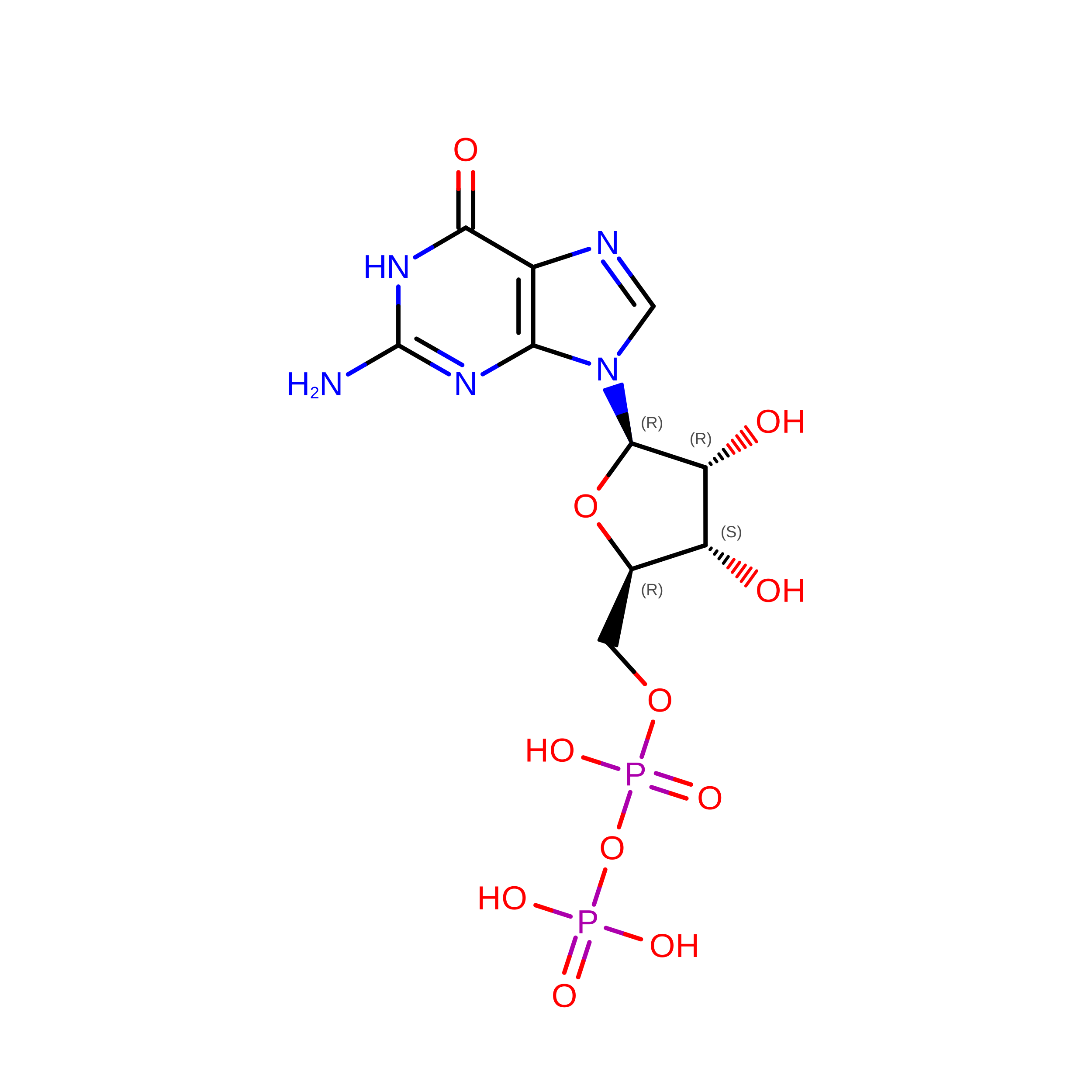
GDP
Query on GDP

Download Ideal Coordinates CCD File 
B [auth A]GUANOSINE-5'-DIPHOSPHATE
C10 H15 N5 O11 P2
QGWNDRXFNXRZMB-UUOKFMHZSA-N
Experimental Data & Validation

Experimental Data

  • Method: X-RAY DIFFRACTION
  • Resolution: 3.34 Å
  • R-Value Free:  0.280 (Depositor), 0.290 (DCC) 
  • R-Value Work:  0.205 (Depositor), 0.210 (DCC) 
  • R-Value Observed: 0.208 (Depositor) 
Space Group: P 42 21 2
Unit Cell:
Length ( Å )Angle ( ˚ )
a = 113.065α = 90
b = 113.065β = 90
c = 68.68γ = 90
Software Package:
Software NamePurpose
PHENIXrefinement
autoPROCdata reduction
XDSdata scaling
PHASERphasing

Structure Validation

View Full Validation Report


Ligand Structure Quality Assessment 


Entry History & Funding Information

Deposition Data


Funding OrganizationLocationGrant Number
Ministerio de Ciencia e Innovacion (MCIN)SpainPID2020-113225GB-I00

Revision History  (Full details and data files)

  • Version 1.0: 2024-05-15
    Type: Initial release
  • Version 1.1: 2025-01-15
    Changes: Database references, Structure summary