Download Mendeley
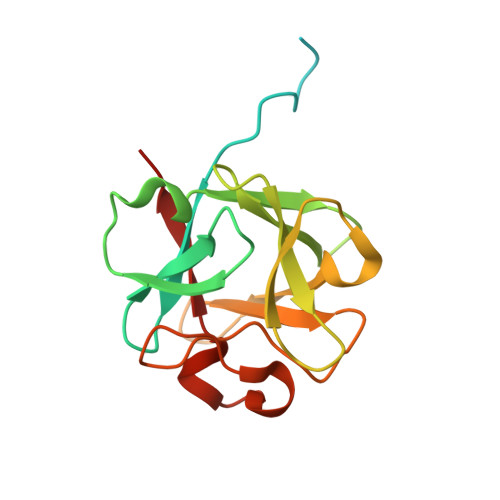
Structural analysis of the stable form of fibroblast growth factor 2 - FGF2-STAB.
de La Bourdonnaye, G., Marek, M., Ghazalova, T., Damborsky, J., Pachl, P., Brynda, J., Stepankova, V., Chaloupkova, R.(2024) J Struct Biol X 10: 100112-100112
- PubMed: 39512606 Search on PubMedSearch on PubMed Central
- DOI: https://doi.org/10.1016/j.yjsbx.2024.100112
- Primary Citation Related Structures:
8OM6 - PubMed Abstract:
Fibroblast growth factor 2 (FGF2) is a signaling protein that plays a significant role in tissue development and repair. FGF2 binds to fibroblast growth factor receptors (FGFRs) alongside its co-factor heparin, which protects FGF2 from degradation. The binding between FGF2 and FGFRs induces intracellular signaling pathways such as RAS-MAPK, PI3K-AKT, and STAT. FGF2 has strong potential for application in cell culturing, wound healing, and cosmetics but the potential is severely limited by its low protein stability. The thermostable variant FGF2-STAB was constructed by computer-assisted protein engineering to overcome the natural limitation of FGF2. Previously reported characterization of FGF2-STAB revealed an enhanced ability to induce MAP/ERK signaling while having a lower dependence on heparin when compared with FGF2-wt. Here we report the crystal structure of FGF2-STAB solved at 1.3 Å resolution. Protein stabilization is achieved by newly formed hydrophobic interactions, polar contacts, and one additional hydrogen bond. The overall structure of FGF2-STAB is similar to FGF2-wt and does not reveal information on the experimentally observed lower dependence on heparin. A noticeable difference in flexibility in the receptor binding region can explain the differences in signaling between FGF2-STAB and its wild-type counterpart. Our structural analysis provided molecular insights into the stabilization and unique biological properties of FGF2-STAB.
- Loschmidt Laboratories, Department of Experimental Biology and RECETOX, Faculty of Science, Masaryk University, Brno, Czech Republic.
Organizational Affiliation: