Download Mendeley
Structural insights into the Caprin-2 HR1 domain in canonical Wnt signaling.
Su, C., Zhong, Y., Zhou, Z., Li, Y., Jia, Y., Xie, S., Zhao, J., Miao, H., Luo, H., Li, Z., Shi, Z., Li, L., Song, X.(2024) J Biol Chem 300: 107694-107694
- PubMed: 39159816 Search on PubMedSearch on PubMed Central
- DOI: https://doi.org/10.1016/j.jbc.2024.107694
- Primary Citation Related Structures:
8K9D - PubMed Abstract:
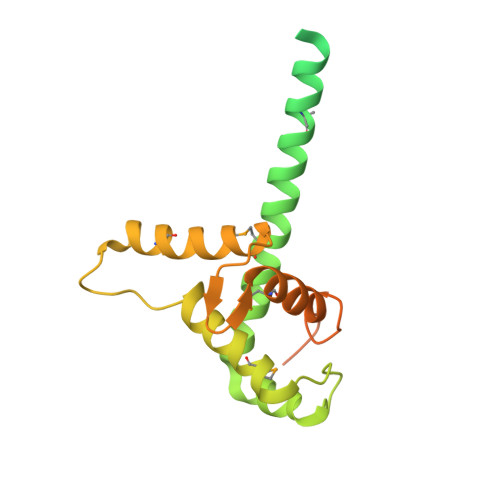
The canonical Wnt signaling pathway plays crucial roles in cell fate decisions as well as in pathogenesis of various diseases. Previously, we reported Caprin-2 as a new regulator of canonical Wnt signaling through a mechanism of facilitating LRP5/6 phosphorylation. Here, we resolved the crystal structure of the N-terminal homologous region 1 (HR1) domain of human Caprin-2. HR1 domain is so far only observed in Caprin-2 and its homologous protein Caprin-1, and the function of this domain remains largely mysterious. Here, the structure showed that HR1 domain of human Caprin-2 forms a homo-dimer and exhibits an overall structure roughly resembling the appearance of a pair of scissors. Moreover, we found that residues R200 and R201, which located at a basic cluster within the N-terminal "blades" region, are critical for Caprin-2's localization to the plasma membrane. In line with this, mutations targeting these two residues decrease Caprin-2's activity in the canonical Wnt signaling. Overall, we characterized a previously unknown "scissors"-like structure of the full-length HR1 domain and revealed its function in mediating Caprin-2's localization to the plasma membrane.
- Key Laboratory of Multi-Cell Systems, Shanghai Institute of Biochemistry and Cell Biology, Center for Excellence in Molecular Cell Science, Chinese Academy of Sciences, Shanghai, China.
Organizational Affiliation: