8K4Q | pdb_00008k4q

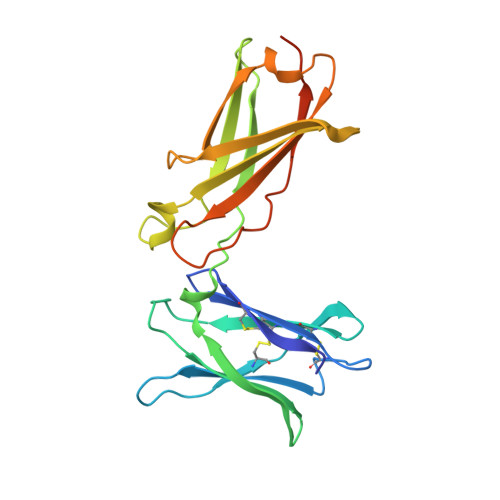
Crystal structure of nanobody HuNb103 bound to human interleukin-4 receptor subunit alpha


Experimental Data Snapshot

  • Method: X-RAY DIFFRACTION
  • Resolution: 2.59 Å
  • R-Value Free: 
    0.280 (Depositor), 0.305 (DCC) 
  • R-Value Work: 
    0.222 (Depositor), 0.261 (DCC) 
  • R-Value Observed: 
    0.225 (Depositor) 

Starting Model: in silico
View more details

wwPDB Validation 3D Report Full Report

Validation slider image for 8K4Q

Ligand Structure Quality Assessment 


This is version 1.2 of the entry. See complete history

Literature

A novel inhalable nanobody targeting IL-4R alpha for the treatment of asthma.

Zhu, M.Ma, L.Zhong, P.Huang, J.Gai, J.Li, G.Li, Y.Qiao, P.Gu, H.Li, X.Yin, Y.Zhang, L.Deng, Z.Sun, B.Chen, Z.Ding, Y.Wan, Y.

(2024) J Allergy Clin Immunol 154: 1008-1021

  • DOI: https://doi.org/10.1016/j.jaci.2024.05.027
  • Primary Citation Related Structures: 
    8K4Q

  • PubMed Abstract: 

    Inhalable biologics represent a promising approach to improve the efficacy and safety of asthma treatment. Although several mAbs targeting IL-4 receptor α chain (IL-4Rα) have been approved or are undergoing clinical trials, the development of inhalable mAbs targeting IL-4Rα presents significant challenges. Capitalizing on the distinctive advantages of nanobodies (Nbs) in maintaining efficacy during storage and administration, we sought to develop a novel inhalable IL-4Rα Nb for effectively treating asthma. Three IL-4Rα immunized Nb libraries were used to generate specific and functional IL-4Rα Nbs. LQ036, a bivalent Nb comprising 2 HuNb103 units, was constructed with a high affinity and specificity for human IL-4Rα. The efficacy, pharmacokinetics, and safety of inhaled LQ036 were evaluated in B-hIL4/hIL4RA humanized mice. LQ036 inhibited secreted embryonic alkaline phosphatase reporter activity, inhibited TF-1 cell proliferation, and suppressed phosphorylated signal transducer and activator of transduction 6 in T cells from patients with asthma. Crystal structure analysis revealed a binding region similar to dupilumab but with higher affinity, leading to better efficacy in blocking the signaling pathway. HuNb103 competed with IL-4 and IL-13 for IL-4Rα binding. Additionally, LQ036 significantly inhibited ovalbumin-specific IgE levels in serum, CCL17 levels in bronchoalveolar lavage fluid, bronchial mucous cell hyperplasia, and airway goblet cell hyperplasia in B-hIL4/hIL4RA humanized mice. Inhaled LQ036 exhibited favorable pharmacokinetics, safety, and tissue distribution, with higher concentrations observed in the lungs and bronchi. These findings from preclinical studies establish the safety and efficacy of inhaled LQ036, underscoring its potential as a pioneering inhalable biologic therapy for asthma.


  • Organizational Affiliation
    • Shanghai Novamab Biopharmaceuticals Co, Ltd, Shanghai, China.

Macromolecule Content 

  • Total Structure Weight: 78.23 kDa 
  • Atom Count: 5,304 
  • Modeled Residue Count: 633 
  • Deposited Residue Count: 670 
  • Unique protein chains: 2

Macromolecules

Find similar proteins by:|  3D Structure
Entity ID: 1
MoleculeChains  Sequence LengthOrganismDetailsImage
Interleukin-4 receptor subunit alpha
A, C
214Homo sapiensMutation(s): 0 
UniProt & NIH Common Fund Data Resources
Find proteins for P24394 (Homo sapiens)
Explore P24394 
Go to UniProtKB:  P24394
PHAROS:  P24394
GTEx:  ENSG00000077238 
Entity Groups
Sequence Clusters30% Identity50% Identity70% Identity90% Identity95% Identity100% Identity
UniProt GroupP24394
Glycosylation
Glycosylation Sites: 4Go to GlyGen: P24394-1
Sequence Annotations
Expand
Reference Sequence
Find similar proteins by:|  3D Structure
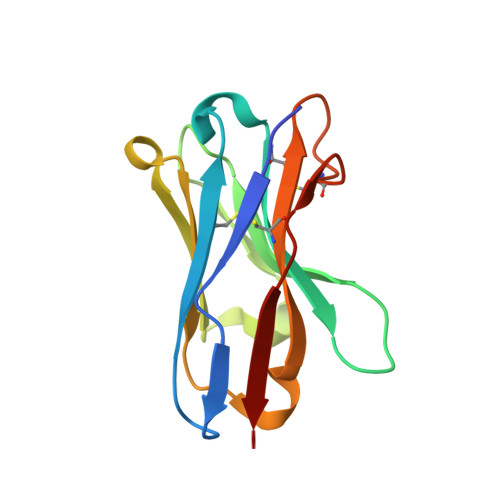
Entity ID: 2
MoleculeChains  Sequence LengthOrganismDetailsImage
IL-4R nanobody HuNb103
B, D
121Camelus dromedariusMutation(s): 0 
Entity Groups
Sequence Clusters30% Identity50% Identity70% Identity90% Identity95% Identity100% Identity
Sequence Annotations
Expand
Reference Sequence

Oligosaccharides

Help  
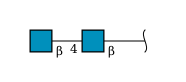
Entity ID: 3
MoleculeChains Length2D Diagram GlycosylationD Interactions
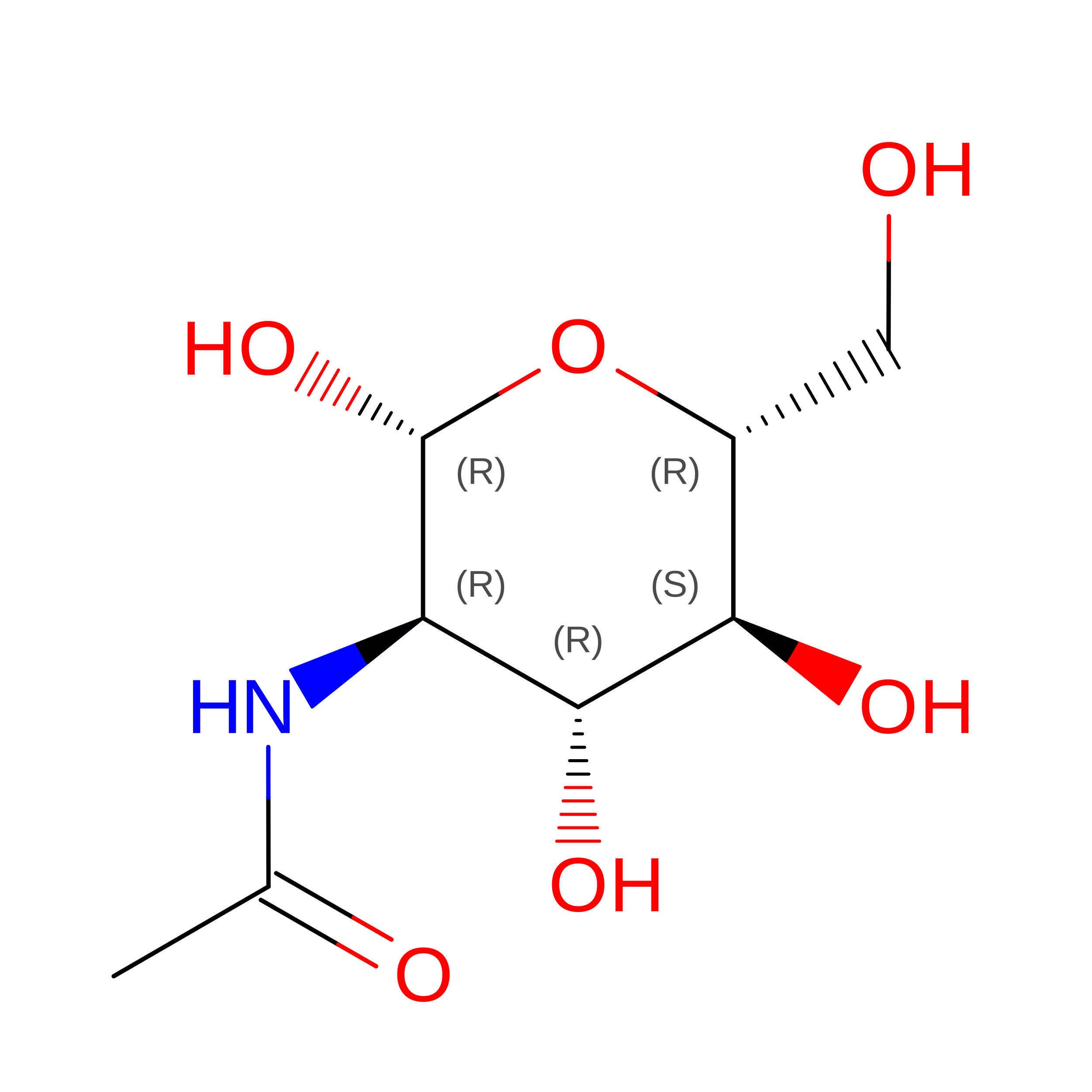
2-acetamido-2-deoxy-beta-D-glucopyranose-(1-4)-2-acetamido-2-deoxy-beta-D-glucopyranose
E, G
2N-Glycosylation
Glycosylation Resources
GlyTouCan: G42666HT
GlyCosmos: G42666HT
GlyGen: G42666HT
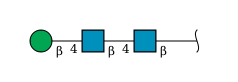
Entity ID: 4
MoleculeChains Length2D Diagram GlycosylationD Interactions
beta-D-mannopyranose-(1-4)-2-acetamido-2-deoxy-beta-D-glucopyranose-(1-4)-2-acetamido-2-deoxy-beta-D-glucopyranose
F, H
3N-Glycosylation
Glycosylation Resources
GlyTouCan: G15407YE
GlyCosmos: G15407YE
GlyGen: G15407YE

Experimental Data & Validation

Experimental Data

  • Method: X-RAY DIFFRACTION
  • Resolution: 2.59 Å
  • R-Value Free:  0.280 (Depositor), 0.305 (DCC) 
  • R-Value Work:  0.222 (Depositor), 0.261 (DCC) 
  • R-Value Observed: 0.225 (Depositor) 
Space Group: P 1 21 1
Unit Cell:
Length ( Å )Angle ( ˚ )
a = 57.87α = 90
b = 109.598β = 98.48
c = 64.167γ = 90
Software Package:
Software NamePurpose
REFMACrefinement
DIALSdata scaling
DIALSdata reduction
PHASERphasing

Structure Validation

View Full Validation Report


Ligand Structure Quality Assessment 


Entry History 

& Funding Information

Deposition Data


Funding OrganizationLocationGrant Number
National Science Foundation (NSF, China)China32070939
National Science Foundation (NSF, China)China82030106
Ministry of Science and Technology (MoST, China)China2021YFA0805200

Revision History  (Full details and data files)

  • Version 1.0: 2024-06-26
    Type: Initial release
  • Version 1.1: 2024-07-03
    Changes: Source and taxonomy
  • Version 1.2: 2024-10-23
    Changes: Database references, Structure summary