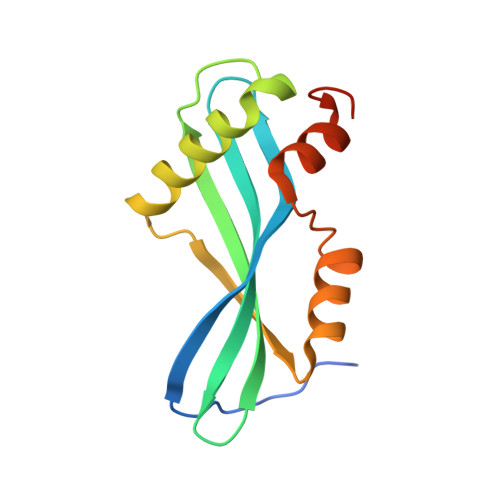
8K4M | pdb_00008k4m

Anti CRISPR protein, AcrIIA13b


Experimental Data Snapshot

  • Method: X-RAY DIFFRACTION
  • Resolution: 1.53 Å
  • R-Value Free: 
    0.237 (Depositor), 0.230 (DCC) 
  • R-Value Work: 
    0.214 (Depositor), 0.210 (DCC) 
  • R-Value Observed: 
    0.215 (Depositor) 

Starting Model: in silico
View more details

wwPDB Validation   3D Report Full Report


This is version 1.1 of the entry. See complete history


Literature

Investigating the molecular mechanisms underlying the anti-CRISPR function of AcrIIA13b protein.

Lee, S.Y.Park, H.H.

(2025) FEBS J 

  • DOI: https://doi.org/10.1111/febs.70304
  • Primary Citation of Related Structures:  
    8K4M

  • PubMed Abstract: 

    The CRISPR-Cas systems of adaptive immunity in bacteria and archaea provide resistance against phages and other mobile genetic elements. Counteractive anti-CRISPR (Acr) proteins in phages and archaeal viruses impede these CRISPR-Cas systems. Although CRISPR-Cas systems have revolutionized genome editing, potential off-target events remain a safety concern. Hence, a thorough comprehension of the structural and molecular basis of diverse Acrs is imperative to unravel the fundamental mechanisms governing CRISPR-Cas regulation. Here, we present the structure of AcrIIA13b from Staphylococcus haemolyticus and analyze its structural and functional features to reveal the molecular basis underlying the inhibition of Cas9 by AcrIIA13b. Our structural analysis shows that AcrIIA13b eliminates the cleavage activity of Staphylococcus aureus Cas9 (SauCas9) by blocking the PAM-binding region of Cas9 so that Cas9 cannot recognize the target DNA. In addition, we demonstrate that the 15 amino acid residues at the N terminus of AcrIIA13b, which were revealed to be important for its dimerization, are critical for its inhibitory activity against Cas9. Our findings shed light on the molecular basis of AcrIIA13b-mediated CRISPR-Cas inhibition and provide valuable insights into the arms race between bacteria and phages.


  • Organizational Affiliation
    • College of Pharmacy, Chung-Ang University, Seoul, Korea.

Macromolecules
Find similar proteins by:  (by identity cutoff)  |  3D Structure
Entity ID: 1
MoleculeChains Sequence LengthOrganismDetailsImage
Anti CRISPR protein137Staphylococcus haemolyticusMutation(s): 0 
UniProt
Find proteins for A0AAX7FLQ9 (Staphylococcus haemolyticus)
Explore A0AAX7FLQ9 
Go to UniProtKB:  A0AAX7FLQ9
Entity Groups  
Sequence Clusters30% Identity50% Identity70% Identity90% Identity95% Identity100% Identity
UniProt GroupA0AAX7FLQ9
Sequence Annotations
Expand
  • Reference Sequence
Experimental Data & Validation

Experimental Data

  • Method: X-RAY DIFFRACTION
  • Resolution: 1.53 Å
  • R-Value Free:  0.237 (Depositor), 0.230 (DCC) 
  • R-Value Work:  0.214 (Depositor), 0.210 (DCC) 
  • R-Value Observed: 0.215 (Depositor) 
Space Group: C 1 2 1
Unit Cell:
Length ( Å )Angle ( ˚ )
a = 102.51α = 90
b = 37.47β = 103.29
c = 37.09γ = 90
Software Package:
Software NamePurpose
PHENIXrefinement
XDSdata reduction
XDSdata scaling
PHENIXphasing

Structure Validation

View Full Validation Report


Entry History & Funding Information

Deposition Data


Funding OrganizationLocationGrant Number
National Research Foundation (NRF, Korea)Korea, Republic Of--

Revision History  (Full details and data files)

  • Version 1.0: 2024-07-24
    Type: Initial release
  • Version 1.1: 2026-02-04
    Changes: Database references, Structure summary