8JXS | pdb_00008jxs

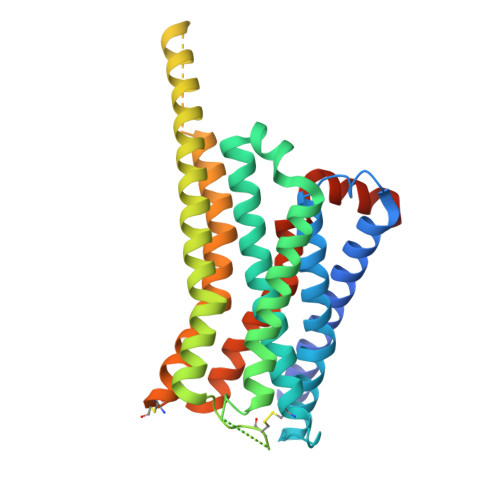
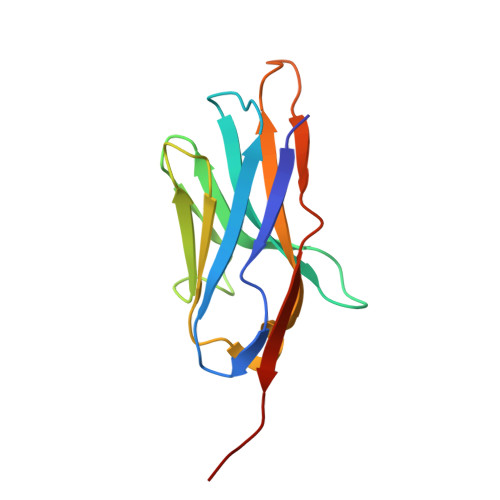
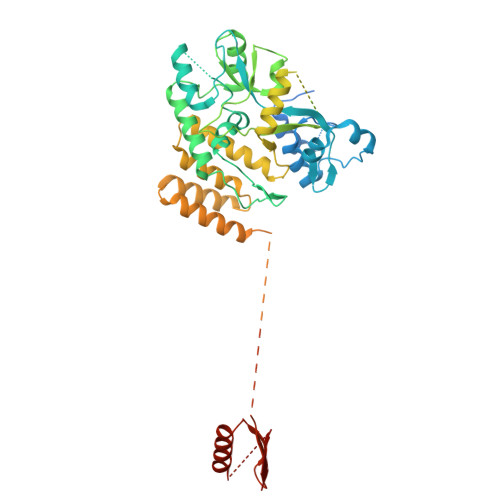
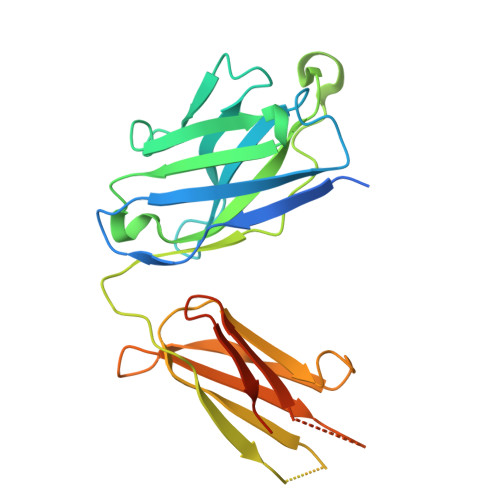
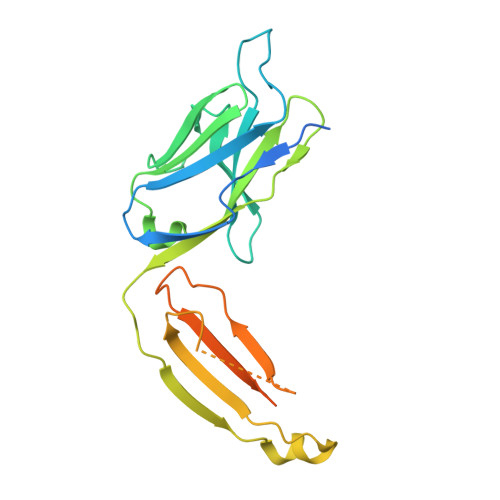
Structure of nanobody-bound DRD1_PF-6142 complex


Experimental Data Snapshot

  • Method: ELECTRON MICROSCOPY
  • Resolution: 3.00 Å
  • Aggregation State: PARTICLE 
  • Reconstruction Method: SINGLE PARTICLE 

wwPDB Validation   3D Report Full Report


This is version 1.2 of the entry. See complete history


Literature

Structural basis of psychedelic LSD recognition at dopamine D 1 receptor.

Fan, L.Zhuang, Y.Wu, H.Li, H.Xu, Y.Wang, Y.He, L.Wang, S.Chen, Z.Cheng, J.Xu, H.E.Wang, S.

(2024) Neuron 112: 3295

  • DOI: https://doi.org/10.1016/j.neuron.2024.07.003
  • Primary Citation of Related Structures:  
    8JXR, 8JXS

  • PubMed Abstract: 

    Understanding the kinetics of LSD in receptors and subsequent induced signaling is crucial for comprehending both the psychoactive and therapeutic effects of LSD. Despite extensive research on LSD's interactions with serotonin 2A and 2B receptors, its behavior on other targets, including dopamine receptors, has remained elusive. Here, we present cryo-EM structures of LSD/PF6142-bound dopamine D 1 receptor (DRD1)-legobody complexes, accompanied by a β-arrestin-mimicking nanobody, NBA3, shedding light on the determinants of G protein coupling versus β-arrestin coupling. Structural analysis unveils a distinctive binding mode of LSD in DRD1, particularly with the ergoline moiety oriented toward TM4. Kinetic investigations uncover an exceptionally rapid dissociation rate of LSD in DRD1, attributed to the flexibility of extracellular loop 2 (ECL2). Moreover, G protein can stabilize ECL2 conformation, leading to a significant slowdown in ligand's dissociation rate. These findings establish a solid foundation for further exploration of G protein-coupled receptor (GPCR) dynamics and their relevance to signal transduction.


  • Organizational Affiliation
    • Key Laboratory of Systems Health Science of Zhejiang Province, School of Life Science, Hangzhou Institute for Advanced Study, University of Chinese Academy of Sciences, Hangzhou 310024, China. Electronic address: fanluyu2018@sibcb.ac.cn.

Macromolecules
Find similar proteins by:  (by identity cutoff)  |  3D Structure
Entity ID: 1
MoleculeChains Sequence LengthOrganismDetailsImage
D(1A) dopamine receptor352Homo sapiensMutation(s): 2 
Gene Names: DRD1
Membrane Entity: Yes 
UniProt & NIH Common Fund Data Resources
Find proteins for P21728 (Homo sapiens)
Explore P21728 
Go to UniProtKB:  P21728
PHAROS:  P21728
GTEx:  ENSG00000184845 
Entity Groups  
Sequence Clusters30% Identity50% Identity70% Identity90% Identity95% Identity100% Identity
UniProt GroupP21728
Sequence Annotations
Expand
  • Reference Sequence
Find similar proteins by:  (by identity cutoff)  |  3D Structure
Entity ID: 2
MoleculeChains Sequence LengthOrganismDetailsImage
NBA3125Homo sapiensMutation(s): 0 
Entity Groups  
Sequence Clusters30% Identity50% Identity70% Identity90% Identity95% Identity100% Identity
Sequence Annotations
Expand
  • Reference Sequence
Find similar proteins by:  (by identity cutoff)  |  3D Structure
Entity ID: 3
MoleculeChains Sequence LengthOrganismDetailsImage
Maltose/maltodextrin-binding periplasmic protein,Immunoglobulin G-binding protein A,Immunoglobulin G-binding protein G559Escherichia coli K-12Staphylococcus aureusMutation(s): 7 
Gene Names: malEspaSAV0111spg
Membrane Entity: Yes 
UniProt
Find proteins for P06654 (Streptococcus sp. group G)
Explore P06654 
Go to UniProtKB:  P06654
Find proteins for P0A015 (Staphylococcus aureus (strain Mu50 / ATCC 700699))
Explore P0A015 
Go to UniProtKB:  P0A015
Find proteins for P0AEX9 (Escherichia coli (strain K12))
Explore P0AEX9 
Go to UniProtKB:  P0AEX9
Find proteins for P38507 (Staphylococcus aureus)
Explore P38507 
Go to UniProtKB:  P38507
Entity Groups  
Sequence Clusters30% Identity50% Identity70% Identity90% Identity95% Identity100% Identity
UniProt GroupsP38507P06654P0AEX9P0A015
Sequence Annotations
Expand
  • Reference Sequence
Find similar proteins by:  (by identity cutoff)  |  3D Structure
Entity ID: 4
MoleculeChains Sequence LengthOrganismDetailsImage
Fab 8D3 heavy chainD [auth H]253Mus musculusMutation(s): 0 
Entity Groups  
Sequence Clusters30% Identity50% Identity70% Identity90% Identity95% Identity100% Identity
Sequence Annotations
Expand
  • Reference Sequence
Find similar proteins by:  (by identity cutoff)  |  3D Structure
Entity ID: 5
MoleculeChains Sequence LengthOrganismDetailsImage
Fab 8D3 light chainE [auth L]239Mus musculusMutation(s): 0 
Entity Groups  
Sequence Clusters30% Identity50% Identity70% Identity90% Identity95% Identity100% Identity
Sequence Annotations
Expand
  • Reference Sequence
Small Molecules
Ligands 1 Unique
IDChains Name / Formula / InChI Key2D Diagram3D Interactions
V6X
Query on V6X

Download Ideal Coordinates CCD File 
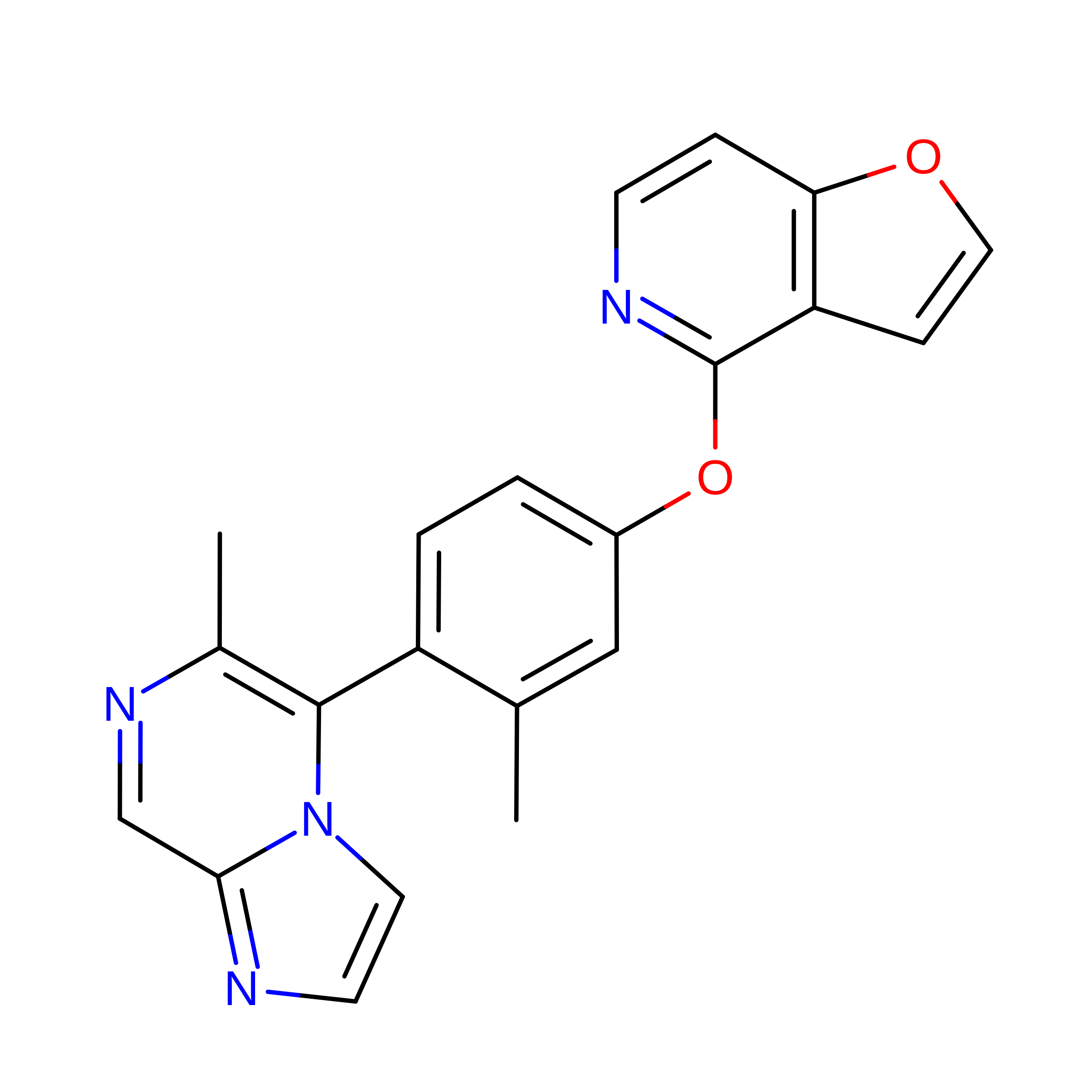
F [auth A]4-[3-methyl-4-(6-methylimidazo[1,2-a]pyrazin-5-yl)phenoxy]furo[3,2-c]pyridine
C21 H16 N4 O2
HWAIAGZSWHOLLK-UHFFFAOYSA-N
Experimental Data & Validation

Experimental Data

  • Method: ELECTRON MICROSCOPY
  • Resolution: 3.00 Å
  • Aggregation State: PARTICLE 
  • Reconstruction Method: SINGLE PARTICLE 

Structure Validation

View Full Validation Report


Entry History & Funding Information

Deposition Data


Funding OrganizationLocationGrant Number
National Natural Science Foundation of China (NSFC)China32130022
National Natural Science Foundation of China (NSFC)China82121005

Revision History  (Full details and data files)

  • Version 1.0: 2024-09-04
    Type: Initial release
  • Version 1.1: 2024-10-23
    Changes: Data collection, Structure summary
  • Version 1.2: 2024-10-30
    Changes: Data collection, Database references