8JR3 | pdb_00008jr3

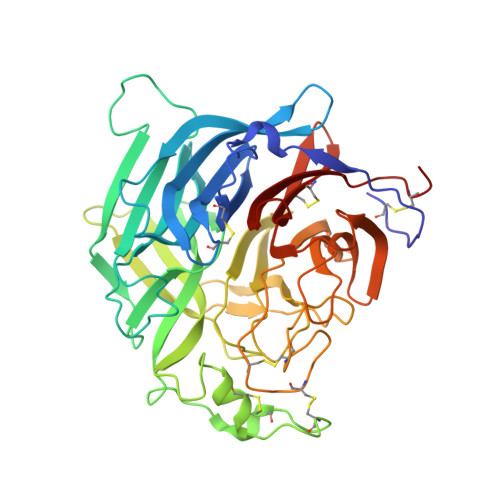
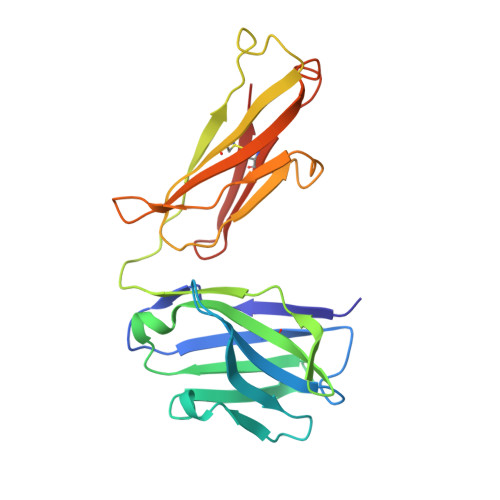
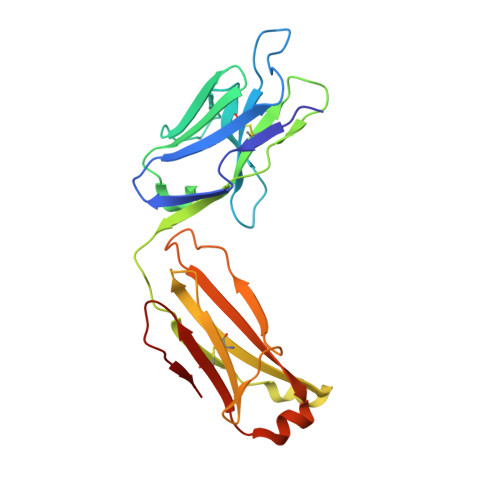
Crystal structure of Hendra Virus attachment(G) glycoprotein mutant S586N in complex with neutralizing antibody 14F8


Experimental Data Snapshot

  • Method: X-RAY DIFFRACTION
  • Resolution: 3.22 Å
  • R-Value Free: 
    0.241 (Depositor), 0.242 (DCC) 
  • R-Value Work: 
    0.215 (Depositor), 0.215 (DCC) 
  • R-Value Observed: 
    0.217 (Depositor) 

wwPDB Validation   3D Report Full Report


Ligand Structure Quality Assessment 


This is version 1.2 of the entry. See complete history


Literature

Single amino acid substitution in Hendra virus attachment glycoprotein induces cross-neutralizing antibodies against Nipah virus.

Li, Y.Huang, X.Li, R.Zai, X.Yang, Y.Zhang, Y.Zhang, Z.Zhang, J.Xu, J.Chen, W.

(2025) Signal Transduct Target Ther 10: 276-276

  • DOI: https://doi.org/10.1038/s41392-025-02370-0
  • Primary Citation of Related Structures:  
    8JA5, 8JR3, 8JR5

  • PubMed Abstract: 

    Nipah virus (NiV) and Hendra virus (HeV) are highly pathogenic henipaviruses within the Paramyxoviridae family, causing severe respiratory and neurological diseases in humans and animals with fatality rates up to 75%, and no licensed human vaccines or therapeutics. In this study, we identified a unique vulnerable epitope on the NiV attachment glycoprotein (G) recognized by the potent neutralizing antibody 14F8, which targets a receptor-binding site and neutralizes NiV effectively. Using the 2.8 Å crystal structure of the 14F8 Fab-NiV-G complex as a guide, we reconstructed this epitope on HeV-G via a single amino acid substitution (S586N), creating the HeV-G S586N mutant. Immunization with HeV-G S586N in BALB/c mice and cynomolgus monkeys elicited robust, broadly neutralizing antibody responses against both NiV and HeV, achieving higher NiV-neutralizing titers post-prime compared to wild-type HeV-G, as confirmed by pseudovirus and live-virus assays. Crystal structures of HeV-G S586N (3.3 Å) and its 14F8 complex (3.2 Å) showed the S586N substitution induced a 9 Å conformational rearrangement in β-propeller blade 6, reshaping the molecular skeleton and solvent-accessible surface without direct N586-14F8 interaction, thus mimicking the NiV epitope. These findings position HeV-G S586N as a promising broad-spectrum antigen for henipavirus prevention and demonstrate the value of structure-guided epitope reconstruction in universal vaccine design for emerging viral threats.


  • Organizational Affiliation
    • Laboratory of Advanced Biotechnology, Beijing Institute of Biotechnology, Beijing, China.

Macromolecules
Find similar proteins by:  (by identity cutoff)  |  3D Structure
Entity ID: 1
MoleculeChains Sequence LengthOrganismDetailsImage
Glycoprotein GA [auth E],
B [auth F]
416Hendra virus horse/Australia/Hendra/1994Mutation(s): 1 
Gene Names: G
UniProt
Find proteins for O89343 (Hendra virus (isolate Horse/Autralia/Hendra/1994))
Explore O89343 
Go to UniProtKB:  O89343
Entity Groups  
Sequence Clusters30% Identity50% Identity70% Identity90% Identity95% Identity100% Identity
UniProt GroupO89343
Glycosylation
Glycosylation Sites: 5
Sequence Annotations
Expand
  • Reference Sequence
Find similar proteins by:  (by identity cutoff)  |  3D Structure
Entity ID: 2
MoleculeChains Sequence LengthOrganismDetailsImage
Heavy chain of neutralizing antibody 14F8C [auth A],
E [auth B]
217Mus musculusMutation(s): 0 
Entity Groups  
Sequence Clusters30% Identity50% Identity70% Identity90% Identity95% Identity100% Identity
Sequence Annotations
Expand
  • Reference Sequence
Find similar proteins by:  (by identity cutoff)  |  3D Structure
Entity ID: 3
MoleculeChains Sequence LengthOrganismDetailsImage
Light chain of neutralizing antibody 14F8D,
F [auth C]
212Mus musculusMutation(s): 0 
Entity Groups  
Sequence Clusters30% Identity50% Identity70% Identity90% Identity95% Identity100% Identity
Sequence Annotations
Expand
  • Reference Sequence
Oligosaccharides

Help

Entity ID: 4
MoleculeChains Length2D Diagram Glycosylation3D Interactions
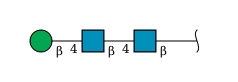
beta-D-mannopyranose-(1-4)-2-acetamido-2-deoxy-beta-D-glucopyranose-(1-4)-2-acetamido-2-deoxy-beta-D-glucopyranose
G
3N-Glycosylation
Glycosylation Resources
GlyTouCan:  G15407YE
GlyCosmos:  G15407YE
GlyGen:  G15407YE
Entity ID: 5
MoleculeChains Length2D Diagram Glycosylation3D Interactions
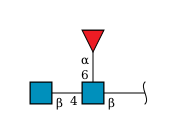
2-acetamido-2-deoxy-beta-D-glucopyranose-(1-4)-[alpha-L-fucopyranose-(1-6)]2-acetamido-2-deoxy-beta-D-glucopyranose
H, N, O
3N-Glycosylation
Glycosylation Resources
GlyTouCan:  G21290RB
GlyCosmos:  G21290RB
GlyGen:  G21290RB
Entity ID: 6
MoleculeChains Length2D Diagram Glycosylation3D Interactions
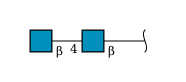
2-acetamido-2-deoxy-beta-D-glucopyranose-(1-4)-2-acetamido-2-deoxy-beta-D-glucopyranose
I, J, L, M
2N-Glycosylation
Glycosylation Resources
GlyTouCan:  G42666HT
GlyCosmos:  G42666HT
GlyGen:  G42666HT
Entity ID: 7
MoleculeChains Length2D Diagram Glycosylation3D Interactions
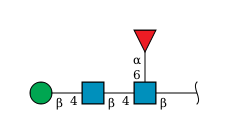
beta-D-mannopyranose-(1-4)-2-acetamido-2-deoxy-beta-D-glucopyranose-(1-4)-[alpha-L-fucopyranose-(1-6)]2-acetamido-2-deoxy-beta-D-glucopyranose
K
4N-Glycosylation
Glycosylation Resources
GlyTouCan:  G32152BH
GlyCosmos:  G32152BH
GlyGen:  G32152BH
Small Molecules
Ligands 1 Unique
IDChains Name / Formula / InChI Key2D Diagram3D Interactions
NAG
Query on NAG

Download Ideal Coordinates CCD File 
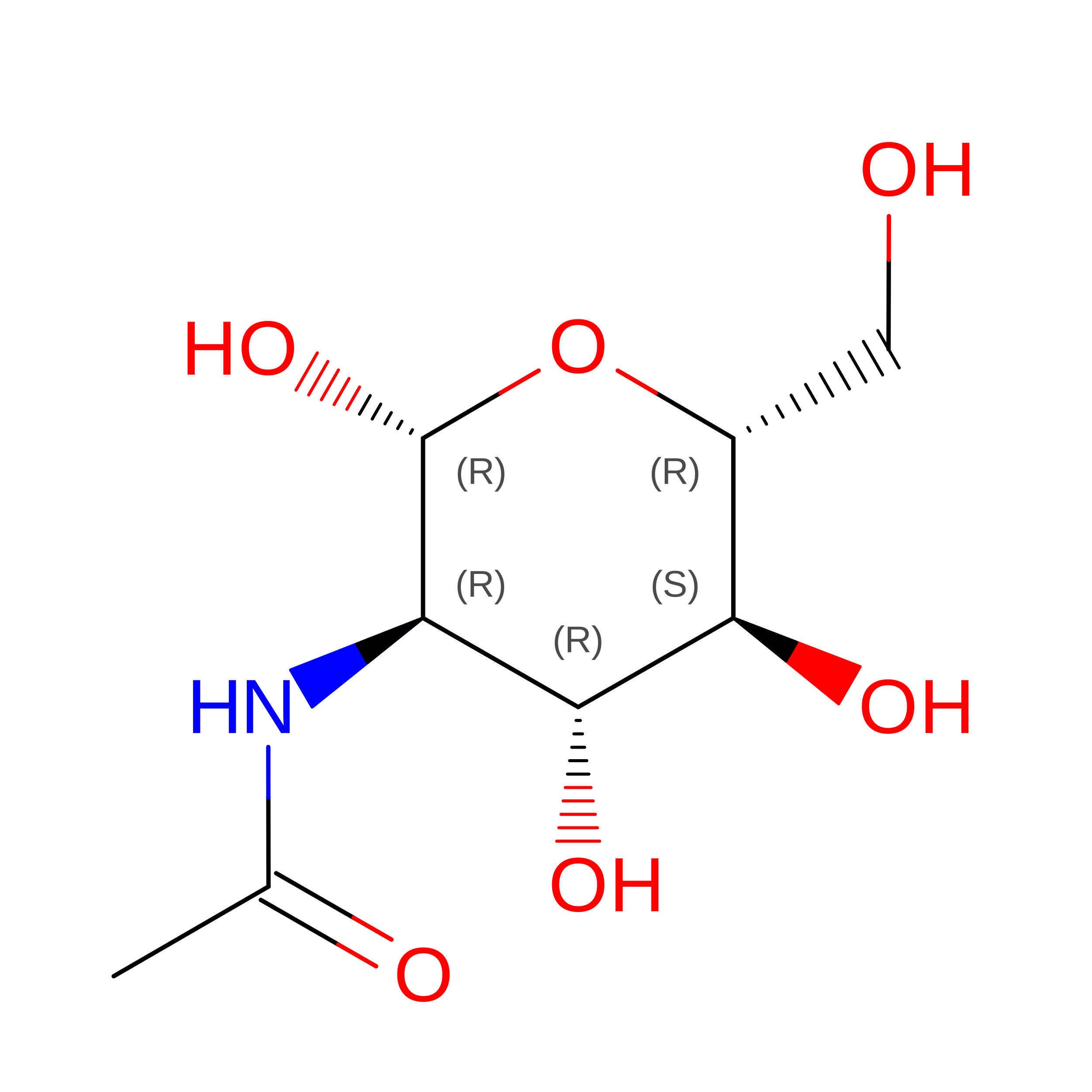
P [auth F]2-acetamido-2-deoxy-beta-D-glucopyranose
C8 H15 N O6
OVRNDRQMDRJTHS-FMDGEEDCSA-N
Experimental Data & Validation

Experimental Data

  • Method: X-RAY DIFFRACTION
  • Resolution: 3.22 Å
  • R-Value Free:  0.241 (Depositor), 0.242 (DCC) 
  • R-Value Work:  0.215 (Depositor), 0.215 (DCC) 
  • R-Value Observed: 0.217 (Depositor) 
Space Group: C 2 2 21
Unit Cell:
Length ( Å )Angle ( ˚ )
a = 110.843α = 90
b = 257.014β = 90
c = 193.518γ = 90
Software Package:
Software NamePurpose
PHENIXrefinement
HKL-2000data scaling
HKL-2000data reduction
PHASERphasing

Structure Validation

View Full Validation Report


Ligand Structure Quality Assessment 


Entry History & Funding Information

Deposition Data


Funding OrganizationLocationGrant Number
National Natural Science Foundation of China (NSFC)China32200762

Revision History  (Full details and data files)

  • Version 1.0: 2024-06-19
    Type: Initial release
  • Version 1.1: 2024-10-23
    Changes: Structure summary
  • Version 1.2: 2025-12-31
    Changes: Database references