Download Mendeley
Employing a Highly Potent Fluorescence Probe to Discover a PARP-1/2 Binder and the Complex Structures Analysis.
Wang, X., Wang, C., Li, J., Zhou, J., Xu, B.(2025) ChemMedChem : e202500168-e202500168
- PubMed: 40204633 Search on PubMed
- DOI: https://doi.org/10.1002/cmdc.202500168
- Primary Citation Related Structures:
8JNY, 8JNZ - PubMed Abstract:
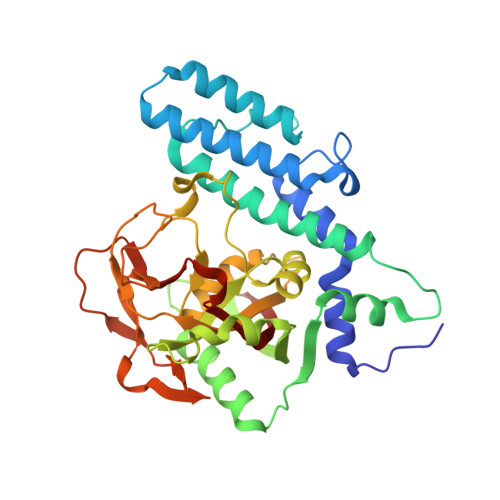
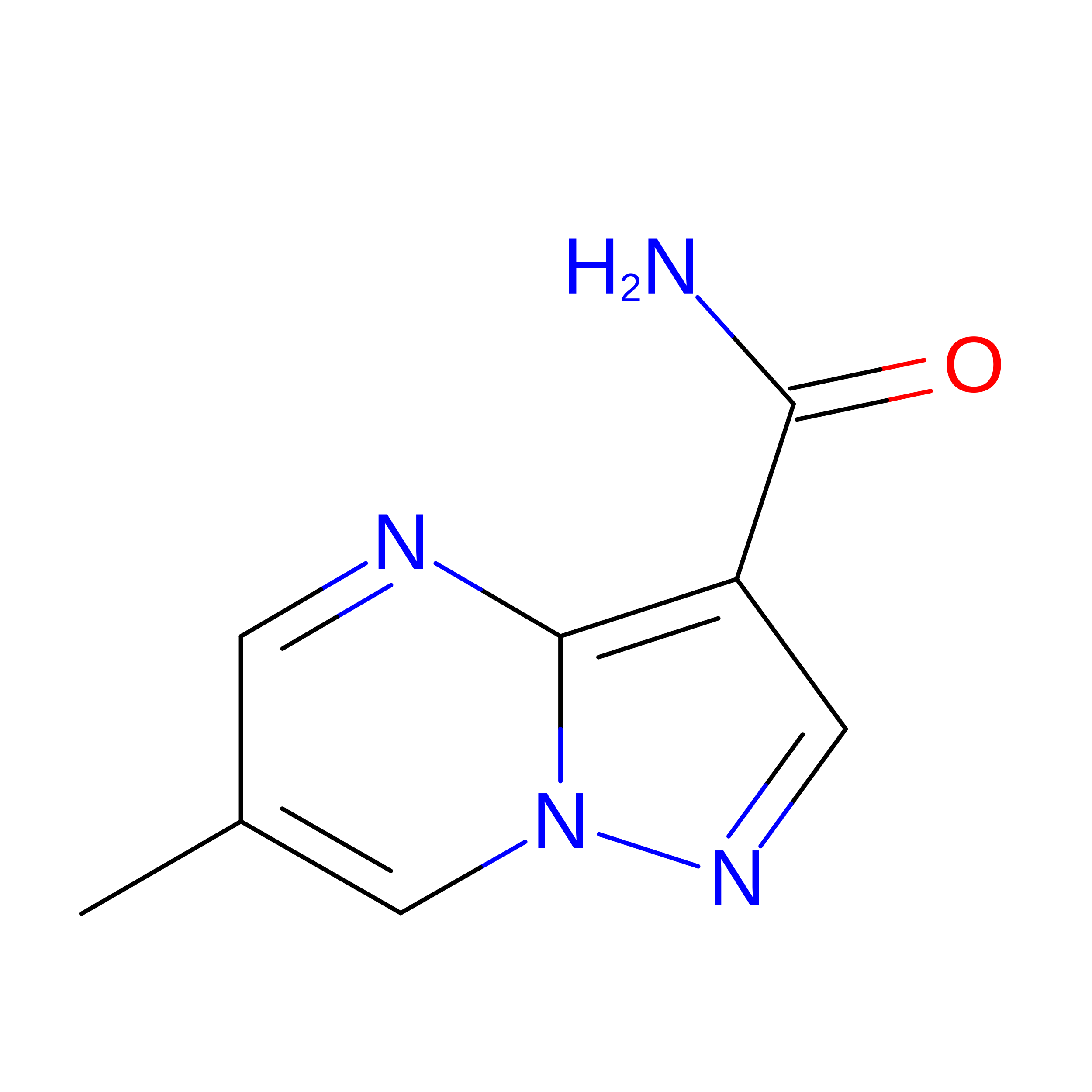
Poly (ADP-ribose) polymerases-1/2 (PARP-1/2) has been identified as important antitumor drug targets and the development of PARP-1/2 inhibitors featuring novel structures is still a promising strategy for cancer treatments. In this work, a highly potent PARP-1/2 probe with a quinazolinone scaffold was designed and synthesized, showing dissociation constants (K d ) of 2.07 and 1.6 nM toward catPARP-1 and catPARP-2SE, respectively. By employing this probe to screen an in-house compound library, compound A bearing a pyrazolo[1,5-a]pyrimidine-3-carboxamide scaffold is disclosed as a structurally novel PARP-1/2 binder, which has dissociation constants of 5.6 and 7.9 μM for catPARP-1 and catPARP-2SE, respectively, in the isothermal titration calorimetry (ITC) assay. Moreover, the crystal structures of compound A in complex with PARP-1 and PARP-2 catalytic domains are solved to reveal the binding modes of this compound and these two complex structures are analyzed with IGMH method at GFN2-xTB and B3LYP levels. Interestingly, this compound presents significant differences in binding modes within PARP-1 and PARP-2. These results can provide a structural basis for the discovery of novel PARP-1 or PARP-2 selective inhibitors by taking compound A as a template structure.
- Beijing Key Laboratory of Active Substances Discovery and Druggability Evaluation, Institute of Materia Medica, Chinese Academy of Medical Sciences and Peking Union Medical College, Beijing, 100050, China.
Organizational Affiliation: