8JCJ | pdb_00008jcj

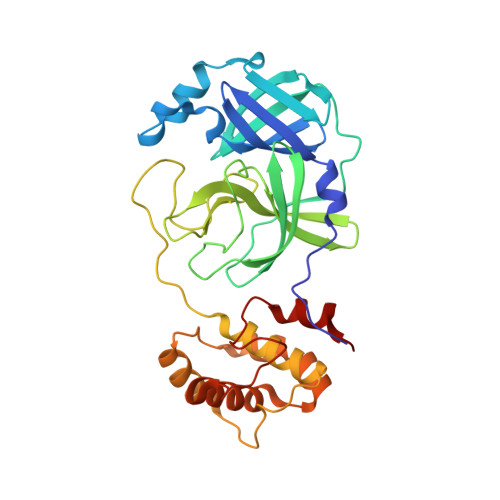
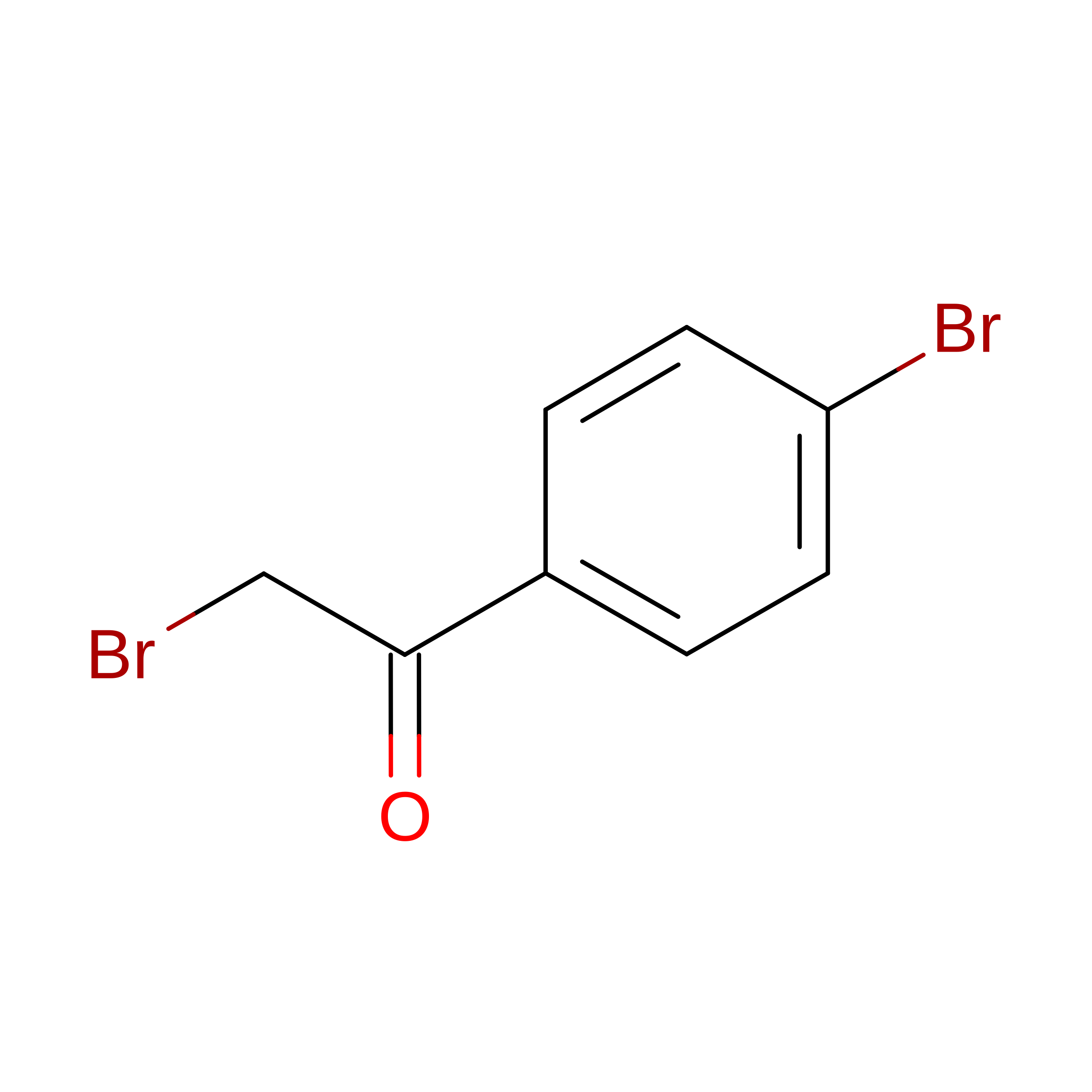
The crystal structure of SARS-CoV-2 main protease in complex with Compound 18


Experimental Data Snapshot

  • Method: X-RAY DIFFRACTION
  • Resolution: 1.70 Å
  • R-Value Free: 
    0.188 (Depositor), 0.215 (DCC) 
  • R-Value Work: 
    0.162 (Depositor) 
  • R-Value Observed: 
    0.164 (Depositor) 

Starting Model: experimental
View more details

wwPDB Validation 3D Report Full Report

Validation slider image for 8JCJ

Ligand Structure Quality Assessment 


This is version 1.1 of the entry. See complete history

Literature

De novo design of SARS-CoV-2 main protease inhibitors with characteristic binding modes.

Zhu, Y.Meng, J.Feng, B.Zhao, Y.Zang, Y.Lu, L.Su, M.Yang, Q.Zhang, Q.Feng, L.Zhao, J.Shao, M.Ma, Y.Yang, X.Yang, H.Li, J.Jiang, X.Rao, Z.

(2024) Structure 32: 1327-1334.e3

  • DOI: https://doi.org/10.1016/j.str.2024.05.019
  • Primary Citation Related Structures: 
    8JCJ, 8JCK, 8JCL, 8JCM, 8JCN, 8JCO

  • PubMed Abstract: 

    The coronavirus disease 2019 (COVID-19) is caused by a novel coronavirus called severe acute respiratory syndrome coronavirus 2 (SARS-CoV-2), which spreads rapidly all over the world. The main protease (M pro ) is significant to the replication and transcription of viruses, making it an attractive drug target against coronaviruses. Here, we introduce a series of novel inhibitors which are designed de novo through structure-based drug design approach that have great potential to inhibit SARS-CoV-2 M pro in vitro. High-resolution structures show that these inhibitors form covalent bonds with the catalytic cysteine through the novel dibromomethyl ketone (DBMK) as a reactive warhead. At the same time, the designed phenyl group beside the DBMK warhead inserts into the cleft between H41 and C145 through π-π stacking interaction, splitting the catalytic dyad and disrupting proton transfer. This unique binding model provides novel clues for the cysteine protease inhibitor development of SARS-CoV-2 as well as other pathogens.


  • Organizational Affiliation
    • Shanghai Institute for Advanced Immunochemical Studies and School of Life Science and Technology, ShanghaiTech University, Shanghai 201210, China; National Clinical Research Center for Infectious Disease, Shenzhen Third People's Hospital, Shenzhen 518112, China.

Macromolecule Content 

  • Total Structure Weight: 34.31 kDa 
  • Atom Count: 2,672 
  • Modeled Residue Count: 302 
  • Deposited Residue Count: 306 
  • Unique protein chains: 1

Macromolecules

Find similar proteins by:|  3D Structure
Entity ID: 1
MoleculeChains  Sequence LengthOrganismDetailsImage
3C-like proteinase nsp5306Severe acute respiratory syndrome coronavirus 2Mutation(s): 0 
EC: 3.4.22.69
UniProt
Find proteins for P0DTD1 (Severe acute respiratory syndrome coronavirus 2)
Explore P0DTD1 
Go to UniProtKB:  P0DTD1
Entity Groups
Sequence Clusters30% Identity50% Identity70% Identity90% Identity95% Identity100% Identity
UniProt GroupP0DTD1
Sequence Annotations
Expand
Reference Sequence

Experimental Data & Validation

Experimental Data

  • Method: X-RAY DIFFRACTION
  • Resolution: 1.70 Å
  • R-Value Free:  0.188 (Depositor), 0.215 (DCC) 
  • R-Value Work:  0.162 (Depositor) 
  • R-Value Observed: 0.164 (Depositor) 
Space Group: C 1 2 1
Unit Cell:
Length ( Å )Angle ( ˚ )
a = 97.704α = 90
b = 82.073β = 114.91
c = 51.777γ = 90
Software Package:
Software NamePurpose
PHENIXrefinement
XSCALEdata scaling
XDSdata reduction
PHASERphasing

Structure Validation

View Full Validation Report


Ligand Structure Quality Assessment 


Entry History 

& Funding Information

Deposition Data


Funding OrganizationLocationGrant Number
National Natural Science Foundation of China (NSFC)China32200131

Revision History  (Full details and data files)

  • Version 1.0: 2024-05-15
    Type: Initial release
  • Version 1.1: 2025-05-28
    Changes: Advisory, Database references, Derived calculations, Structure summary