Download Mendeley
Structural and Comparative Stability of a Truncated N-Terminal Domain of DNA Gyrase A From Salmonella Typhi.
Salman, M., Sachdeva, E., Negi, S., Das, U., Ethayathulla, A.S., Kaur, P.(2025) Proteins
- PubMed: 41116293 Search on PubMed
- DOI: https://doi.org/10.1002/prot.70070
- Primary Citation Related Structures:
8J9T - PubMed Abstract:
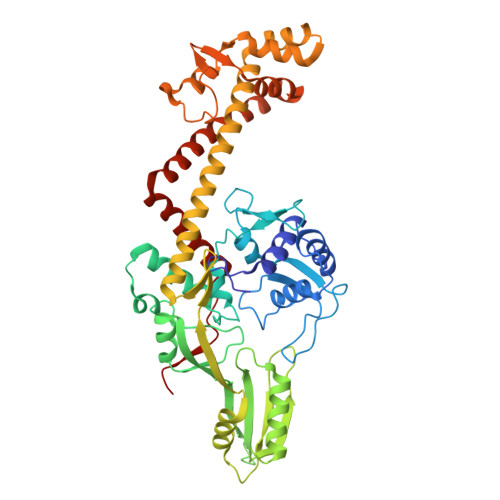
DNA Gyrase, a Type II topoisomerase, introduces negative supercoiling in dsDNA through the cleavage and religation activity at the expense of ATP. DNA Gyrase forms a hetero-tetrameric complex with two Gyrase A and Gyrase B subunits. These two subunits interact dynamically to physically transfer one DNA duplex through another by coupling ATP binding and hydrolysis with DNA binding, cleavage, and strand transport. The N-terminal domain of Gyrase A (GyrA-NTD) mediates the cleavage of the DNA strand and forms the target site for quinolones class of antibiotics. While structures of GyrA-NTD from several prokaryotes have been determined, the N-terminal segment (residues 1-32) remains unresolved in apo forms. Here, we present the crystal structure of a truncated GyrA-NTD (ΔGyrA-NTD; residues 33-530) from Salmonella Typhi at 2.43 Å resolution, alongside comparative biophysical characterization with the wild type. Thermal and chemical denaturation assays revealed that the wild-type GyrA-NTD is more prone to unfolding than the truncated variant, indicating that deletion of the unresolved N-terminal segment enhances domain stability. These findings uncover a structural element influencing GyrA-NTD stability.
- All India Institute of Medical Sciences, New Delhi Department of Biophysics, Delhi, India.
Organizational Affiliation: