8J8I | pdb_00008j8i

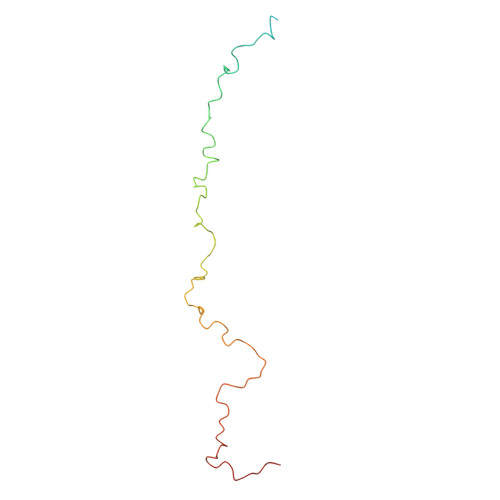
Membrane-bound structure of CD3z cytoplasmic domain

  • Classification: IMMUNE SYSTEM
  • Organism(s): Homo sapiens
  • Expression System: Escherichia coli
  • Mutation(s): Yes 

  • Deposited: 2023-05-01 Released: 2024-05-01 
  • Deposition Author(s): Li, H., Xu, C.
  • Funding Organization(s): National Natural Science Foundation of China (NSFC)

Experimental Data Snapshot

  • Method: SOLUTION NMR
  • Conformers Calculated: 200 
  • Conformers Submitted: 10 
  • Selection Criteria: structures with the least restraint violations 

wwPDB Validation   3D Report Full Report


This is version 1.1 of the entry. See complete history


Literature

Lipid-regulated phosphorylation hierarchy of the T cell receptor tyrosine motifs.

Li, H.Meng, L.Chu, C.Li, C.Yang, H.Cao, K.Zhu, Y.Gao, X.Yan, C.Dushek, O.Wang, H.Shi, X.Xu, C.

(2025) Mol Cell 85: 3694-3710.e8

  • DOI: https://doi.org/10.1016/j.molcel.2025.09.005
  • Primary Citation of Related Structures:  
    8J8I

  • PubMed Abstract: 

    As the antigen receptor, the T cell receptor (TCR)-CD3 complex contains a panel of immunoreceptor tyrosine-based activation motifs (ITAMs) in the CD3 subunits to transduce diverse antigen signals, but the mechanism underlying TCR signaling versatility remains poorly understood. Here, we unraveled the structural and functional heterogeneity of the major CD3ζ signaling component. Using nuclear magnetic resonance spectroscopy, we characterized the membrane-bound structure of the dynamic CD3ζ cytoplasmic domain. ITAM 1 to 3 displayed a gradual increase of membrane insertion, leading to a sequential phosphorylation order from N to C terminus and the generation of partial- and full-phosphorylation species upon physiological triggering. Under chronic TCR stimulation, a scenario relevant to cancer and chronic infection, the C-terminal ITAM displayed faster decay kinetics of phosphorylation than the N-terminal one, causing insufficient TCR signaling. Our study thus reveals a new mechanism of ITAM heterogeneity in TCR signaling that is relevant to physiological and pathological contexts.


  • Organizational Affiliation
    • Key Laboratory of Multi-Cell Systems, CAS Center for Excellence in Molecular Cell Science, Shanghai Institute of Biochemistry and Cell Biology, Chinese Academy of Sciences, University of Chinese Academy of Sciences, Shanghai 200031, China.

Macromolecules
Find similar proteins by:  (by identity cutoff)  |  3D Structure
Entity ID: 1
MoleculeChains Sequence LengthOrganismDetailsImage
T-cell surface glycoprotein CD3 zeta chain140Homo sapiensMutation(s): 6 
Gene Names: CD247CD3ZT3ZTCRZ
UniProt & NIH Common Fund Data Resources
Find proteins for P20963 (Homo sapiens)
Explore P20963 
Go to UniProtKB:  P20963
PHAROS:  P20963
GTEx:  ENSG00000198821 
Entity Groups  
Sequence Clusters30% Identity50% Identity70% Identity90% Identity95% Identity100% Identity
UniProt GroupP20963
Sequence Annotations
Expand
  • Reference Sequence
Experimental Data & Validation

Experimental Data

  • Method: SOLUTION NMR
  • Conformers Calculated: 200 
  • Conformers Submitted: 10 
  • Selection Criteria: structures with the least restraint violations 

Structure Validation

View Full Validation Report


Entry History & Funding Information

Deposition Data

  • Released Date: 2024-05-01 
  • Deposition Author(s): Li, H., Xu, C.

Funding OrganizationLocationGrant Number
National Natural Science Foundation of China (NSFC)China--

Revision History  (Full details and data files)

  • Version 1.0: 2024-05-01
    Type: Initial release
  • Version 1.1: 2025-11-26
    Changes: Database references, Structure summary