8J3O | pdb_00008j3o

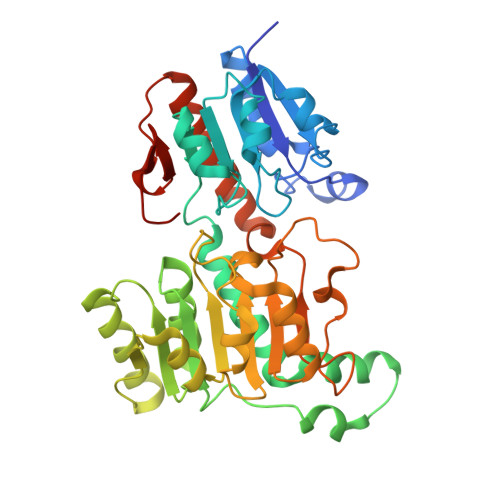
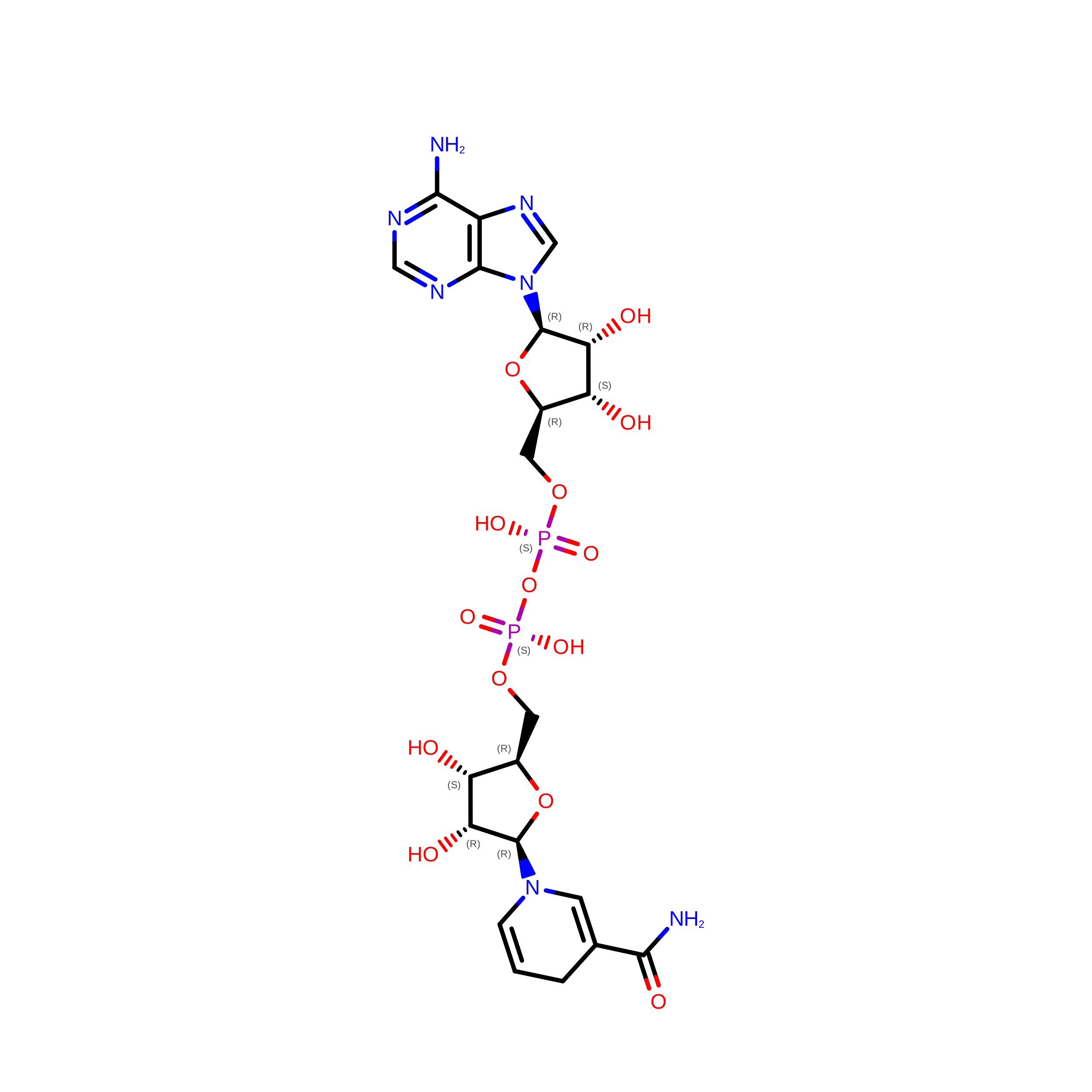
Formate dehydrogenase wild-type enzyme from Candida dubliniensis complexed with NADH


Experimental Data Snapshot

  • Method: X-RAY DIFFRACTION
  • Resolution: 2.65 Å
  • R-Value Free: 
    0.278 (Depositor), 0.280 (DCC) 
  • R-Value Work: 
    0.226 (Depositor), 0.220 (DCC) 
  • R-Value Observed: 
    0.229 (Depositor) 

Starting Model: experimental
View more details

wwPDB Validation   3D Report Full Report


Ligand Structure Quality Assessment 


This is version 1.1 of the entry. See complete history


Literature

Engineering a Formate Dehydrogenase for NADPH Regeneration.

Ma, W.Geng, Q.Chen, C.Zheng, Y.C.Yu, H.L.Xu, J.H.

(2023) Chembiochem 24: e202300390-e202300390

  • DOI: https://doi.org/10.1002/cbic.202300390
  • Primary Citation of Related Structures:  
    8J3O, 8J3P

  • PubMed Abstract: 

    Nicotinamide adenine dinucleotide (NADH) and nicotinamide adenine dinucleotide phosphate (NADPH) constitute major hydrogen donors for oxidative/reductive bio-transformations. NAD(P)H regeneration systems coupled with formate dehydrogenases (FDHs) represent a dreamful method. However, most of the native FDHs are NAD + -dependent and suffer from insufficient reactivity compared to other enzymatic tools, such as glucose dehydrogenase. An efficient and competitive NADP + -utilizing FDH necessitates the availability and robustness of NADPH regeneration systems. Herein, we report the engineering of a new FDH from Candida dubliniensis (CdFDH), which showed no strict NAD + preference by a structure-guided rational/semi-rational design. A combinatorial mutant CdFDH-M4 (D197Q/Y198R/Q199N/A372S/K371T/▵Q375/K167R/H16L/K159R) exhibited 75-fold intensification of catalytic efficiency (k cat /K m ). Moreover, CdFDH-M4 has been successfully employed in diverse asymmetric oxidative/reductive processes with cofactor total turnover numbers (TTNs) ranging from 135 to 986, making it potentially useful for NADPH-required biocatalytic transformations.


  • Organizational Affiliation
    • State Key Laboratory of Bioreactor Engineering, Shanghai Collaborative Innovation Centre for Biomanufacturing, East China University of Science and Technology, Meilong Road 130, Shanghai, 200237, China.

Macromolecules
Find similar proteins by:  (by identity cutoff)  |  3D Structure
Entity ID: 1
MoleculeChains Sequence LengthOrganismDetailsImage
Formate dehydrogenase
A, B, C, D
386Candida dubliniensis CD36Mutation(s): 0 
Gene Names: Cd36_53500CD36_53500
EC: 1.17.1.9
UniProt
Find proteins for B9WHT3 (Candida dubliniensis (strain CD36 / ATCC MYA-646 / CBS 7987 / NCPF 3949 / NRRL Y-17841))
Explore B9WHT3 
Go to UniProtKB:  B9WHT3
Entity Groups  
Sequence Clusters30% Identity50% Identity70% Identity90% Identity95% Identity100% Identity
UniProt GroupB9WHT3
Sequence Annotations
Expand
  • Reference Sequence
Experimental Data & Validation

Experimental Data

  • Method: X-RAY DIFFRACTION
  • Resolution: 2.65 Å
  • R-Value Free:  0.278 (Depositor), 0.280 (DCC) 
  • R-Value Work:  0.226 (Depositor), 0.220 (DCC) 
  • R-Value Observed: 0.229 (Depositor) 
Space Group: P 1
Unit Cell:
Length ( Å )Angle ( ˚ )
a = 51.402α = 90
b = 60.156β = 90
c = 120.482γ = 111.02
Software Package:
Software NamePurpose
PHENIXrefinement
XDSdata reduction
XDSdata scaling
PHASERphasing

Structure Validation

View Full Validation Report


Ligand Structure Quality Assessment 


Entry History & Funding Information

Deposition Data


Funding OrganizationLocationGrant Number
National Science Foundation (NSF, China)China--

Revision History  (Full details and data files)

  • Version 1.0: 2023-09-20
    Type: Initial release
  • Version 1.1: 2023-11-01
    Changes: Database references