8IWO | pdb_00008iwo

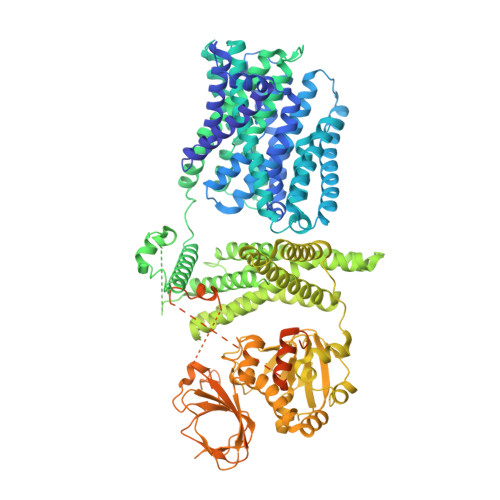
The rice Na+/H+ antiporter SOS1 in an auto-inhibited state


Experimental Data Snapshot

  • Method: ELECTRON MICROSCOPY
  • Resolution: 3.09 Å
  • Aggregation State: PARTICLE 
  • Reconstruction Method: SINGLE PARTICLE 

Starting Model: in silico
View more details

wwPDB Validation 3D Report Full Report

Validation slider image for 8IWO

This is version 1.2 of the entry. See complete history

Literature

Structure and activation mechanism of the rice Salt Overly Sensitive 1 (SOS1) Na + /H + antiporter.

Zhang, X.Y.Tang, L.H.Nie, J.W.Zhang, C.R.Han, X.Li, Q.Y.Qin, L.Wang, M.H.Huang, X.Yu, F.Su, M.Wang, Y.Xu, R.M.Guo, Y.Xie, Q.Chen, Y.H.

(2023) Nat Plants 9: 1924-1936

  • DOI: https://doi.org/10.1038/s41477-023-01551-5
  • Primary Citation Related Structures: 
    8IWO, 8J2M

  • PubMed Abstract: 

    Salinity is one of the most severe abiotic stresses that adversely affect plant growth and agricultural productivity. The plant Na + /H + antiporter Salt Overly Sensitive 1 (SOS1) located in the plasma membrane extrudes excess Na + out of cells in response to salt stress and confers salt tolerance. However, the molecular mechanism underlying SOS1 activation remains largely elusive. Here we elucidate two cryo-electron microscopy structures of rice (Oryza sativa) SOS1, a full-length protein in an auto-inhibited state and a truncated version in an active state. The SOS1 forms a dimeric architecture, with an NhaA-folded transmembrane domain portion in the membrane and an elongated cytosolic portion of multiple regulatory domains in the cytoplasm. The structural comparison shows that SOS1 adopts an elevator transport mechanism accompanied by a conformational transition of the highly conserved Pro 148 in the unwound transmembrane helix 5 (TM 5 ), switching from an occluded conformation in the auto-inhibited state to a conducting conformation in the active state. These findings allow us to propose an inhibition-release mechanism for SOS1 activation and elucidate how SOS1 controls Na + homeostasis in response to salt stress.


  • Organizational Affiliation
    • State Key Laboratory of Molecular Developmental Biology, Institute of Genetics and Developmental Biology, Chinese Academy of Sciences, Beijing, China.

Macromolecule Content 

  • Total Structure Weight: 257.4 kDa 
  • Atom Count: 15,118 
  • Modeled Residue Count: 1,912 
  • Deposited Residue Count: 2,296 
  • Unique protein chains: 1

Macromolecules

Find similar proteins by:|  3D Structure
Entity ID: 1
MoleculeChains  Sequence LengthOrganismDetailsImage
OsSOS1
A, B
1,148Oryza sativa Japonica GroupMutation(s): 0 
Gene Names: SOS1
Membrane Entity: Yes 
UniProt
Find proteins for Q5ICN3 (Oryza sativa subsp. japonica)
Explore Q5ICN3 
Go to UniProtKB:  Q5ICN3
Entity Groups
Sequence Clusters30% Identity50% Identity70% Identity90% Identity95% Identity100% Identity
UniProt GroupQ5ICN3
Sequence Annotations
Expand
Reference Sequence

Small Molecules

Ligands 1 Unique
IDChains Name / Formula / InChI Key2D Diagram3D Interactions
46E

Query on 46E


Download:Ideal Coordinates CCD File
C [auth A],
D [auth B]
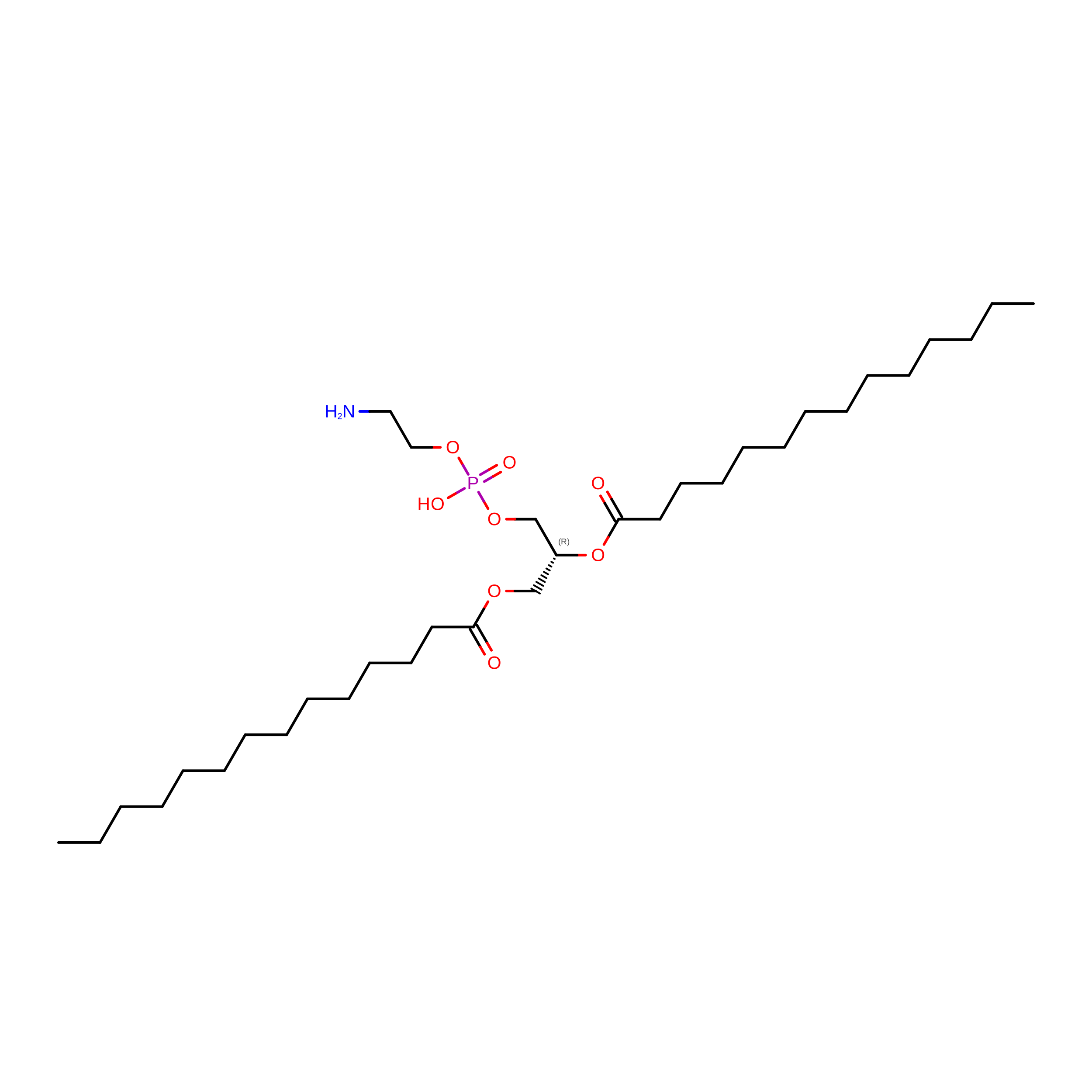
(2R)-3-{[(S)-(2-aminoethoxy)(hydroxy)phosphoryl]oxy}-2-(tetradecanoyloxy)propyl tetradecanoate
C33 H66 N O8 P
NEZDNQCXEZDCBI-WJOKGBTCSA-N

Experimental Data & Validation

Experimental Data

  • Method: ELECTRON MICROSCOPY
  • Resolution: 3.09 Å
  • Aggregation State: PARTICLE 
  • Reconstruction Method: SINGLE PARTICLE 
EM Software:
TaskSoftware PackageVersion
RECONSTRUCTIONcryoSPARC3.2
MODEL REFINEMENTPHENIX

Structure Validation

View Full Validation Report


Entry History 

& Funding Information

Deposition Data


Funding OrganizationLocationGrant Number
Other governmentChina2020YFA0509903

Revision History  (Full details and data files)

  • Version 1.0: 2023-11-22
    Type: Initial release
  • Version 1.1: 2023-11-29
    Changes: Database references
  • Version 1.2: 2024-11-13
    Changes: Data collection, Structure summary