Find PDB structures and Computed Structure Models (CSM) by combining queries from tools in this suite: Attribute Search, Sequence Similarity, Sequence Motif, 3D Similarity, and 3D Motif with 'AND' logic.
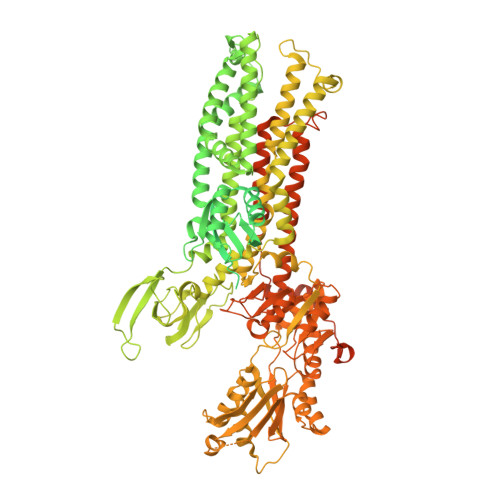
The P-type ATPase ATP7B exports cytosolic copper and plays an essential role in the regulation of cellular copper homeostasis. Mutants of ATP7B cause Wilson disease (WD), an autosomal recessive disorder of copper metabolism. Here, we present cryoelectron microscopy (cryo-EM) structures of human ATP7B in the E1 state in the apo, the putative copper-bound, and the putative cisplatin-bound forms. In ATP7B, the N-terminal sixth metal-binding domain (MBD6) binds at the cytosolic copper entry site of the transmembrane domain (TMD), facilitating the delivery of copper from the MBD6 to the TMD. The sulfur-containing residues in the TMD of ATP7B mark the copper transport pathway. By comparing structures of the E1 state human ATP7B and E2-P i state frog ATP7B, we propose the ATP-driving copper transport model of ATP7B. These structures not only advance our understanding of the mechanisms of ATP7B-mediated copper export but can also guide the development of therapeutics for the treatment of WD.
Organizational Affiliation:
Department of Medical Genetics and Center for Rare Diseases, and Department of Neurology in Second Affiliated Hospital, and Key Laboratory of Medical Neurobiology of Zhejiang Province, Zhejiang University School of Medicine, Hangzhou, Zhejiang 310009, China.
Department of Biophysics, and Department of Neurology of the Fourth Affiliated Hospital, Zhejiang University School of Medicine, Hangzhou, Zhejiang 310058, China.
State Key Laboratory of Biocatalysis and Enzyme Engineering, Hubei Collaborative Innovation Center for Green Transformation of Bio-Resources, Hubei Key Laboratory of Industrial Biotechnology, School of Life Sciences, Hubei University, Wuhan, Hubei 430062, China.
Department of Biophysics, and Department of Pathology of Sir Run Run Shaw Hospital, Zhejiang University School of Medicine, Hangzhou, Zhejiang 310058, China; Center of Cryo Electron Microscopy, Zhejiang University School of Medicine, Hangzhou, Zhejiang 310058, China.
State Key Laboratory of Biocatalysis and Enzyme Engineering, Hubei Collaborative Innovation Center for Green Transformation of Bio-Resources, Hubei Key Laboratory of Industrial Biotechnology, School of Life Sciences, Hubei University, Wuhan, Hubei 430062, China. Electronic address: wushan91@hubu.edu.cn.
Department of Biophysics, and Department of Neurology of the Fourth Affiliated Hospital, Zhejiang University School of Medicine, Hangzhou, Zhejiang 310058, China; State Key Laboratory of Plant Physiology and Biochemistry, College of Life Sciences, Zhejiang University, Hangzhou, Zhejiang 310058, China; Department of Cardiology, Key Laboratory of Cardiovascular Intervention and Regenerative Medicine of Zhejiang Province, Sir Run Run Shaw Hospital, Zhejiang University School of Medicine, Hangzhou, Zhejiang 310016, China; Cancer Center, Zhejiang University, Hangzhou, Zhejiang 310058, China; Liangzhu Laboratory, Zhejiang University Medical Center, 1369 West Wenyi Road, Hangzhou, Zhejiang 311121, China; NHC and CAMS Key Laboratory of Medical Neurobiology, MOE Frontier Science Center for Brain Science and Brain-machine Integration, School of Brain Science and Brain Medicine, Zhejiang University, Hangzhou, Zhejiang 310016, China. Electronic address: jiangtaoguo@zju.edu.cn.
Department of Medical Genetics and Center for Rare Diseases, and Department of Neurology in Second Affiliated Hospital, and Key Laboratory of Medical Neurobiology of Zhejiang Province, Zhejiang University School of Medicine, Hangzhou, Zhejiang 310009, China; Liangzhu Laboratory, Zhejiang University Medical Center, 1369 West Wenyi Road, Hangzhou, Zhejiang 311121, China; NHC and CAMS Key Laboratory of Medical Neurobiology, MOE Frontier Science Center for Brain Science and Brain-machine Integration, School of Brain Science and Brain Medicine, Zhejiang University, Hangzhou, Zhejiang 310016, China. Electronic address: zhiyingwu@zju.edu.cn.

 Download Mendeley