Download Mendeley
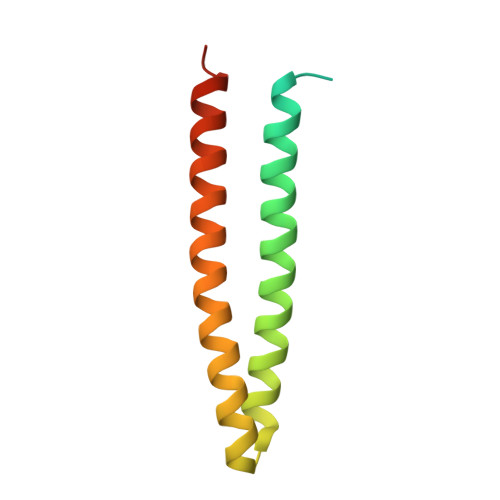
Cep57 regulates human centrosomes through multivalent interactions.
Yeh, H.W., Chen, P.P., Yeh, T.C., Lin, S.L., Chen, Y.T., Lin, W.P., Chen, T., Pang, J.M., Lin, K.T., Wang, L.H., Lin, Y.C., Shih, O., Jeng, U.S., Hsia, K.C., Cheng, H.C.(2024) Proc Natl Acad Sci U S A 121: e2305260121-e2305260121
- PubMed: 38857398 Search on PubMedSearch on PubMed Central
- DOI: https://doi.org/10.1073/pnas.2305260121
- Primary Citation Related Structures:
8IBH - PubMed Abstract:
Human Cep57 is a coiled-coil scaffold at the pericentriolar matrix (PCM), controlling centriole duplication and centrosome maturation for faithful cell division. Genetic truncation mutations of Cep57 are associated with the mosaic-variegated aneuploidy (MVA) syndrome. During interphase, Cep57 forms a complex with Cep63 and Cep152, serving as regulators for centrosome maturation. However, the molecular interplay of Cep57 with these essential scaffolding proteins remains unclear. Here, we demonstrate that Cep57 undergoes liquid-liquid phase separation (LLPS) driven by three critical domains (NTD, CTD, and polybasic LMN). In vitro Cep57 condensates catalyze microtubule nucleation via the LMN motif-mediated tubulin concentration. In cells, the LMN motif is required for centrosomal microtubule aster formation. Moreover, Cep63 restricts Cep57 assembly, expansion, and microtubule polymerization activity. Overexpression of competitive constructs for multivalent interactions, including an MVA mutation, leads to excessive centrosome duplication. In Cep57-depleted cells, self-assembly mutants failed to rescue centriole disengagement and PCM disorganization. Thus, Cep57's multivalent interactions are pivotal for maintaining the accurate structural and functional integrity of human centrosomes.
- Institute of Bioinformatics and Structural Biology, National Tsing Hua University, Hsinchu 30013, Taiwan.
Organizational Affiliation: