Download Mendeley
A soybean cyst nematode suppresses microbial plant symbionts using a lipochitooligosaccharide-hydrolysing enzyme.
Chen, W., Wang, D., Ke, S., Cao, Y., Xiang, W., Guo, X., Yang, Q.(2024) Nat Microbiol 9: 1993-2005
- PubMed: 38886584 Search on PubMedSearch on PubMed Central
- DOI: https://doi.org/10.1038/s41564-024-01727-5
- Primary Citation Related Structures:
8HW6, 8HW7, 8HW8 - PubMed Abstract:
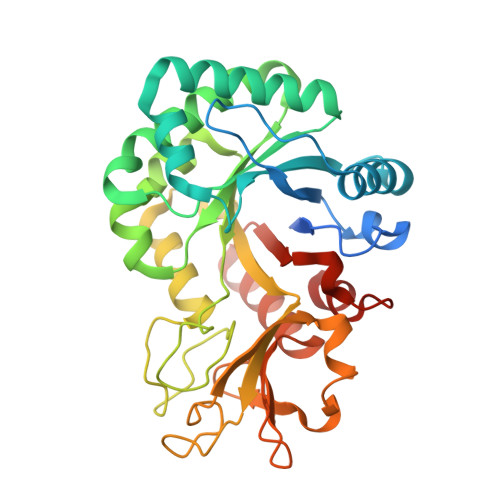
Cyst nematodes are the most damaging species of plant-parasitic nematodes. They antagonize the colonization of beneficial microbial symbionts that are important for nutrient acquisition of plants. The molecular mechanism of the antagonism, however, remains elusive. Here, through biochemical combined with structural analysis, we reveal that Heterodera glycines, the most notorious soybean cyst nematode, suppresses symbiosis by secreting an enzyme named HgCht2 to hydrolyse the key symbiotic signalling molecules, lipochitooligosaccharides (LCOs). We solved the three-dimensional structures of apo HgCht2, as well as its chitooligosaccharide-bound and LCO-bound forms. These structures elucidated the substrate binding and hydrolysing mechanism of the enzyme. We designed an HgCht2 inhibitor, 1516b, which successfully suppresses the antagonism of cyst nematodes towards nitrogen-fixing rhizobia and phosphorus-absorbing arbuscular mycorrhizal symbioses. As HgCht2 is phylogenetically conserved across all cyst nematodes, our study revealed a molecular mechanism by which parasitic cyst nematodes antagonize the establishment of microbial symbiosis and provided a small-molecule solution.
- State Key Laboratory for Biology of Plant Diseases and Insect Pests, Institute of Plant Protection, Chinese Academy of Agricultural Sciences, Beijing, China.
Organizational Affiliation: