8HT7 | pdb_00008ht7

The N-terminal region of Cdc6 specifically recognizes human DNA G-quadruplex


Experimental Data Snapshot

  • Method: SOLUTION NMR
  • Conformers Calculated: 200 
  • Conformers Submitted: 10 
  • Selection Criteria: structures with the lowest energy 

wwPDB Validation 3D Report Full Report

Validation slider image for 8HT7

This is version 1.2 of the entry. See complete history

Literature

The N-terminal region of Cdc6 specifically recognizes human DNA G-quadruplex.

Geng, Y.Liu, C.Xu, N.Shi, X.Suen, M.C.Zhou, B.Yan, B.Wu, C.Li, H.Song, Y.Chen, X.Wang, Z.Cai, Q.Zhu, G.

(2024) Int J Biol Macromol 260: 129487-129487

  • DOI: https://doi.org/10.1016/j.ijbiomac.2024.129487
  • Primary Citation Related Structures: 
    8HT7

  • PubMed Abstract: 

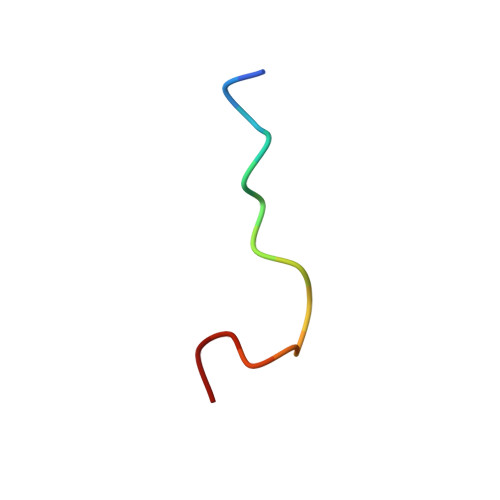
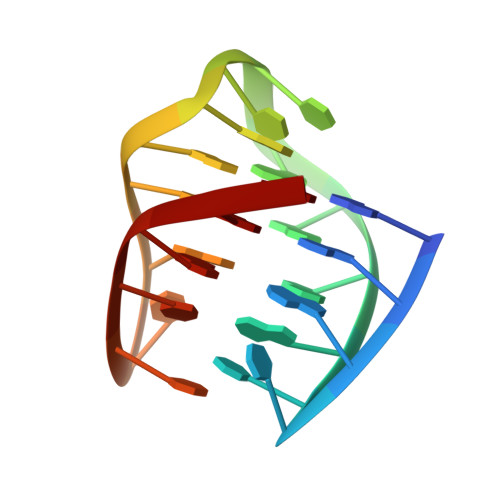
    Guanine (G)-rich nucleic acid sequences can form diverse G-quadruplex structures located in functionally significant genome regions, exerting regulatory control over essential biological processes, including DNA replication in vivo. During the initiation of DNA replication, Cdc6 is recruited by the origin recognition complex (ORC) to target specific chromosomal DNA sequences. This study reveals that human Cdc6 interacts with G-quadruplex structure through a distinct region within the N-terminal intrinsically disordered region (IDR), encompassing residues 7-20. The binding region assumes a hook-type conformation, as elucidated by the NMR solution structure in complex with htel21T 18 . Significantly, mutagenesis and in vivo investigations confirm the highly specific nature of Cdc6's recognition of G-quadruplex. This research enhances our understanding of the fundamental mechanism governing the interaction between G-quadruplex and the N-terminal IDR region of Cdc6, shedding light on the intricate regulation of DNA replication processes.


  • Organizational Affiliation
    • Clinical Research Institute of the First Affiliated Hospital of Xiamen University, Fujian Key Laboratory of Brain Tumors Diagnosis and Precision Treatment, Xiamen Key Laboratory of Brain Center, the First Affiliated Hospital of Xiamen University, School of Medicine, Xiamen University, Xiamen, Fujian, China; Institute for Advanced Study and State Key Laboratory of Molecular Neuroscience, Division of Life Science, The Hong Kong University of Science and Technology, Clear Water Bay, Kowloon, Hong Kong.

Macromolecule Content 

  • Total Structure Weight: 8.43 kDa 
  • Atom Count: 568 
  • Modeled Residue Count: 36 
  • Deposited Residue Count: 36 
  • Unique protein chains: 1
  • Unique nucleic acid chains: 1

Macromolecules


Find similar proteins by:  Sequence   |   3D Structure  
Entity ID: 2
MoleculeChains  Sequence LengthOrganismDetailsImage
GLN-ALA-GLN-ALA-THR-ILE-SER-PHE-PRO-LYS-ARG-LYS-LEU-SER-TRP15Homo sapiensMutation(s): 0 
UniProt & NIH Common Fund Data Resources
Find proteins for Q99741 (Homo sapiens)
Explore Q99741 
Go to UniProtKB:  Q99741
PHAROS:  Q99741
GTEx:  ENSG00000094804 
Entity Groups
Sequence Clusters30% Identity50% Identity70% Identity90% Identity95% Identity100% Identity
UniProt GroupQ99741
Sequence Annotations
Expand
Reference Sequence
Find similar nucleic acids by:  Sequence
Entity ID: 1
MoleculeChains LengthOrganismImage
DNA (5'-D(*GP*GP*GP*TP*TP*AP*GP*GP*GP*TP*TP*AP*GP*GP*GP*TP*TP*TP*GP*GP*G)-3')21Homo sapiens
Sequence Annotations
Expand
Reference Sequence

Experimental Data & Validation

Experimental Data

  • Method: SOLUTION NMR
  • Conformers Calculated: 200 
  • Conformers Submitted: 10 
  • Selection Criteria: structures with the lowest energy 

Structure Validation

View Full Validation Report


Entry History 

& Funding Information

Deposition Data


Funding OrganizationLocationGrant Number
The University Grants Committee, Research Grants Council (RGC)Hong Kong--
National Natural Science Foundation of China (NSFC)China--

Revision History  (Full details and data files)

  • Version 1.0: 2023-12-27
    Type: Initial release
  • Version 1.1: 2024-05-15
    Changes: Database references
  • Version 1.2: 2024-05-22
    Changes: Database references