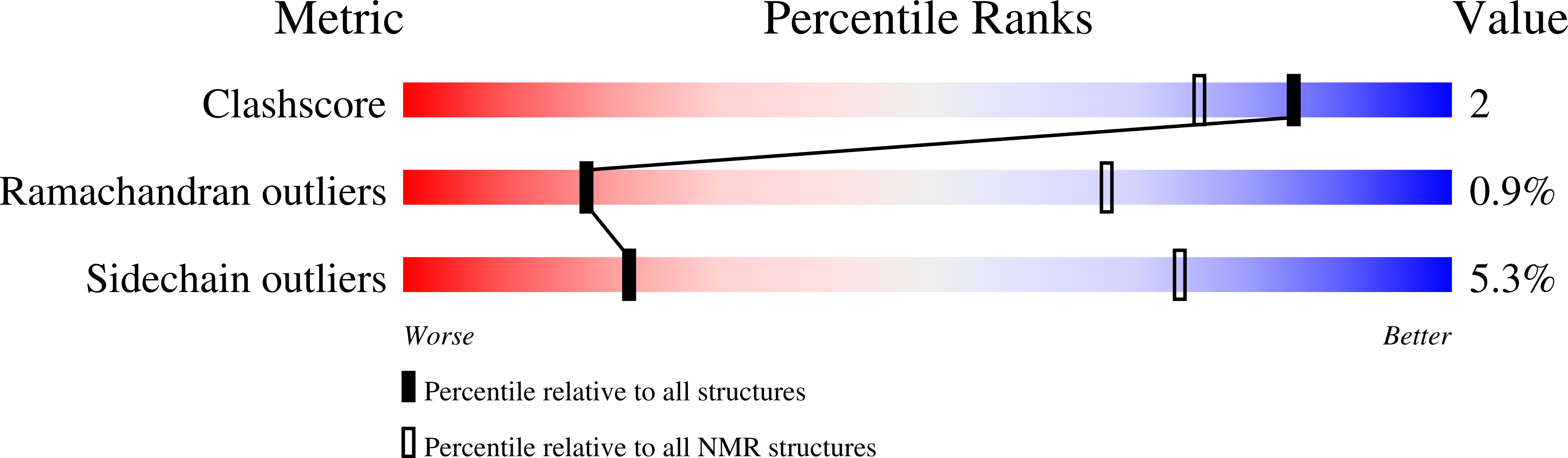
 8HQB | pdb_00008hqb

NMR Structure of OsCIE1-Ubox


Experimental Data Snapshot

  • Method: SOLUTION NMR
  • Conformers Calculated: 100 
  • Conformers Submitted: 20 
  • Selection Criteria: structures with the lowest energy 

wwPDB Validation 3D Report Full Report

Validation slider image for 8HQB

This is version 1.4 of the entry. See complete history. 

Literature

Release of a ubiquitin brake activates OsCERK1-triggered immunity in rice.

Wang, G., Chen, X., Yu, C., Shi, X., Lan, W., Gao, C., Yang, J., Dai, H., Zhang, X., Zhang, H., Zhao, B., Xie, Q., Yu, N., He, Z., Zhang, Y., Wang, E.

(2024) Nature 629: 1158-1164

  • DOI: https://doi.org/10.1038/s41586-024-07418-9
  • Primary Citation Related Structures: 
    7XED, 8HPB, 8HQB

  • PubMed Abstract: 

    Plant pattern-recognition receptors perceive microorganism-associated molecular patterns to activate immune signalling 1,2 . Activation of the pattern-recognition receptor kinase CERK1 is essential for immunity, but tight inhibition of receptor kinases in the absence of pathogen is crucial to prevent autoimmunity 3,4 . Here we find that the U-box ubiquitin E3 ligase OsCIE1 acts as a molecular brake to inhibit OsCERK1 in rice. During homeostasis, OsCIE1 ubiquitinates OsCERK1, reducing its kinase activity. In the presence of the microorganism-associated molecular pattern chitin, active OsCERK1 phosphorylates OsCIE1 and blocks its E3 ligase activity, thus releasing the brake and promoting immunity. Phosphorylation of a serine within the U-box of OsCIE1 prevents its interaction with E2 ubiquitin-conjugating enzymes and serves as a phosphorylation switch. This phosphorylation site is conserved in E3 ligases from plants to animals. Our work identifies a ligand-released brake that enables dynamic immune regulation.


  • Organizational Affiliation: 
    • National Key Laboratory of Plant Molecular Genetics, CAS Center for Excellence in Molecular Plant Sciences, Institute of Plant Physiology and Ecology, Chinese Academy of Sciences, Shanghai, China.

Macromolecule Content 

  • Total Structure Weight: 17.9 kDa 
  • Atom Count: 1,250 
  • Modeled Residue Count: 160 
  • Deposited Residue Count: 160 
  • Unique protein chains: 1

Macromolecules

Find similar proteins by:|  3D Structure
Entity ID: 1
MoleculeChains  Sequence LengthOrganismDetailsImage
U-box domain-containing protein 12
A, B
80Oryza sativa Japonica GroupMutation(s): 0 
Gene Names: PUB12, Os06g0102700, LOC_Os06g01304, OSJNBa0075G19.19-1
EC: 2.3.2.27
UniProt
Find proteins for Q5VRH9 (Oryza sativa subsp. japonica)
Explore Q5VRH9 
Go to UniProtKB:  Q5VRH9
Entity Groups
Sequence Clusters30% Identity50% Identity70% Identity90% Identity95% Identity100% Identity
UniProt GroupQ5VRH9
Sequence Annotations
Expand
Reference Sequence

Experimental Data & Validation

Experimental Data

  • Method: SOLUTION NMR
  • Conformers Calculated: 100 
  • Conformers Submitted: 20 
  • Selection Criteria: structures with the lowest energy 

Structure Validation

View Full Validation Report


Entry History 

& Funding Information

Deposition Data


Funding OrganizationLocationGrant Number
Chinese Academy of SciencesChinaYSBR-011

Revision History  (Full details and data files)

  • Version 1.0: 2023-12-20
    Type: Initial release
  • Version 1.1: 2024-05-08
    Changes: Database references
  • Version 1.2: 2024-05-22
    Changes: Database references
  • Version 1.3: 2024-05-29
    Changes: Database references
  • Version 1.4: 2024-06-12
    Changes: Database references