Download Mendeley
Improving tyrosol production efficiency through shortening the allosteric signal transmission distance of pyruvate decarboxylase.
Xu, H., Yu, B., Wei, W., Chen, X., Gao, C., Liu, J., Guo, L., Song, W., Liu, L., Wu, J.(2023) Appl Microbiol Biotechnol 107: 3535-3549
- PubMed: 37099057 Search on PubMedSearch on PubMed Central
- DOI: https://doi.org/10.1007/s00253-023-12540-1
- Primary Citation Related Structures:
8HP2, 8HP4 - PubMed Abstract:
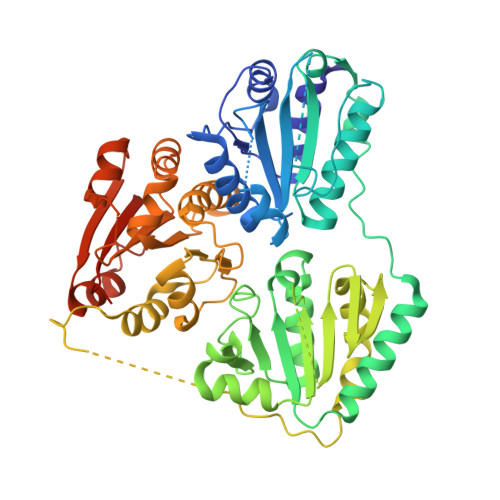
Tyrosol is an important chemical in medicine and chemical industries, which can be synthesized by a four-enzyme cascade pathway constructed in our previous study. However, the low catalytic efficiency of pyruvate decarboxylase from Candida tropicalis (CtPDC) in this cascade is a rate-limiting step. In this study, we resolved the crystal structure of CtPDC and investigated the mechanism of allosteric substrate activation and decarboxylation of this enzyme toward 4-hydroxyphenylpyruvate (4-HPP). In addition, based on the molecular mechanism and structural dynamic changes, we conducted protein engineering of CtPDC to improve decarboxylation efficiency. The conversion of the best mutant, CtPDC Q112G/Q162H/G415S/I417V (CtPDC Mu5 ), had over two-fold improvement compared to the wild-type. Molecular dynamic (MD) simulation revealed that the key catalytic distances and allosteric transmission pathways were shorter in CtPDC Mu5 than in the wild type. Furthermore, when CtPDC in the tyrosol production cascade was replaced with CtPDC Mu5 , the tyrosol yield reached 38 g·L -1 with 99.6% conversion and 1.58 g·L -1 ·h -1 space-time yield in 24 h through further optimization of the conditions. Our study demonstrates that protein engineering of the rate-limiting enzyme in the tyrosol synthesis cascade provides an industrial-scale platform for the biocatalytic production of tyrosol. KEY POINTS: • Protein engineering of CtPDC based on allosteric regulation improved the catalytic efficiency of decarboxylation. • The application of the optimum mutant of CtPDC removed the rate-limiting bottleneck in the cascade. • The final titer of tyrosol reached 38 g·L -1 in 24 h in 3 L bioreactor.
- School of Life Sciences and Health Engineering, Jiangnan University, Wuxi, 214122, China.
Organizational Affiliation: