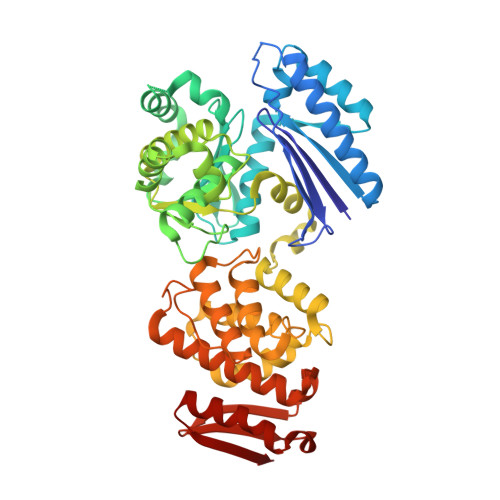
8GTY | pdb_00008gty

Crystal structure of exopolyphosphatase (PPX) from Zymomonas mobilis in complex with magnesium ions


Experimental Data Snapshot

  • Method: X-RAY DIFFRACTION
  • Resolution: 1.80 Å
  • R-Value Free: 
    0.244 (Depositor), 0.239 (DCC) 
  • R-Value Work: 
    0.200 (Depositor), 0.203 (DCC) 

Starting Model: experimental
View more details

wwPDB Validation 3D Report Full Report

Validation slider image for 8GTY

This is version 2.2 of the entry. See complete history

Literature

Structure of the exopolyphosphatase (PPX) from Zymomonas mobilis reveals a two-magnesium-ions PPX.

Lu, Z.Hu, Y.Wang, J.Zhang, B.Zhang, Y.Cui, Z.Zhang, L.Zhang, A.

(2024) Int J Biol Macromol 262: 129796-129796

  • DOI: https://doi.org/10.1016/j.ijbiomac.2024.129796
  • Primary Citation Related Structures: 
    8GTY

  • PubMed Abstract: 

    Rapid adaptation of metabolic capabilities is crucial for bacterial survival in habitats with fluctuating nutrient availability. In such conditions, the bacterial stringent response is a central regulatory mechanism activated by nutrient starvation or other stressors. This response is primarily controlled by exopolyphosphatase/guanosine pentaphosphate phosphohydrolase (PPX/GPPA) enzymes. To gain further insight into these enzymes, the high-resolution crystal structure of PPX from Zymomonas mobilis (ZmPPX) was determined at 1.8 Å. The phosphatase activity of PPX was strictly dependent on the presence of divalent metal cations. Notably, the structure of ZmPPX revealed the presence of two magnesium ions in the active site center, which is atypical compared to other PPX structures where only one divalent ion is observed. ZmPPX exists as a dimer in solution and belongs to the "long" PPX group consisting of four domains. Remarkably, the dimer configuration exhibits a substantial and deep aqueduct with positive potential along its interface. This aqueduct appears to extend towards the active site region, suggesting that this positively charged aqueduct could potentially serve as a binding site for polyP.


  • Organizational Affiliation
    • Food and Pharmacy College, Xuchang University, Xuchang 461000, Henan, China; Key Laboratory of Biomarker-Based Rapid Detection Technology for Food Safety of Henan Province, Xuchang University, Xuchang 461000, Henan, China.

Macromolecule Content 

  • Total Structure Weight: 53.52 kDa 
  • Atom Count: 3,934 
  • Modeled Residue Count: 472 
  • Deposited Residue Count: 483 
  • Unique protein chains: 1

Macromolecules

Find similar proteins by:|  3D Structure
Entity ID: 1
MoleculeChains  Sequence LengthOrganismDetailsImage
Ppx/GppA phosphatase483Zymomonas mobilis subsp. mobilis ZM4 = ATCC 31821Mutation(s): 1 
Gene Names: ZMO0713
UniProt
Find proteins for Q5NPM3 (Zymomonas mobilis subsp. mobilis (strain ATCC 31821 / ZM4 / CP4))
Explore Q5NPM3 
Go to UniProtKB:  Q5NPM3
Entity Groups
Sequence Clusters30% Identity50% Identity70% Identity90% Identity95% Identity100% Identity
UniProt GroupQ5NPM3
Sequence Annotations
Expand
Reference Sequence

Experimental Data & Validation

Experimental Data

  • Method: X-RAY DIFFRACTION
  • Resolution: 1.80 Å
  • R-Value Free:  0.244 (Depositor), 0.239 (DCC) 
  • R-Value Work:  0.200 (Depositor), 0.203 (DCC) 
Space Group: C 1 2 1
Unit Cell:
Length ( Å )Angle ( ˚ )
a = 122.023α = 90
b = 47.118β = 124.45
c = 89.48γ = 90
Software Package:
Software NamePurpose
PHENIXrefinement
HKL-2000data scaling
PDB_EXTRACTdata extraction
HKL-2000data reduction
BALBESphasing

Structure Validation

View Full Validation Report


Entry History 

& Funding Information

Deposition Data


Funding OrganizationLocationGrant Number
Not funded--

Revision History  (Full details and data files)

  • Version 1.0: 2023-09-13
    Type: Initial release
  • Version 2.0: 2024-03-27
    Type: Coordinate replacement
    Reason: Ligand identity
    Changes: Advisory, Atomic model, Data collection, Database references, Derived calculations, Refinement description, Structure summary
  • Version 2.1: 2024-05-08
    Changes: Database references
  • Version 2.2: 2026-03-04
    Changes: Refinement description, Structure summary