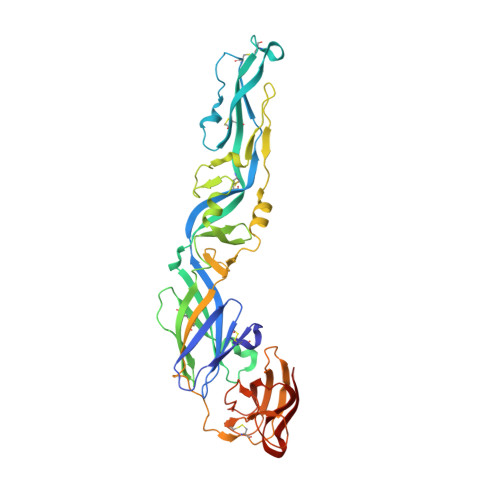
8GPU | pdb_00008gpu

YFV_E_YD6Fab_prefusion


Experimental Data Snapshot

  • Method: X-RAY DIFFRACTION
  • Resolution: 2.79 Å
  • R-Value Free: 
    0.279 (Depositor), 0.277 (DCC) 
  • R-Value Work: 
    0.244 (Depositor), 0.243 (DCC) 
  • R-Value Observed: 
    0.246 (Depositor) 

Starting Model: experimental
View more details

wwPDB Validation 3D Report Full Report

Validation slider image for 8GPU

This is version 1.2 of the entry. See complete history

Literature

A neutralizing-protective supersite of human monoclonal antibodies for yellow fever virus.

Li, Y.Chen, Z.Wu, L.Dai, L.Qi, J.Chai, Y.Li, S.Wang, Q.Tong, Z.Ma, S.Duan, X.Ren, S.Song, R.Liang, M.Liu, W.Yan, J.Gao, G.F.

(2022) Innovation (Camb) 3: 100323-100323

  • DOI: https://doi.org/10.1016/j.xinn.2022.100323
  • Primary Citation Related Structures: 
    8GPT, 8GPU, 8GPX

  • PubMed Abstract: 

    The yellow fever virus (YFV) is a life-threatening human pathogen. Owing to the lack of available therapeutics, non-vaccinated individuals are at risk. Here, we isolated eight human monoclonal antibodies that neutralize YFV infection. Five recognized overlapping epitopes and exhibited potent neutralizing activity. Two (YD6 and YD73) were ultra-potent and conferred complete protection against the lethal challenge of YFV as both prophylactics and therapeutics in a mouse model. Crystal structures revealed that YD6 engaged the YFV envelope protein in both pre- and post-fusion states, suggesting viral inhibition by a "double-lock" mechanism. The recognition determinants for YD6 and YD73 are clustered at the premembrane (prM)-binding site. Notably, antibodies targeting this site were present in minute traces in YFV-infected individuals but contributed significantly to neutralization, suggesting a vulnerable supersite of YFV. We provide two promising candidates for immunotherapy against YFV, and the supersite represents an ideal target for epitope-based vaccine design.


  • Organizational Affiliation
    • CAS Key Laboratory of Pathogen Microbiology and Immunology, Institute of Microbiology, Chinese Academy of Sciences, Beijing 100101, China.

Macromolecule Content 

  • Total Structure Weight: 537.27 kDa 
  • Atom Count: 37,132 
  • Modeled Residue Count: 4,914 
  • Deposited Residue Count: 4,992 
  • Unique protein chains: 3

Macromolecules

Find similar proteins by:|  3D Structure
Entity ID: 1
MoleculeChains  Sequence LengthOrganismDetailsImage
Envelope protein398Yellow fever virusMutation(s): 0 
UniProt
Find proteins for Q89292 (Yellow fever virus)
Explore Q89292 
Go to UniProtKB:  Q89292
Entity Groups
Sequence Clusters30% Identity50% Identity70% Identity90% Identity95% Identity100% Identity
UniProt GroupQ89292
Sequence Annotations
Expand
Reference Sequence
Find similar proteins by:|  3D Structure
Entity ID: 2
MoleculeChains  Sequence LengthOrganismDetailsImage
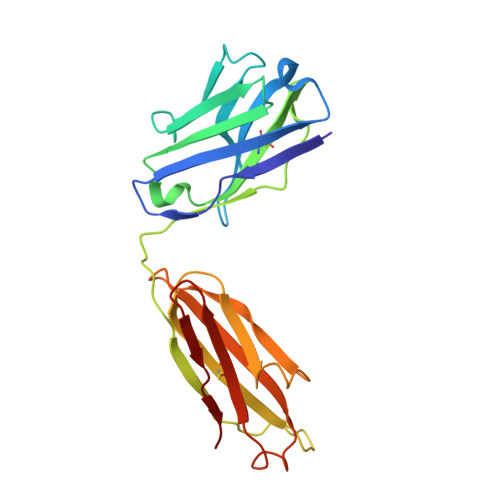
YD6Fab_H217Homo sapiensMutation(s): 0 
Find similar proteins by:|  3D Structure
Entity ID: 3
MoleculeChains  Sequence LengthOrganismDetailsImage
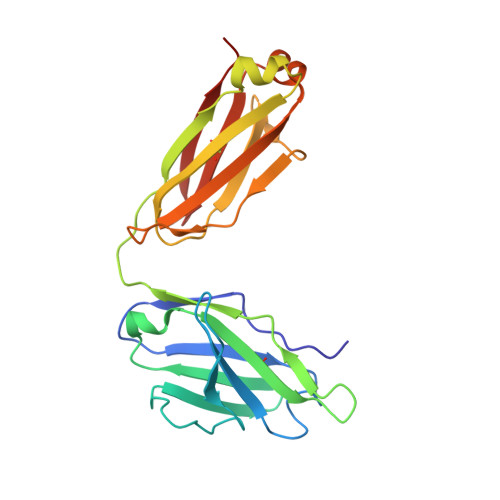
YD6Fab_L217Homo sapiensMutation(s): 0 

Experimental Data & Validation

Experimental Data

  • Method: X-RAY DIFFRACTION
  • Resolution: 2.79 Å
  • R-Value Free:  0.279 (Depositor), 0.277 (DCC) 
  • R-Value Work:  0.244 (Depositor), 0.243 (DCC) 
  • R-Value Observed: 0.246 (Depositor) 
Space Group: C 2 2 21
Unit Cell:
Length ( Å )Angle ( ˚ )
a = 157.259α = 90
b = 278.003β = 90
c = 354.657γ = 90
Software Package:
Software NamePurpose
PHENIXrefinement
HKL-2000data reduction
HKL-2000data scaling
PHASERphasing

Structure Validation

View Full Validation Report


Entry History 

& Funding Information

Deposition Data


Funding OrganizationLocationGrant Number
National Natural Science Foundation of China (NSFC)China--

Revision History  (Full details and data files)

  • Version 1.0: 2022-11-02
    Type: Initial release
  • Version 1.1: 2023-11-29
    Changes: Data collection, Refinement description
  • Version 1.2: 2024-10-16
    Changes: Structure summary